


AI rarely fails because the technology is not ready. It fails because organisations adopt it without deciding what it is meant to change.
Across industries, teams build promising proofs of concept, demonstrate impressive model accuracy, and experiment with the latest AI tools. The same questions surface in companies: Why did the AI pilot never reach production? Why does AI not guide core decisions? Why is the return so hard to explain to stakeholders?
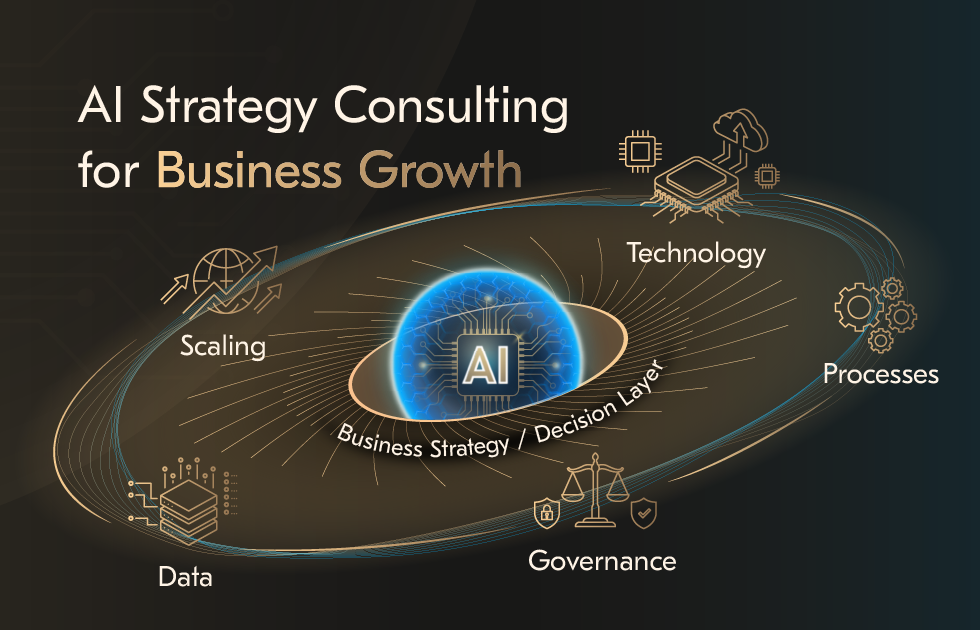
AI strategy consulting exists to break this cycle. It brings structure to AI adoption. The roadmap is a set of components that align business objectives, data foundations, architecture, and governance into a coherent plan. Strategy consulting focuses on the different aspects. Some of them are the answers to: where AI should be applied, how value will be measured, and how adoption can scale without increasing risk. It replaces fragmented experimentation with coordinated progress.
At Acropolium, we work with organisations at this exact inflection point within AI and Ml consulting services. Our teams help develop AI visions into execution-ready strategies for industry companies grounded in real systems and operating models.
The sections below explain how AI strategy consulting works, why it matters for scalable adoption, and how a structured approach enables AI to become a durable driver of business growth rather than a series of stalled initiatives.
What is AI strategy consulting?
AI strategy consulting is a structured advisory practice. It was created to help organisations turn artificial intelligence from an experimental capability into a reliable, value-generating part of their business. It addresses the gap between what AI makes technically possible and what an organisation can realistically deploy, govern, and scale in its operating environment. The focus is not on building models, but on defining how AI should influence decisions, processes, and outcomes over time.
At its core, AI technology consulting answers three fundamental questions:
why AI is needed,
where it should be applied,
how adoption should progress without creating fragmentation or risk.
Rather than starting with technology choices, the work begins with business priorities and constraints. Strategy defines which problems are worth solving with AI, which are premature, and which require foundational work before any model development makes sense.
A central outcome of AI transformation consulting is a coherent roadmap that connects ambition with execution. AI strategy consulting typically covers several critical areas:
Business-driven prioritisation focused on decisions and outcomes, not experimentation
Readiness assessment across data, systems, skills, and operating model
Roadmap definition that sequences initiatives from validation to enterprise scale
Data and architecture alignment to support reliability and future evolution
Governance and risk management covering explainability, privacy, and compliance
Adoption and change considerations to ensure AI is actually used in operations
A defining characteristic of an effective AI strategy is its attention to non-technical factors. Model performance alone does not determine success; how people trust AI outputs, how workflows adapt, and how accountability is maintained all shape whether AI delivers lasting value. Strategy consulting addresses these dimensions explicitly, rather than treating them as secondary concerns.
Why do companies fail with AI without a strategy?
When AI adoption starts without a strategy, experimentation accelerates while impact stalls. Market data highlights the scale of the problem. Artificial intelligence is already embedded in business operations around 88% of organizations report using AI in at least one function. Yet maturity remains elusive: only 1% of business leaders believe their AI initiatives are truly mature, and 75% report they are not seeing meaningful ROI.
The issue is not adoption, but direction. As AI investment accelerates toward a projected $15.7 trillion contribution to the global economy by 2030, the gap between experimentation and impact continues to widen. Let’s discover the most common failure patterns below.
Why do AI pilots never reach production?
Without a strategic roadmap, AI initiatives emerge as isolated proofs of concept owned by individual teams. Pilots demonstrate technical feasibility but are not designed for integration, security, or long-term ownership. Production requirements surface late, revealing gaps that were never planned for. Over time, organisations accumulate disconnected experiments that cannot be scaled or governed consistently.
What happens when people and processes are ignored?
AI introduces new decision dynamics, yet many initiatives focus only on technology. Workflows remain unchanged, accountability is unclear, and teams lack confidence in AI outputs. Without structured change management and upskilling, adoption slows or stops altogether. Technically sound systems fail to influence decisions because the organisation was not prepared to use them.
Why does AI fail to deliver measurable ROI?
AI projects launched without explicit business goals drift toward technical optimisation rather than business impact. Model accuracy improves while costs rise and outcomes remain unclear. When KPIs are undefined, leadership cannot assess value or justify continued investment. Budget erosion follows as AI is perceived as experimental rather than strategic.
What breaks when data is not strategy-led?
Data challenges surface quickly once AI development begins. Inconsistent definitions, fragmented ownership, and poor quality delay delivery and undermine trust in results. Teams spend excessive time preparing data instead of improving outcomes. Without a data strategy aligned to AI priorities, model performance degrades and delivery timelines slip.
AI fails without a strategy because complexity compounds faster than learning can keep pace. A coherent AI strategy provides direction, sequencing, and accountability, enabling organisations to convert experimentation into sustainable, enterprise-scale capability.
How do AI strategy consulting work in practice?
AI technology consulting is about creating clarity before scale. The work defines what to build, why it matters, and what must be in place for AI to operate reliably inside real systems and workflows. Below is how a typical engagement is structured, from early alignment to sustained adoption.
Defining business intent and decision focus: The process starts by agreeing on which decisions or processes AI should improve and how success will be measured. This keeps initiatives tied to outcomes rather than technology exploration.
Assessing readiness and constraints: Data quality, system architecture, governance maturity, and organisational capacity are reviewed together. This step surfaces gaps that shape what can realistically be delivered and in what sequence.
Selecting and prioritising AI use cases: Potential initiatives are narrowed to those with clear impact and feasible AI integration paths. Prioritisation balances near-term validation with long-term strategic relevance.
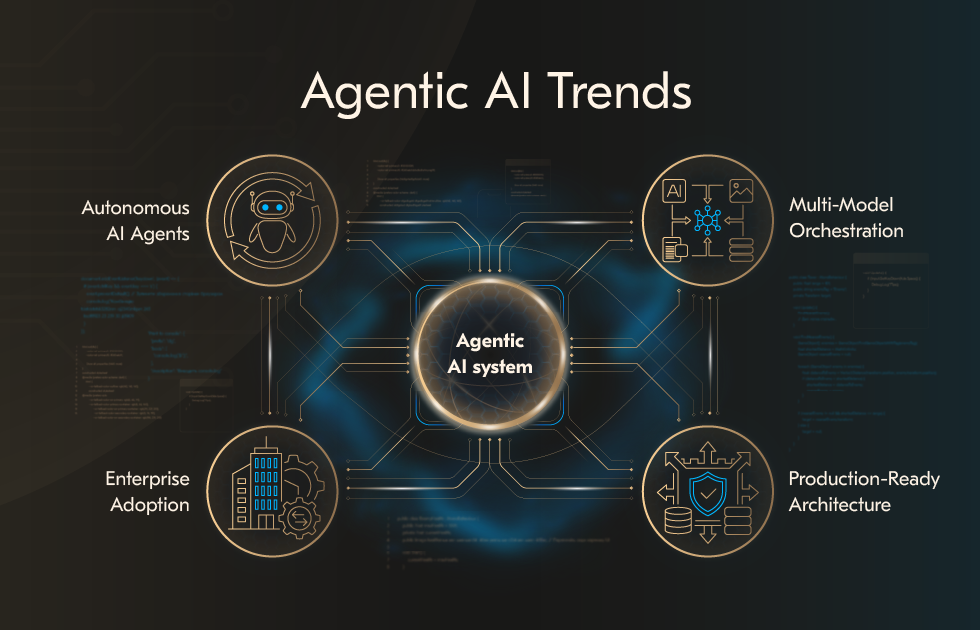
Designing architecture and governance: Integration patterns, model orchestration, monitoring, and accountability are defined early. Designing architecture and governance includes defining how multiple models interact, how decisions are routed between them, and how AI capabilities are integrated across systems using multi-model AI integration.
Validating through pilots and controlled rollout: Pilots test value and operational fit under realistic conditions. Learnings are used to refine scope and sequencing before broader deployment.
Scaling and evolving the AI portfolio: Successful initiatives are integrated into core systems and processes, supported by ongoing monitoring and change management. As initiatives mature, successful AI solutions are integrated into core systems and operational workflows, often requiring custom AI software development to ensure reliability, security, and long-term scalability.
How does an AI strategy roadmap look?
An AI strategy roadmap is a decision framework. It defines what must happen, in what order, and under which conditions AI becomes a dependable part of the organisation’s operating model. A strong enterprise AI roadmap removes contradictions around priorities, ownership, and scale, replacing ad hoc experimentation with deliberate progress. 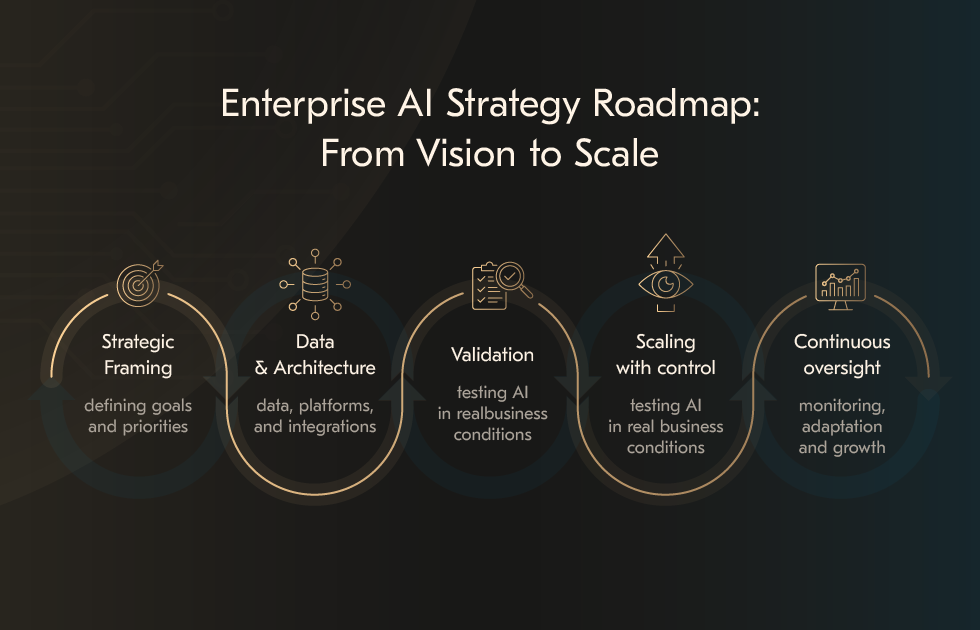
Step 1. Strategic framing
The consulting Artificial Intelligence roadmap starts by fixing direction. Business objectives are translated into decision domains where AI can change outcomes, such as risk assessment, demand planning, or operational coordination. Readiness is assessed with equal rigour, covering data availability, system constraints, internal skills, and governance maturity. Use cases are filtered through two lenses: measurable impact and integration with existing workflows. Governance is defined upfront, setting boundaries for data use, accountability, and compliance before delivery begins.
At this point, the roadmap answers a critical question: which AI initiatives deserve investment now, and which should wait until foundations are in place?
Step 2. Data and architecture
Once priorities are clear, attention shifts to the foundations that will determine whether AI scales or stalls. Data ownership, quality controls, and access models are formalised. Architectural decisions define how models interact with systems, how outputs reach users, and how components evolve independently. The roadmap favours modular design to avoid lock-in and to support future model changes without disrupting operations.
Sequencing becomes explicit. Near-term initiatives validate assumptions, mid-term initiatives focus on integration and reliability, and long-term initiatives extend AI across functions and regions. Architectural planning also defines when LLM customization is required to ensure models reflect proprietary data, terminology, and operational constraints.
Step 3. Validation under real operating conditions
Roadmaps fail when validation is treated as a technical checkpoint. Strong roadmaps treat validation as a business test. Proofs of concept and pilots run in environments that reflect production constraints, with success measured against operational metrics rather than model accuracy alone. Feedback loops capture where AI supports decisions and where friction appears.
Validation builds organisational confidence and reveals where the roadmap needs adjustment before scale is introduced, which introduces risk.
Step 4. Scaling with control
Scaling marks a shift from delivery to discipline. Successful initiatives are embedded into core processes, supported by defined ownership and lifecycle management. Decision rights are clarified so teams understand when AI informs, recommends, or acts. Change management becomes structural, ensuring AI is adopted consistently rather than selectively.
As AI scales, some initiatives evolve toward agent-based execution models, requiring the development of structured AI agents aligned with governance and operating constraints.
Step 5. Continuous oversight
An AI strategy roadmap remains active long after deployment. Performance monitoring tracks outcomes, drift, and compliance. Governance adapts to regulatory change and internal standards. As maturity grows, the roadmap evolves from optimisation toward reinvention, enabling new services or operating models built on established AI capability.
A robust AI strategy roadmap creates momentum without fragility. It enables organisations to move with intent, learn quickly, and scale responsibly, ensuring AI becomes an enduring capability rather than a cycle of disconnected initiatives.
What are the key principles of an effective AI strategy?
A sustainable AI strategy creates clarity in environments where technical possibilities often outpace organisational readiness. It provides direction for investment, sets expectations for impact, and establishes the conditions under which AI systems can be deployed and scaled responsibly. The principles below reflect patterns that consistently support long-term AI adoption rather than short-term experimentation.
Business alignment
AI initiatives succeed when they are framed as business programmes rather than technical projects. Strategy work must begin with clear outcomes: which decisions should improve, which processes should change, and which metrics will confirm progress. Who owns these outcomes once models are deployed? Strategic ownership at the executive level ensures AI remains tied to core priorities and receives sustained investment.
People, processes, and the operating model
AI changes how decisions are made and who makes them. A strong strategy addresses how workflows adapt when AI is introduced into the process and how accountability is maintained. Adoption often depends less on model accuracy and more on whether teams trust and understand AI outputs. Training, role definition, and process redesign turn AI from an analytical tool into a reliable part of daily operations.
Data as a managed enterprise asset
No AI strategy can progress faster than the organisation’s data foundations allow. Strategy must clarify where data comes from, how it is governed, and how quality is maintained over time. Questions around ownership, access, and consistency shape what models can realistically deliver. Treating data as an enterprise asset rather than a by-product of systems creates the stability AI systems need to perform reliably at scale.
Risk management
AI adoption depends on trust from both internal users and external stakeholders. Strategy defines how risks such as bias, privacy exposure, and opaque decision-making are identified and controlled. In regulated environments, explainability and auditability determine whether AI can be used in production at all. Governance built into the strategy provides confidence that AI systems will behave predictably as conditions change.
Phased roadmap
AI strategies work best when they define a clear path from validation to scale. Early initiatives test value and feasibility, while later phases focus on integration and operational resilience. How will successful use cases expand across teams, regions, or products? AI implementation planning must anticipate growth, ensuring that early success does not create technical or organisational bottlenecks.
Capability development
AI in consulting also defines how capabilities are built and sustained. Internal teams rarely cover the full spectrum of skills required for modern AI systems. Strategic use of platforms, tooling, and partners accelerates progress while preserving long-term control. Clear boundaries between internal ownership and external support prevent dependency and allow organisations to evolve their AI capabilities over time.
Together, these principles form a practical framework for AI strategy.
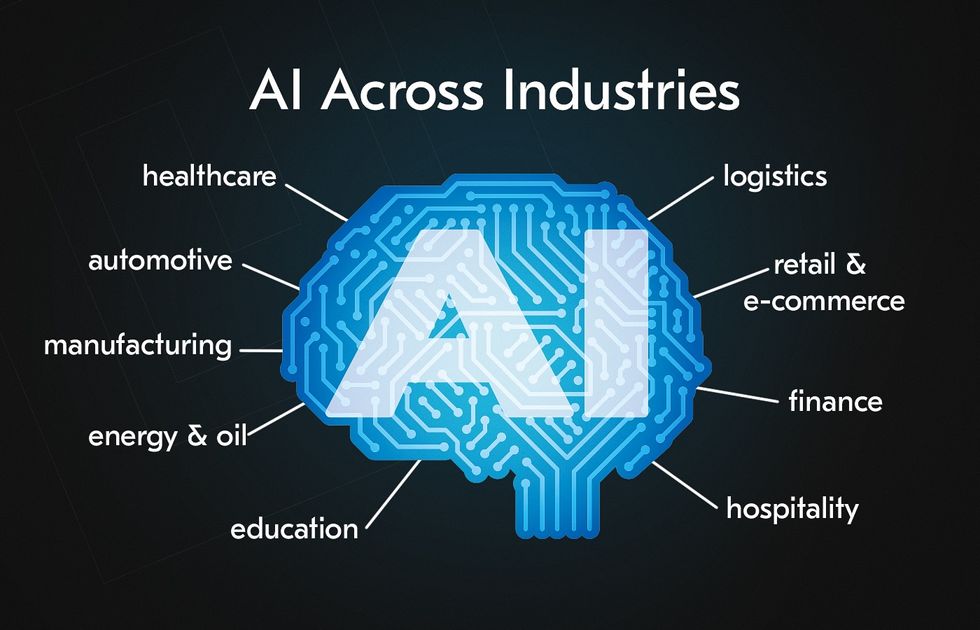
What are the examples of AI strategy consulting across industries?
AI and consulting must reflect how each industry operates, how decisions are made, and where risk and value concentrate. Below are the primary industry contexts where AI strategy plays a defining role, with a focus on what AI enables and how strategy shapes adoption at scale.
Financial services
AI strategies in financial services focus on high-volume decision-making under strict regulatory oversight. Strategy consulting defines how models support real-time decisions while remaining explainable and auditable. A core emphasis is on integrating AI into transaction flows, underwriting, and claims processes without creating parallel systems. Effective AI and consulting strategies also establish governance for model risk, data lineage, and regulatory reporting.
Real-time fraud detection and transaction monitoring;
Risk assessment, credit scoring, and underwriting automation;
Claims processing and operational decision support;
Governance models for explainability, auditability, and compliance.
Healthcare
Healthcare AI strategies must prioritise safety, data protection, and clinical accountability before scale. Strategy work addresses how data is curated, validated, and accessed across clinical and operational systems. Adoption often follows a phased path, starting with decision support and analytics before expanding into predictive and diagnostic use cases. A strong strategy also defines validation cycles, ownership, and escalation paths to ensure AI supports clinicians rather than introducing operational risk.
Clinical decision support and diagnostic assistance;
Medical data curation and analytics platforms;
Predictive models for outcomes and capacity planning;
Governance for sensitive data and model validation.
Retail
AI in retail connects predictive insights directly to revenue-driving decisions. Consulting efforts focus on aligning forecasting, personalisation, and pricing models with merchandising and supply chain workflows. Strategy defines how AI insights are operationalised across channels, not confined to analytics teams. Data consistency and near-real-time integration are critical to ensure recommendations influence inventory, promotions, and customer engagement at scale.
Demand forecasting and inventory optimisation;
Personalisation across digital and physical channels;
Pricing and promotion intelligence;
Data alignment across commerce and supply chain systems.
Automotive
Manufacturing and automotive AI strategies are shaped by uptime requirements, quality standards, and complex physical operations. Strategy consulting defines how sensor data, computer vision, and production systems feed into a unified analytical layer. AI in consulting enables predictive maintenance and quality inspection to scale across plants instead of remaining localised initiatives. Effective strategies also address interoperability across equipment vendors and long system lifecycles.
Predictive maintenance and asset monitoring;
Computer vision for quality inspection;
Production planning and throughput optimisation;
Integration of sensor data and manufacturing systems.
Transportation
Transportation and logistics operate in dynamic, time-sensitive environments where AI supports coordination rather than full automation. Strategy work focuses on embedding predictive models and decision support into dispatch, routing, and fleet operations. A key element is maintaining human oversight while improving response time and utilisation. Integration with existing logistics platforms ensures AI transportation recommendations are available where operational decisions are made.
Route optimisation and demand forecasting;
Fleet monitoring and maintenance planning;
Dispatcher and operations decision support;
Integration with TMS, ERP, and real-time data feeds.
Travel and Hospitality
AI in travel and hospitality addresses demand volatility, service consistency, and operational scale. Consulting defines how forecasting, recommendation, and automation systems integrate with booking and operational platforms. Business-driven AI solutions allow organisations to improve service quality without increasing operational complexity.
Demand forecasting and capacity planning;
Personalised booking and service recommendations;
Service automation and operational analytics;
Integration with reservation and property management systems.
Why choose Acropolium for AI strategy consulting?
Acropolium works as a hands-on AI strategy partner for organisations that expect strategy to lead to real execution. We do not separate advisory work from delivery reality. Our teams design AI strategies with a clear understanding of how they will be built, integrated, governed, and scaled inside complex production environments.
We bring over 22 years of experience in custom software engineering, which directly shapes our approach to AI strategy. Our consultants and engineers work together to align business objectives with data readiness, system architecture, and operating models. All of this allows us to define AI roadmaps that account for legacy platforms, security constraints, regulatory requirements, and internal capabilities from the start.
Our strength lies in deep, practical expertise across modern, scalable AI architecture. We help organisations plan and implement LLM-based solutions, multi-model AI systems, AI agents, generative AI development, and orchestration layers that connect models with enterprise workflows. Our AI strategies account for execution complexity, including model orchestration that ensures AI systems remain controllable, auditable, and scalable.
We have supported companies at different growth stages, from startups that grew into unicorns to Fortune 500 organisations and long-term enterprise partners with contracts spanning more than 10 years. With hundreds of delivered applications and a strong partner ecosystem, we understand how AI initiatives evolve beyond early success and how strategy must adapt as organisations scale.
If you are planning to move beyond isolated AI initiatives and want a clear, execution-ready AI strategy, contact us. Our teams will work with you to assess your current environment, define high-impact AI use cases, and build an enterprise AI roadmap that aligns with your business priorities.





![How to Integrate AI into Your Business: [A Comprehensive Guide]](/img/articles/how-to-integrate-ai-into-your-business-a-comprehensive-guide/img01.jpg)
![AI in Retail: [Use Cases & Applications for 2025]](/img/articles/ai-in-retail-use-cases/img01.jpg)