


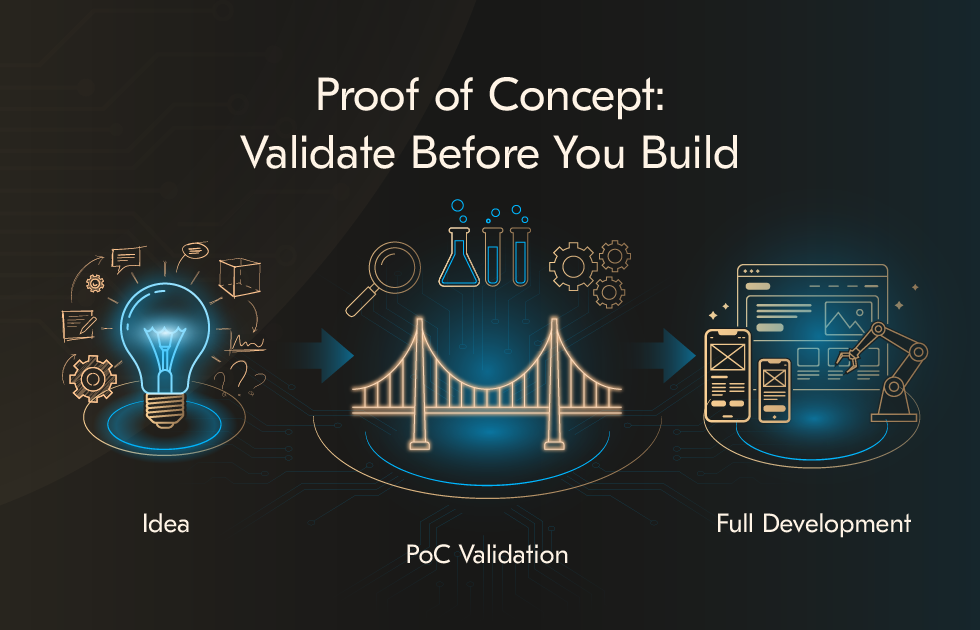
Teams often fail with new software ideas. They struggle with critical assumptions that were never tested early enough, about technology limits, integrations, data, performance, or real-world usage. By the time those issues surface, budgets are committed, architectures are fixed, and reversing direction becomes expensive for companies.
In many cases, the first real technical validation happens only after months of development and significant spend. At that point, discovering that a core assumption was wrong does not stop the project, it destabilizes it.
A proof of concept exists to solve this issue. It transforms uncertainty into sunk cost and confirms an idea’s technical viability prior to development. On top of betting on projections and architectural promises, teams get concrete evidence about what works, what does not, and why.
This article explains what PoC means in software. We will show how it helps to reduce risk across startups and innovation-heavy projects. In real life, PoC work often requires experienced engineering judgment at the point where risk is highest. At Acropolium, we support teams precisely at this stage. We help with validation of technical assumptions, assess feasibility, and define a viable path forward before large-scale investment begins. Our goal is simple: help you make early decisions based on facts.
What is proof of concept in software development?
A proof of concept (PoC) in software development is a structured verification methodology used at the very beginning of the product lifecycle to validate technical feasibility and overall viability. Its purpose is narrow and precise: to determine whether a specific idea, approach, or technology can work under real constraints. A PoC answers a single, decisive question, can this be implemented as envisioned, before time, budget, and organisational momentum are committed to full delivery.
A PoC meaning in software is not a product and is not meant for users or the market. It is known via the experimental code, a technical spike, a system model, or a documented results from controlled testing for better understanding of all nuances. What is relevant for development teams is usability, or completeness, and evidence. The scope of PoC is limited to the most uncertain elements of the idea. It processes architecture choices, performance thresholds, data availability, integrations, or compliance boundaries. By isolating those risks early, teams avoid embedding fragile assumptions into later stages of development.
Organizations invest in PoCs because early-stage software innovation carries disproportionate risk. A significant share of software initiatives collapsed when feasibility of the project was never properly tested. A PoC introduces discipline at the point where uncertainty is highest and decisions are most reversible.
Although often used interchangeably, PoC, prototype, and MVP/minimal viable solution serve fundamentally different purposes. Confusing them usually leads to misplaced expectations, wasted effort, or premature scaling.
| Dimension | Proof of concept | Prototype | Minimum viable product |
|---|---|---|---|
| Primary objective | Validate technical feasibility | Validate user experience and flow | Validate market demand |
| Core question answered | Can it be built under real constraints? | How should it work for the user? | Will users adopt or pay for it? |
| Focus area | Architecture, integrations, performance, data | Interface, interactions, usability | Functional value and feedback |
| Scope | Narrow and experimental | Visually complete but functionally limited | Functional product with essential features |
| Users involved | Internal teams, technical stakeholders | Stakeholders, test users | Early adopters, real customers |
| Code quality | Experimental, disposable | Often partial or mocked | Production-grade |
| Typical duration | Days to a few weeks | Several weeks | Several months |
| Business outcome | Go / pivot / stop decision | Design validation | Market traction and learning |
The correct sequence matters. A PoC comes first to provide feasibility software project risk reduction. A prototype development follows to refine interaction and usability. An MVP validation is built only after both technical and experiential assumptions are sufficiently validated. Skipping or reordering these stages usually shifts risk forward rather than removing it.
Why businesses should start with a proof of concept?
At the earliest stage of any software initiative, uncertainty is highest and information is weakest. Modern organizations resolve architecture, feasibility, cost, and delivery until evidence exists to support them. A proof of concept comes in the project with early-stage software testing the most critical assumptions in a controlled, low-risk environment. Rather than accelerating execution, a PoC accelerates understanding, which has a far greater impact on long-term outcomes.
Startups: testing new business ideas quickly
For startups, the primary risk is not speed to market. They can commit scarce capital to an unvalidated direction.
A PoC allows C-level executives to confirm whether a proposed solution can be implemented with available technology in addition to whether it addresses a real, observable problem. Early concept validation in IT can help with evidence that the successful technology investments deliver measurable business benefit quickly. For example, unified data platforms have been shown to deliver up to 2.5× higher conversion rates and 80% positive ROI in a year after being integrated effectively. It reveals data availability, performance limits, or user behaviour. All the hidden constraints were not readily noticeable during creation. Through correcting those uncertainties ahead of time, startups can refine their scope, adjust positioning, or pivot. This prevents the organizations from incorporating in the huge investment.
Once technical feasibility is confirmed through a PoC, teams can move faster toward implementation, often using approaches such as low-code MVP development to shorten time to market without skipping critical validation steps.
Enterprises: validating innovation-heavy projects
In enterprises, innovation almost never comes in on its own without the right process. New initiatives must coexist with legacy systems, compliance requirements, operational processes, and existing teams. When projects involve AI models, IoT infrastructure, advanced analytics, or complex integrations, technical uncertainty increases ten-fold. A PoC in software creates a safe boundary. That’s how it can be tested without disrupting the existing production environments of business.
Enterprise applies PoCs for different cases. Some of them are:
Validating integration paths with existing platforms, data sources, and security regulations.
Assessing architectural choices against performance and resilience requirements.
Identifying data quality, latency, and governance constraints ahead of time.
Testing operational impact of the monitoring and maintenance implications.
Investors: demonstrating feasibility before funding
Investor leaders rely on the feasibility of software development products as much as on vision. If you are asking why, here’s the answer.
A PoC provides concrete evidence that a concept can move beyond slides and projections into working reality. PoC in IT industry demonstrates that technical risks have been identified, tested, and understood, and that the team has a realistic view of delivery effort and constraints. This level of transparency enables more accurate funding decisions, reduces perceived execution risk, and supports rational discussions around timelines and valuation.
How PoC software development works step-by-step 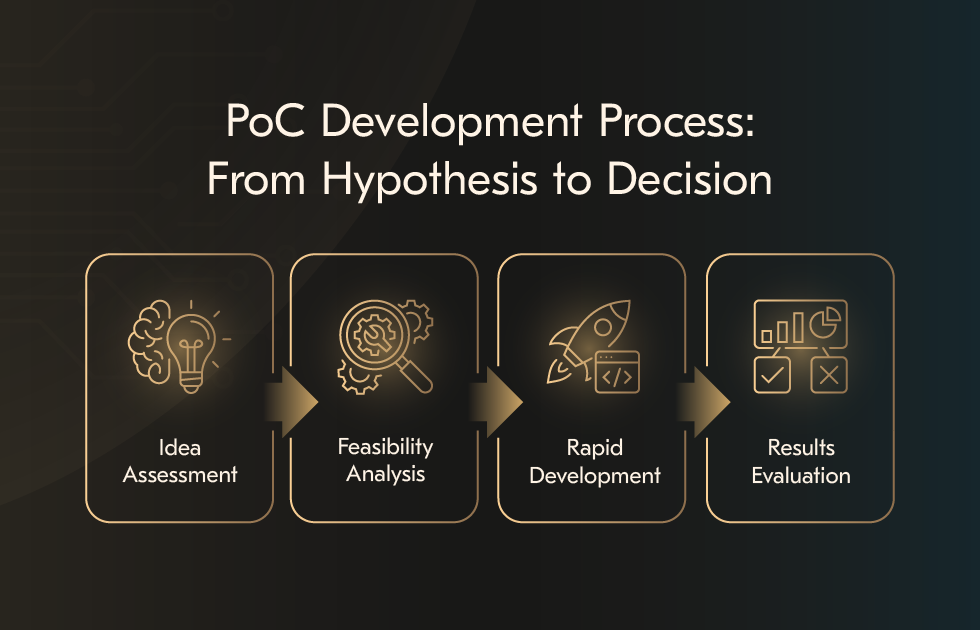
Idea assessment and hypothesis formulation
Work in the teams starts with clarifying the problem. Stakeholders align on the business outcome to prove needs and on the specific assumption that creates the most risk: a user behaviour, a technology choice, an integration, or a performance expectation.
From there, the team submits the one hypothesis. For example, “Using X model and Y data source, we can achieve Z metric under defined conditions.” After it, they tend to narrow scope to the smallest functional slice to test that point of view. Success criteria, constraints, and dependencies are documented so every later decision in the software PoC can be traced back to a specific question.
Technical feasibility assessment and risk analysis
Once the hypothesis is defined, attention shifts to whether it can be implemented within real-world constraints. The team of architects and seasoned engineers evaluate candidate technologies, integration options, and infrastructure choices. These characteristics they make based on the security, scalability, and maintainability requirements of the product PoC.
Key risks are identified during the feasibility assessment expressly. We always face with data quality, latency, vendor lock-in, regulatory exposure, operational impact, and any legacy limitations working with the different size of clients. For each risk, the each team defines what “pass” and “fail” look like in measurable terms. A lightweight delivery plan and timeline are created so the PoC remains a controlled experiment.
Large software initiatives frequently fall behind schedule and overrun budget: McKinsey found that major software projects run an average of 66 % over budget and 33 % over schedule, with as many as 17 % performing so poorly they threaten corporate viability. This underscores why technical feasibility should be validated before broad commitment.
Rapid development and interactive demo
Development focuses only on what is required to prove or disprove the hypothesis. Engineers who defined the assessment implement the minimal functional flow, stubbing or simplifying everything. Each element that is not central to the validation goal: limited UI, reduced configuration, constrained data sets - matters in the long-term production.
Reliable software development companies use rapid iterations to keep stakeholders close to the evolving solution, often with short demo cycles that expose behaviour early. By the end of this phase, stakeholders have an interactive artefact, dashboard, workflow, model endpoint, or kiosk flow, that demonstrates how the concept behaves under realistic scenarios, even if it is not production-ready in terms of robustness or scale.
Results evaluation and insights for next steps
Once the PoC is deployed, quantitative metrics and qualitative feedback are analysed in terms of the initial success criteria. Teams with the QA expertise review what worked, what failed, and which constraints emerged that were not initially visible. They review characteristics such as data availability, support overhead, or licensing implications. The outcome for this stage is a clear decision: proceed as planned, adjust scope or architecture, explore an alternative approach, or stop the initiative entirely.
All technical findings, configuration details, and lessons learned are captured so they feed directly into the next phase without repeating the same discovery work. In a mature process, the PoC closes with a concrete roadmap that links the validated concept to an achievable delivery plan.
Success stories: Explore PoC in action from Acropolium case studies
At Acropolium, proof of concept is not an abstract exercise. We use PoC engagements to validate feasibility where uncertainty is highest and to create a reliable foundation for long-term delivery. The case studies below illustrate how we apply PoC thinking in real client projects to reduce risk and guide strategic decisions before full-scale implementation.
How we validated AI feasibility before modernising a hotel management platform
In a SaaS-based hotel management system, we were asked to introduce AI-driven forecasting and automation into an existing production environment. The key challenge for the organization on the other side was data readiness and model accuracy. However, their biggest concern was the performance of system under live operational load.
Through a focused PoC, we validated data pipelines, tested model behaviour, and assessed integration impact without disrupting ongoing operations. The results gave the client confidence to proceed with full platform modernisation on a proven technical foundation.
How we tested AI-driven optimisation for a transportation management system
For a transportation and logistics client, we explored whether AI-based planning and optimisation could be effective within a legacy system landscape. Our PoC assessed real-time data ingestion, routing logic, and interoperability with existing workflows. We conducted the early validation that revealed data quality constraints. Also, we discovered integration dependencies with other third-party systems that influenced architectural decisions. PoC in software allowed us to modernise the system without costly redesigns later in the delivery phase.
How we de-risked an AI-powered hotel self-check-in kiosk
Self-service hospitality business faced the technical risk that extended beyond software. It moved to hardware integration and unattended operation reliability that directly impacts the effectiveness.
We ran a PoC to validate device communication, biometric processing, and error-handling mechanisms in real conditions. The PoC confirmed that the solution could meet operational stability requirements and guided implementation choices for production rollout.
How we assessed architectural viability for automotive dealership software
Automotive dealership network organization reached us with the modernization concern. We started the cooperation with the evaluation team to support system modernisation. They were investigating how to preserve integrations with inventory, finance, and reporting tools. The PoC focused on validating a modular architecture and testing critical workflows under real usage patterns.
How we reduced delivery risk in construction management platforms
In construction-focused dealer and procurement systems, complexity arises from multi-role workflows, approval chains, and external integrations. We conducted PoCs to validate transaction volume handling, permission models, and reporting accuracy. Early feasibility PoC in software testing clarified scalability boundaries and allowed us to proceed with implementation using evidence-backed architectural decisions.
What are the common mistakes companies make without PoC?
When teams skip a software proof of concept, they remove the only stage designed to test assumptions cheaply and safely. What follows is not faster delivery, but deferred uncertainty that reappears later as rework, overruns, or strategic failure. The patterns below appear repeatedly across industries and company sizes.
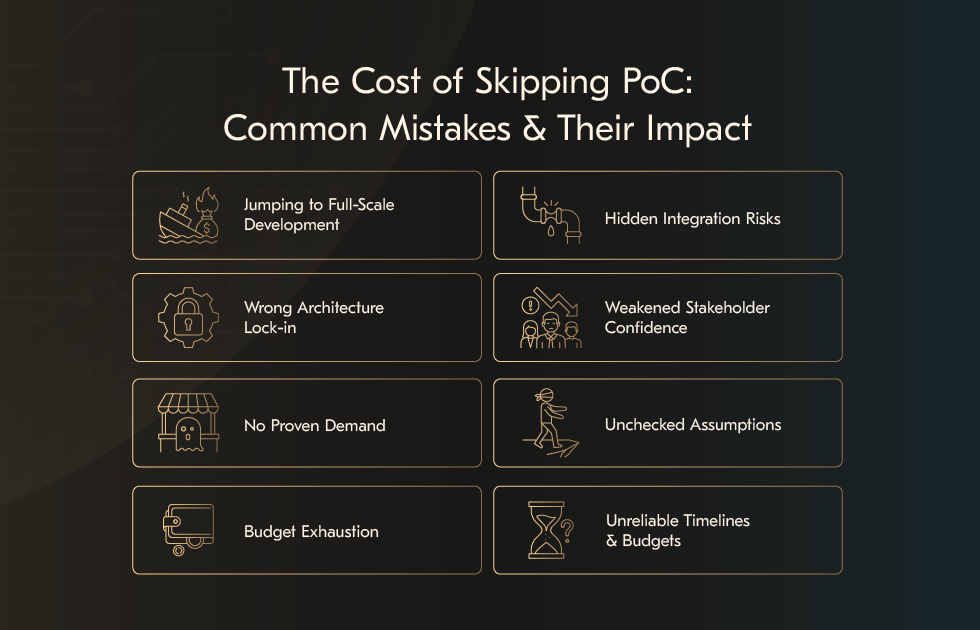
What happens if you jump straight into full-scale development
Rushing directly into full implementation shifts effort toward execution before feasibility is understood. Teams build features, integrations, and infrastructure without knowing whether the core idea can function under real constraints. Issues surface late, when timelines are fixed and budgets are already committed. A PoC full form in software would have exposed those limits early, while change was still inexpensive.
Why early technology choices often lock teams into the wrong architecture
Without technical and technology validation, architecture decisions are made on preference or trend rather than evidence. Teams select frameworks, databases, or integration models that later fail to meet performance, security, or scalability requirements. Once development progresses, those choices become structural and costly to reverse. A PoC provides a safe space to test architectural fit before it hardens into long-term dependency.
What goes wrong when products are built without proven demand
Assuming demand without validation leads to solutions that work technically. But they don’t solve a real problem for business. Teams rely on internal conviction instead of observable user behaviour or market signals. The result of PoC in tech is a functional product that struggles with adoption because it addresses the wrong need.
Why budgets are exhausted before value becomes clear
Full-scale development consumes resources quickly, especially when direction changes midstream. Without early validation, companies often spend most of their budget discovering fundamental flaws that could have been identified earlier. By the time corrective action is considered, financial flexibility is gone. A PoC stands for in software and limits exposure while still producing decision-grade insight.
How hidden technical and integration risks surface too late
Complex systems never fail at the feature level; they fail at the seams. Performance bottlenecks, data inconsistencies, and integration gaps often appear in a unknown way. Only when real workloads are applied. Without a PoC in software development, those risks remain invisible until they affect multiple components. Early feasibility testing, even at small scale, reveals constraints that would otherwise trigger expensive redesign.
In practice, teams often underestimate platform-level risks. Especially, they don’t count on adopting rapid development approaches such as low-code tools without prior validation, which can introduce security and compliance gaps if not assessed early (See how to mitigate low-code security risks).
Why skipping validation weakens stakeholder and investor confidence
Many of these failures stem from the absence of structured early risk control, which is why proof-of-concept initiatives often play the same preventive role as dedicated risk-mitigation software in identifying potential crises before they escalate.
Decision-makers and investors expect evidence. When a project lacks empirical validation, confidence depends on projections rather than proof. That makes funding discussions harder and governance more cautious. A PoC provides tangible results that support informed approval and reduce perceived execution risk.
What unchecked assumptions do to delivery accuracy
Every project rests on assumptions about users, data, performance, and operations. Without a PoC, those assumptions remain untested and quietly shape decisions. Teams may deliver exactly what they planned. Still, they miss the actual requirement of the business. Validation forces assumptions into the open, where they can be confirmed or corrected early.
Why timelines and budgets become unreliable without early validation
Planning without feasibility data leads to estimates based on hope. The teams underestimate complexity, overestimate reuse, and miss hidden dependencies. As a result, schedules slip and budgets expand. PoC insights anchor planning in observed reality, making subsequent forecasts far more reliable.
What are the examples of PoC software development?
PoC meaning in software development become most valuable when it addresses a concrete uncertainty: technical feasibility, operational fit, or user behaviour. Across industries, PoCs are used to test one critical assumption before broader commitments. Let’s look at the examples below to focus on what was validated and why it matters, with company references.
Testing demand before building a platform
One early-stage mobility platform validated its idea by releasing a basic ride-request application to a limited geographic area. The PoC focused on whether real users would complete end-to-end transactions under real conditions. The experiment confirmed both technical feasibility and behavioural adoption, creating the foundation for what later became Uber. The key outcome was evidence of demand.
A similar approach was used in short-term accommodation marketplaces, where founders tested willingness to transact by offering a single, constrained listing through a simple website. The PoC software engineering validated trust mechanisms, payment flow, and user intent before any platform complexity was added. That early validation shaped the roadmap that later powered Airbnb’s global expansion.
Validating interest without building the product
In some cases, proof of concept software development does not require software at all. A cloud storage startup validated its concept by publishing a short demo video that simulated how file synchronisation would work. The PoC measured sign-ups and engagement rather than performance metrics. This approach, later associated with Dropbox, confirmed market interest and justified full product development.
Another consumer application originally launched with multiple features, but PoC-style usage analysis showed that one function dominated engagement. By narrowing scope and validating that insight early, the team redirected all development toward a single core capability. That decision later defined Instagram’s product focus.
Technology feasibility
Large retailers often use PoCs to test emerging technologies under real operational constraints. In food supply chains, blockchain-based PoCs were used to verify whether product origin could be traced accurately and quickly across distributed systems. The validation proved technical feasibility while also revealing data quality and process dependencies. One such initiative was later publicly referenced by Walmart.
In automotive logistics, autonomous vehicle pilots have been deployed as PoCs to assess routing reliability, safety, and regulatory interaction in live urban settings. These projects focus on integration with existing infrastructure rather than autonomy alone. Ford has used this model to evaluate delivery and mobility scenarios before scaling investment.
Regulated and knowledge-intensive domains
Healthcare and legal technology frequently rely on PoCs. TThis regulated organizations aim to validate compliance as well as performance for the solution’s effectiveness. In digital medical education, a PoC was used to confirm that a learning platform could meet accreditation standards. As well as needed for the healthcare it can support scalable content delivery. The validation phase clarified architectural constraints and informed a productive product launch for future development stages.
In legal research, PoCs have been built to test whether AI systems can process large volumes of judicial decisions within acceptable accuracy and response times. One such initiative reduced analysis time from hours to seconds, proving feasibility before integration into daily legal workflows.
Functional and technical validation
PoCs are also widely used for narrowly defined technical challenges. Robotics industry can implement it for the slip detection and object recognition models. The industry test it through PoCs to confirm reliability of sensor data on trigger corrective actions. These validations focus on signal quality and model behaviour.
Enterprise IT teams often request PoCs before adopting service management platforms. Their goal can vary. But most often they want to validate operational automation, ticket routing, and integration with existing tools in a controlled setting. Similar approaches are used in mobile and connected device development, where PoC project workflow test security, performance, or hardware interaction before full feature development.
Network and infrastructure innovation
Telecommunications providers use PoCs in various ways. One of the examples are to evaluate advanced network control scenarios. In emergency response contexts, PoCs test AI-driven network loops. It is critical to verify the dynamically allocation of bandwidth between public traffic and first responders. These experiments in the telecom industry validate coordination logic and reliability under stress conditions. To be prepared for the long before production rollout.
Across all these cases, the value of a proof of concept lies in its focus. Each PoC isolates a single uncertainty, tests it under realistic conditions, and produces evidence that informs the next decision.
Why Acropolium is the right PoC partner?
A proof of concept can bring positive impact when it leads to a clear decision. Acropolium manages PoC development with that outcome in mind. We work on reducing uncertainty early and providing concrete technical evidence you can act on. With 22 years of hands-on software engineering experience, we work with our clients to test ideas against real-world constraints.
We structure around defined scope, clear hypotheses, and predictable costs. Before development starts, we align on what must be proven, which risks are being tested, and how success will be measured in a concrete case.
We support proof of concept development initiatives from start to end. Our plan is a collaborative engagement on each stage. Our engineering teams work closely with stakeholders on the initial concept, assess technical feasibility, validate architecture choices. After that, we come to you with a grounded plan for further development. When a PoC confirms viability, the same team can continue into prototype, MVP, or full product delivery. As they already know all the constrains and hidden points of projects, they won’t lose context or rebuild decisions from start to finish.
Our delivery history reflects this approach. We have supported startups that scaled into unicorns, worked with Fortune 500 companies, maintained long-term partnerships exceeding 10 years. Our expertise and the senior engineers supported the delivery of 450+ software applications across industries such as fintech, healthcare, logistics, automotive, and risk management. This breadth allows us to anticipate industry-specific constraints early in the PoC phase.
Our clients work with a us as a partner, not a vendor. Start your proof of concept and validate your idea with clarity, discipline, and technical depth with Acropolium.





![Why Do Software Projects Fail [6 Reasons and Solutions]](/img/articles/why-do-software-projects-fail/img01.jpg)
![ᐉ Enterprise Chatbot Development [2025 Guide]](/img/articles/enterprise-chatbot-development-guide/img01.jpg)


![How Much Does App Development Cost? [Breakdown for 2025]](/img/articles/how-much-it-costs-to-develop-an-app/img01.jpg)