Why Orchestration is the Missing Layer in Most AI Agent Stacks
In February 2024, Klarna told the world an AI assistant was doing the work of 700 full-time agents. A year later, the same company publicly acknowledged that pure automation had limits in customer service and shifted to a hybrid human-plus-AI model – rebuilt on a different orchestration foundation.
This is the story of nearly every serious AI agent project in 2026.
The demo works. The pilot works. Then someone tries to put four agents in the same workflow, with real customers, real money, real audit logs, and real failure modes – and the system collapses under the weight of state it can’t carry, handoffs it can’t recover from, and decisions it can’t explain.
Camunda’s 2026 State of Agentic Orchestration and Automation report surveyed 1,150 enterprise leaders and found that only 11% of agentic AI use cases reached production in the last year. The framework wasn’t the problem. The layer above the framework was.
That layer is orchestration. And in 2026, AI agent orchestration frameworks have become the single most consequential architectural decision in any enterprise AI program.
Pick right and you ship Klarna’s 80% faster resolution times, EY Canvas processing 1.4 trillion lines of audit data a year, UnitedHealthcare’s 26 million calls routed by AI with sub-3-minute claims processing.
Pick wrong and you’re Walmart in mid-2025 – staring at a sprawl of overlapping chatbots and trying to figure out which one your customer is actually talking to.
Let’s explore the best AI agent orchestration frameworks of 2026 more closely.
AI Agent Orchestration Framework: Definition in Simple Language
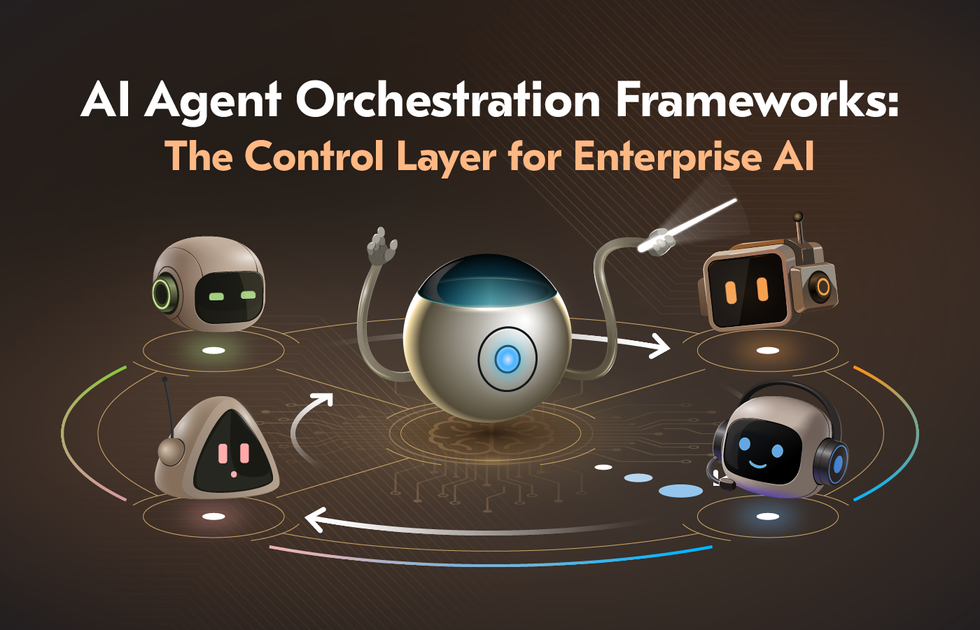
An orchestration framework is the software layer that tells a group of AI agents who runs next, what they remember, which tools they’re allowed to touch, what happens when they fail, and how a human will reconstruct what they did.
A single AI agent is a model + a prompt + a tool list. An agent orchestration framework is the operating system that turns those AI agents into a system.
That distinction matters more than it sounds, because the industry keeps conflating the two. When a founder says "we built an AI agent," they almost always mean they wrapped a prompt around a model with a couple of function calls bolted on. Useful for demos. Useless above six concurrent users, three steps of state, or one regulator.
An AI orchestration framework is what sits between that prototype and a production system that handles 2.5 million conversations a month without losing data when an API times out.
Princeton’s HAL benchmark makes the point cleanly: the same Claude Opus 4 model scores 64.9% on GAIA inside one orchestration scaffold and 57.6% inside another – a 7-point swing from the orchestration layer alone, larger than the lift between most frontier model releases.
You can pay $200 a month for a better model, or invest a week in better orchestration and get more accuracy improvement for free. But most teams do neither – they keep upgrading the model and wondering why the system still hallucinates on edge cases.
| If you’re new to where this fits relative to traditional automation, read our breakdown of AI agents vs RPA vs chatbots. |
|---|
Key Components of an Orchestration Framework
Every production-grade AI orchestration framework is built on four load-bearing components. Each one is a place where projects go to die. 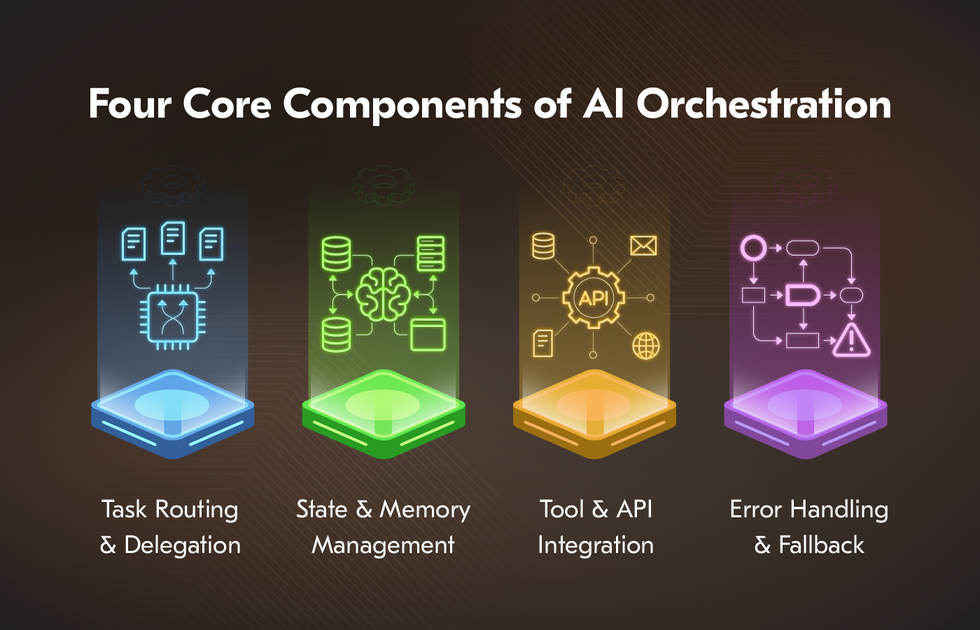
Task Routing and Delegation
Routing is the question of who runs next, and why.
In a customer service workflow, a triage agent reads the user’s first message, classifies the intent (billing, returns, technical), and hands off to a specialist.
In a research workflow, a planner agent decomposes a question and delegates sub-questions.
In a fraud workflow, a scoring agent decides whether the case goes to auto-clear, to a rules engine, or to a human analyst.
The routing logic can be hard-coded (deterministic edges in a graph), model-driven (an LLM chooses the next agent), or a mix. Production systems almost always combine both: deterministic routing for the parts where regulation or cost requires predictability, model-driven routing for the parts where flexibility wins.
When Klarna rebuilt their AI Assistant on LangGraph, the explicit reason was that they needed routing they could point at the code and prove – both to themselves and to financial regulators across 23 markets. They couldn’t ship “the LLM decided” as an answer.
Expert Tip from Acropolium: Start with deterministic routing for any path that touches money, PHI, or PII. Reserve model-driven routing for low-stakes branches like research, summarization, or draft generation.
State and Memory Management
State is where most agent projects die, and it almost never dies loudly. It dies by drift – three weeks in, you notice the agent is “forgetting things,” and by week six the workflow can’t survive a single LLM timeout without a full restart.
Modern frameworks address this through:
Short-term (conversational) memory – what the user just said, what each agent has produced so far.
Long-term (cross-session) memory – what we know about this customer, this case, this property, this account.
Execution state – exactly where in the workflow we are, what’s been done, what’s pending, what failed.
The frameworks that win in production all solve execution state with something called durable checkpointing: every node saves enough information that the workflow can resume mid-run after a crash.
LangGraph’s checkpoints + LangSmith’s time-travel debugging is the gold standard right now. The Microsoft Agent Framework is catching up via Azure AI Foundry. The OpenAI Agents SDK ships built-in tracing as a primitive.
Why does this matter? Because at LLM prices, restarts are unfunded liabilities. A 12-step workflow that crashes at step 11 and has to restart from zero burns 11 steps of token cost twice. Multiply that by enterprise volume and you have a budget conversation you didn’t plan to have.
Tool and API Integration Layer
Agents are only as useful as the tools they can call. The integration layer defines how agents discover available tools, how arguments are validated, how authentication is brokered, and how results are passed back into state.
Two standards now matter more than any specific vendor’s SDK:
- MCP (Model Context Protocol) – Anthropic’s open standard for connecting agents to external data and tool servers. Public MCP server adoption has crossed 10,500 servers and is now embedded natively across the Anthropic, Microsoft, OpenAI, and Google ecosystems.
- A2A (Agent-to-Agent Protocol) – Google’s open protocol for letting AI agents from different frameworks discover and call each other. Google Cloud rolled it out with contributions from 50+ partners including Atlassian, Box, Cohere, Intuit, LangChain, MongoDB, PayPal, Salesforce, SAP, ServiceNow, and Workday.
Error Handling and Fallback Logic
In a non-trivial workflow, something will fail every run. A model will time out. An API will rate-limit. A tool will return malformed JSON. A guardrail will trip. The question isn’t whether failures will happen. It’s whether your framework gives you primitives for handling them.
You need at least four:
- Capped retries with backoff – 3 retries is usually the right answer. 5 is a budget incident.
- Fallback paths – if the primary model fails, route to a cheaper backup. If the cheaper backup fails, route to a human.
- Human-in-the-loop interrupts – pause the workflow, queue a human review, resume with the human’s input.
- Compensating actions – if step 3 succeeded but step 4 failed, what reverses step 3? This is the question almost nobody asks before launch and everybody regrets after.
The 2026 State of AI Agents Report by Anthropic found that 46% of organizations cite integration of AI agents with existing systems as their biggest deployment blocker. Almost every one of those failures is, on inspection, a failure of error handling and fallback logic – not a failure of model quality.
AI Agent Orchestration Frameworks Comparison
Time for the AI agent orchestration frameworks comparison every CTO actually wants to see: which of the AI agent orchestration frameworks vendors is right for which workload, with real production data, not vendor marketing.
We’ll cover the six that account for the majority of serious enterprise deployments in 2026. This is not the exhaustive AI agent orchestration frameworks list – there are dozens of credible options – but it covers the choices most enterprise teams will realistically evaluate.
LangGraph
LangGraph models agents as nodes in a directed graph with conditional edges, explicit state schemas, and first-class durable execution. Built by LangChain, it’s the runtime under the modern LangChain agent abstraction, and as of early 2026 it sits at roughly 34.5 million monthly PyPI downloads.
The production list reads like a Fortune 500 directory. Approximately 400 companies run LangGraph Platform deployments, including Klarna, Uber, LinkedIn, Elastic, BlackRock, Cisco, Replit, AppFolio, Ally, and JPMorgan. Let’s anchor on three to make it concrete:
- Klarna’s flagship AI Assistant – 85 million active users, 2.5 million daily transactions, the equivalent work output of 700 full-time customer service agents – runs on LangGraph and is tested through LangSmith. Average customer query resolution dropped 80% (from 11 minutes to about 2). Roughly 70% of repetitive support tasks are automated. Operational savings: $40+ million annually.
- Elastic orchestrates AI agents for security threat detection using LangGraph. Their GenAI features have measurably reduced labor-intensive SecOps work.
- AppFolio’s Realm-X copilot helps property managers make decisions faster. After switching to LangGraph, response accuracy doubled and property managers reportedly save 10+ hours a week.
The honest take: LangGraph is the most expressive open-source AI agent orchestration framework option in 2026, because it wins on production reliability (durable checkpointing, time-travel debugging through LangSmith), on cyclical workflows with feedback loops, and on completion rates for complex tasks.
Independent benchmarks show LangGraph completing 62% of complex 8+ step tasks versus 54% for CrewAI and 58% for AutoGen. The trade-off is a steeper learning curve and more boilerplate.
CrewAI
CrewAI organizes agents into role-based “crews” – each agent has a role, a goal, and a toolset, with a process type (sequential or hierarchical) that defines how they collaborate. CrewAI has seen strong adoption as an open-source framework for role-based multi-agent orchestration.
CrewAI remains the fastest path from idea to working multi-agent prototype. It fits teams that want to ship a working multi-agent orchestration prototype in days, not weeks. CrewAI is especially strong for business workflows that map naturally onto roles – a researcher agent, a writer agent, an editor agent.
The trade-offs show up at scale: limited checkpointing, weaker observability than LangGraph, and a debugging story that practitioners describe as “painful” when cyclical workflows misbehave.
AutoGen / Microsoft Agent Framework
Microsoft Research’s AutoGen pioneered the conversational multi-agent pattern: agents talk to each other in a structured group chat, debate, reach consensus, or escalate to a human proxy. It crossed 42,000 GitHub stars and shipped widely in research and offline-quality workloads.
The strategic shift to know about: as of 2026, Microsoft has placed AutoGen and its sister SDK Semantic Kernel into maintenance mode and consolidated both into the new Microsoft Agent Framework, which unifies AutoGen’s research-grade orchestration with Semantic Kernel’s enterprise SDK. The framework supports sequential, concurrent, group chat, handoff, and “magentic” (manager-driven task ledger) orchestration patterns, with native MCP and A2A support, Python and .NET bindings, and tight integration with Azure AI Foundry, Microsoft 365, and Dynamics 365. GA was targeted for Q1 2026.
If your stack is Azure + .NET, the Microsoft Agent Framework is the strongest single choice in the market. If it isn’t, the integration overhead is real.
OpenAI Agents SDK
The OpenAI Agents SDK replaced the experimental Swarm project in March 2025 and matured aggressively. It’s built on three primitives: Agents, Handoffs, and Guardrails. By April 2026 it had added sandboxed execution, a long-horizon harness, subagents, code mode, and provider-agnostic routing across 100+ LLMs via LiteLLM routing.
The handoff model – where one agent explicitly transfers control plus conversation context to another – maps cleanly onto the orchestrator-worker pattern used in customer service triage, sales triage, and incident response. Built-in tracing captures the full execution graph automatically, which removes a real source of debugging pain.
The trade-off: tightest integration is with OpenAI’s models, and while the SDK is provider-agnostic in principle, the easiest path is still inside OpenAI’s ecosystem.
Semantic Kernel
Semantic Kernel was Microsoft’s enterprise SDK for orchestrating LLMs, prompts, plugins, and memory, with first-class .NET and Python support. It earned strong adoption in regulated industries such as banking, insurance, and the public sector because of its clean separation between AI components and business logic, its plugin system, and its tight Azure integration.
As noted above, Semantic Kernel has now been folded into the Microsoft Agent Framework. Existing Semantic Kernel codebases will continue to work and receive bug fixes, but new development should target the unified framework.
n8n / Dify / No-Code Options
Not every team needs a code-first agent orchestration framework. The no-code and low-code segment – n8n, Dify, Zapier’s AI features, Microsoft Power Automate’s agent capabilities – has matured to the point where business teams can wire up genuinely useful multi-agent workflows without engineering involvement.
n8n is the strongest fit for self-hosted, integration-heavy automation (it supports 400+ services and can run on your own infrastructure for data-residency reasons).
Dify is the strongest fit for teams that want a visual builder for LLM applications with agentic features layered in.
Both can call external APIs, route between LLM providers, and embed human approval steps.
The trade-off is the ceiling: these tools win for breadth of integration and speed-to-first-workflow, but they hit limits on complex state management, custom tool development, and the kind of observability regulated industries require.
The AI agent orchestration frameworks comparison snapshot
| Framework | Best for | Production maturity | Notable real-world adopters | Trade-off |
|---|---|---|---|---|
| LangGraph | Stateful, regulated, complex workloads | Highest (LangSmith, durable checkpoints, time-travel debug) | Klarna, Uber, LinkedIn, BlackRock, JPMorgan, Cisco, Replit, AppFolio, Ally, Elastic | Steeper learning curve |
| CrewAI | Role-based multi-agent prototypes | Medium (growing, weaker observability) | Mid-market, content/research workflows | Limited at scale |
| Microsoft Agent Framework | Azure-native, .NET enterprises | GA Q1 2026 (preview at scale) | Microsoft 365 + Dynamics customers, financial services | Ecosystem-bound |
| OpenAI Agents SDK | Handoff triage, OpenAI-first stacks | High (built-in tracing + sandbox) | Broad mid-market adoption | OpenAI ecosystem gravity |
| Semantic Kernel | Existing .NET enterprise codebases | Maintenance (merged into MAF) | Regulated industries with .NET stacks | New development should target MAF |
| n8n / Dify | Citizen-developer automation | Production for low/medium complexity | SMB, internal ops, integration-heavy | Caps on state and observability |
How to Choose the Right AI Agent Orchestration Framework
There is no universally best AI orchestration framework. There is only the one that fits your workload, your stack, your compliance constraints, and your team’s depth. After shipping these systems across fintech, healthcare, hospitality, and logistics, we’ve boiled the decision down to 5 questions you actually need to answer.
Question #1. What does the workflow shape look like?
A linear pipeline (extract → classify → summarize → file) is overserved by LangGraph; a no-code tool or CrewAI handles it fine. A cyclical workflow with feedback loops (draft → critique → revise → critique) needs explicit cycle support – LangGraph wins. A multi-party debate or consensus workflow – used in offline analysis like medical second opinions or legal review – is where AutoGen/Microsoft Agent Framework wins.
Question #2. How strict are your audit and governance requirements?
Regulated industries – banking, insurance, healthcare, public sector – need full execution traces, deterministic routing on critical paths, and the ability to replay any run. LangGraph and the Microsoft Agent Framework are the safest defaults. CrewAI and no-code options usually require additional logging infrastructure to meet those bars.
Question #3. What’s your existing cloud and language stack?
Heavy Azure + .NET? Microsoft Agent Framework is the strongest single choice.
AWS + Bedrock? AWS Strands and OpenAI Agents SDK both integrate cleanly.
GCP + Vertex AI? Google ADK with A2A is the natural fit.
Mixed or vendor-neutral? LangGraph is the most portable, and the LangChain integration footprint is the broadest in the market – 1,000+ integrations including Salesforce, HubSpot, Slack, Notion, Jira, BigQuery, and Snowflake.
Question #4. Who owns the system after launch?
A code-first framework demands ongoing engineering investment. A no-code tool transfers ownership to business teams but caps complexity. Hybrid approaches – code-first for the core, no-code wrappers for non-engineers – are increasingly common.
Question #5. What’s your tolerance for vendor lock-in?
This is the question CTOs forget to ask in year one and regret in year two. OpenAI Agents SDK, Microsoft Agent Framework, and Google ADK all have escape hatches but optimize for their own ecosystems. LangGraph is the most provider-neutral. If you’re worried about being repriced in 18 months, weight portability higher.
Pro Tip: The hybrid pattern that wins in practice most often is using CrewAI or OpenAI Agents SDK for the research and ideation phases – where speed beats determinism – then handing a structured object off to LangGraph for the execution phase, where determinism, observability, and human-in-the-loop matter more. Acropolium often deploys this hybrid pattern for clients who need both rapid iteration and audit-grade reliability.
| If you’re trying to figure out where this fits into a broader enterprise AI program, our deeper writeup on multi-model AI systems for enterprise automation covers the architectural decisions in more depth, and our Model Orchestration and Multi-Model AI Integration services are where we apply this thinking in client engagements. |
|---|
Orchestration Patterns: How AI Agents Communicate and Delegate
The framework choice tells you what you’re building with. The orchestration pattern tells you how the agents are wired together. There are six patterns that show up in real production systems. Pick the wrong one for the workload and the framework barely matters.
AI Agent Orchestration Framework Diagram
Below is the high-level AI agent orchestration framework diagram that captures the orchestrator-worker pattern – the single most common pattern in production enterprise systems today. It’s also, not coincidentally, the pattern that Klarna’s AI Assistant, JPMorgan’s Ask David, and Salesforce Agentforce all use. 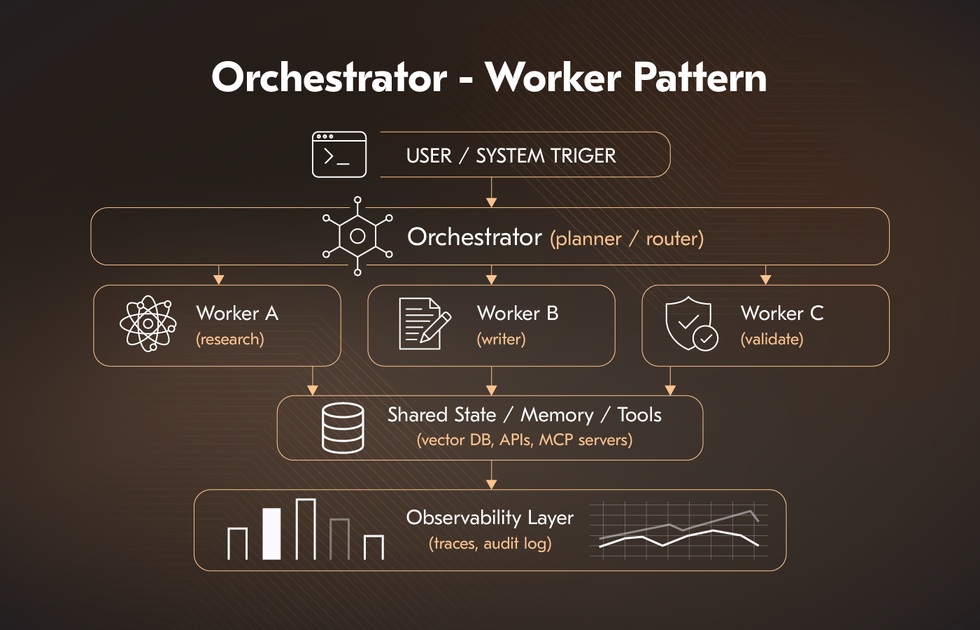
The Six Patterns and When Each One Wins
| Pattern | Where it wins | Where it hurts |
|---|---|---|
| Sequential pipeline | Linear, high-volume workloads. Cheapest and most stable at scale (100K+ docs/day) | Workflows where downstream steps depend on conditional results |
| Concurrent / parallel fan-out | Speed-critical tasks that decompose into independent subtasks | Spiky token consumption; coordination cost at merge time |
| Hierarchical (supervisor–worker) | The default for complex enterprise workloads – best balance of accuracy, cost, latency | A bad planner cascades failures down the whole tree |
| Handoff (orchestrator transfers control) | Customer service triage, sales triage, incident response | Long handoff chains lose context; OpenAI SDK is the best home for this |
| Group chat / debate | Quality-sensitive tasks where multiple perspectives reduce error | Token cost explodes; latency unsuitable for real-time |
| Event-driven | Monitoring, incident response, integration-triggered workflows | Hard to reason about; feedback-loop risk |
Independent benchmarks of orchestration patterns across high-volume document workloads converge on a consistent pattern: reflexive (self-correcting) architectures hit the highest accuracy at moderate scale but degrade sharply at very high volume; sequential pipelines are the most scale-resilient; hierarchical (supervisor-worker) is, by consensus, the best default for most production workloads.
The plain-English version: pick the pattern for the volume, not the prestige. Reflexive looks impressive on a demo and breaks at scale. Sequential is the boring choice that survives.
Common Pitfalls When Implementing Agent Orchestration
Here are the failure modes that show up over and over in our discovery calls with clients who’ve tried to build this in-house first. None of these are framework bugs. They’re discipline bugs.
Agent sprawl. The canonical case is Walmart’s 2024–2025 experience: the retailer rolled out specialized bots for product search, staff scheduling, supplier management, advertising, and developer tooling – and ended up with overlapping AI assistants, fragmented user experience, and governance gaps that made compliance reviews nearly impossible. The fix, rolled out in mid-2025, was consolidation into four domain-level “super agents,” including the customer-facing Sparky that now greets shoppers in the Walmart app. Walmart didn’t need more bots. It needed the right orchestration.
No checkpointing. When the system crashes mid-workflow and there’s no resume point, every retry burns the full token cost again. This is the single largest unbudgeted line item we see in agentic AI project post-mortems.
Missing observability. If you can’t reconstruct who did what and why, you can’t debug failures, satisfy auditors, or tune the system. The Princeton HAL data on framework-driven accuracy swings is only useful if you can see the framework’s behavior. The fastest way to get visibility today: LangSmith for LangGraph, built-in tracing for OpenAI Agents SDK, Azure AI Foundry traces for Microsoft Agent Framework.
Over-permissioning. Each agent’s IAM scope tends to drift wider over time, because it’s easier to grant access than to refactor. Wiz’s 2026 security analysis flags this as one of the highest-impact attack vectors against orchestrated systems – a single prompt injection in a permissive agent can cascade across the whole graph. Treat agent identities like service accounts, not like users.
Skipping the data layer. Bad retrieval kills agents before the orchestration framework even matters. If your RAG pipeline returns garbage, no framework saves you. Fix data quality first.
No human-in-the-loop on high-stakes paths. McKinsey’s State of AI 2025 found that AI high performers – the ~6% reporting more than 5% EBIT impact from AI – are 3.6× more likely than peers to drive enterprise-wide transformation, and 55% of them fundamentally redesign workflows when deploying AI (vs ~20% for other firms). Translation: ownership and workflow redesign separate the winners from the stalled-pilots cohort. The correlation with production success is strong. Ownership matters.
Picking the framework you saw in a tutorial. The most expensive mistake in this space is choosing the framework first and the workflow second. The result is a six-month rebuild. Start with the workflow shape.
Believing the headline. Klarna’s “AI doing the work of 700 agents” was technically true, and it co-existed with quietly hiring humans back into customer support because the hybrid model outperformed pure automation for complex cases. The lesson isn’t that AI didn’t work. It’s that automation is a spectrum, not a switch, and the orchestration layer is what lets you live on the spectrum with confidence. | For a deeper economic view of where this goes wrong – and where it pays back – our analysis of AI agent unit economics, TCO, and ROI breaks down the math case by case. | | — |
AI Agent Orchestration Framework Examples in Enterprise
The cleanest AI agent orchestration framework example for 2026 isn’t a single company. It’s a portfolio of named deployments, each one teaching a different lesson.
KLARNA
Klarna is the LangGraph case study every fintech team should read. The AI Assistant handles 2.5 million conversations across 23 markets and 35+ languages, with average resolution time down from 11 to 2 minutes, repeat inquiries down 25%, and roughly $40 million in annual operational savings. Critically, it’s not pure automation. The orchestration layer includes explicit human-handoff primitives, dynamic prompt tailoring, and step-by-step LangSmith traces that the customer service leadership team uses to refine the system weekly. Klarna also helped design meta-prompting features that made it back into LangSmith – production-grade orchestration is a two-way relationship with the framework vendor.
JPMORGAN CHASE
JPMorgan Chase runs the platform play. The bank’s internal infrastructure – the LLM Suite, OmniAI, and the JADE data ecosystem – is the substrate. Ask David (D.A.V.I.D. is an acronym for Data Analytics, Visualization, Insights, and Decision-making system), the bank’s multi-agent investment research platform built on LangGraph, has been credited with 83% faster research cycles for portfolio managers and traders. A separate platform, COiN (Contract Intelligence), automates 360,000+ legal review hours annually by processing 12,000 commercial credit agreements in seconds. The bank now operates roughly 450+ production AI use cases, scaling toward 1,000 by end of 2026 – heavily concentrated in fraud detection, trade settlement, and compliance. Internal-first deployment before client-facing is the JPMorgan playbook other banks are now copying.
WALMART
Walmart’s Sparky is the consolidation case. After two years of “let a thousand bots bloom,” the retailer rebuilt around four domain-level super agents – a customer-facing one (Sparky), an associate-facing one, a partner-facing one (Marty, for suppliers and sellers), and an internal developer one. The architectural lesson: scale doesn’t come from more AI agents. It comes from fewer, better-orchestrated ones.
UNITEDHEALTHCARE
UnitedHealthcare Group is the volume case. The company runs 1,000+ AI tools in production with another 1,000 in development, processes 26 million consumer calls annually with AI routing, cut claims processing time from 12–15 minutes down to 3, projects AI agents will handle more than half of all inbound calls by year-end 2025, and committed $1.6 billion to AI investment in 2026 alone. The orchestration discipline: 22,000 software engineers, 80%+ of whom are using AI to write code or build new agents, all working under a unified governance layer.
ERNST AND YOUNG
EY’s Canvas platform is the compliance case. It processes 1.4 trillion lines of journal entry data annually across 160,000 audit engagements in 150+ countries, with an embedded multi-agent framework (built on Microsoft Foundry, Fabric, and Azure) available to 130,000 audit professionals. If you’re wondering whether agentic AI can operate at audit-grade scale, EY is the answer.
ATLANTICCARE
AtlantiCare, a regional U.S. health system, deployed Oracle Health’s Clinical AI Agent across 50 providers with 80% sustained adoption, yielding a 42% reduction in documentation time and about 66 minutes of physician time saved per day.
What unites these production cases isn’t the framework. It’s the orchestration discipline: one platform layer, governed handoffs, audit trails by default, and a single accountable owner. Every successful enterprise agent deployment in 2026 has all four. Every failed one is missing at least two.
How Acropolium Builds Production-Grade Orchestration Systems
We’ve been building AI and machine learning systems for enterprise clients over the last 5 years, and we’ve watched the agent space go from “experimental tooling for AI labs” to “operating infrastructure for regulated production workloads” in about 24 months. The principle that has consolidated our practice: the orchestration layer is the deliverable. The model is a commodity inside it. The framework is a tool. The workflow shape is the design.
Our AI Agents Development Practice offers the following end-to-end services:
AI Connectors, and
so that the orchestration layer, the model layer, and the integration layer evolve together rather than fighting each other.
A few representative cases from our portfolio, mapped to the frameworks they fit best.
Built on LangGraph: stateful, regulated, audit-grade workloads
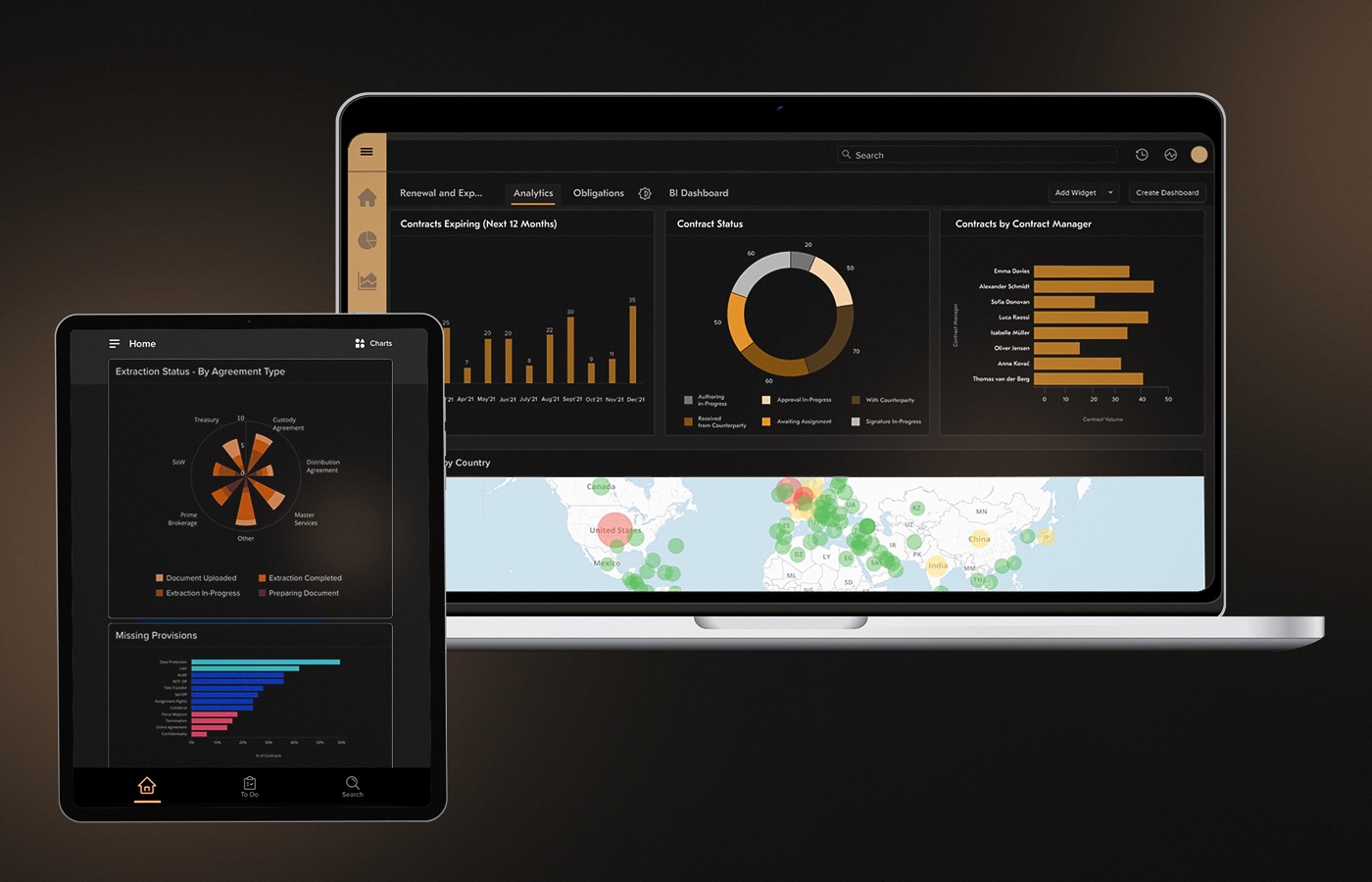
AI Contracting Software Modernization for an International Legal Firm (Europe)
Our client is an international legal company serving individuals, businesses, and organizations across multiple jurisdictions. Their early-generation AI contract management tool used for drafting, reviewing, versioning, and monitoring contractual documents had stopped keeping up with the complexity of modern contracts and couldn’t surface insights to non-legal staff.
Acropolium rebuilt the orchestration: document ingestion, clause classification, risk scoring, summarization, and recommendation agents wired together with full traceability for compliance review – exactly the shape LangGraph was designed for.
Every decision is logged. Every source is cited. Every exception is documented.
Outcomes:
contract review times reduced by 75%
materially improved precision in risk and compliance analysis
decreased operational costs, and
reduced reliance on external legal services.
Built on CrewAI: role-based, multi-specialist workflows
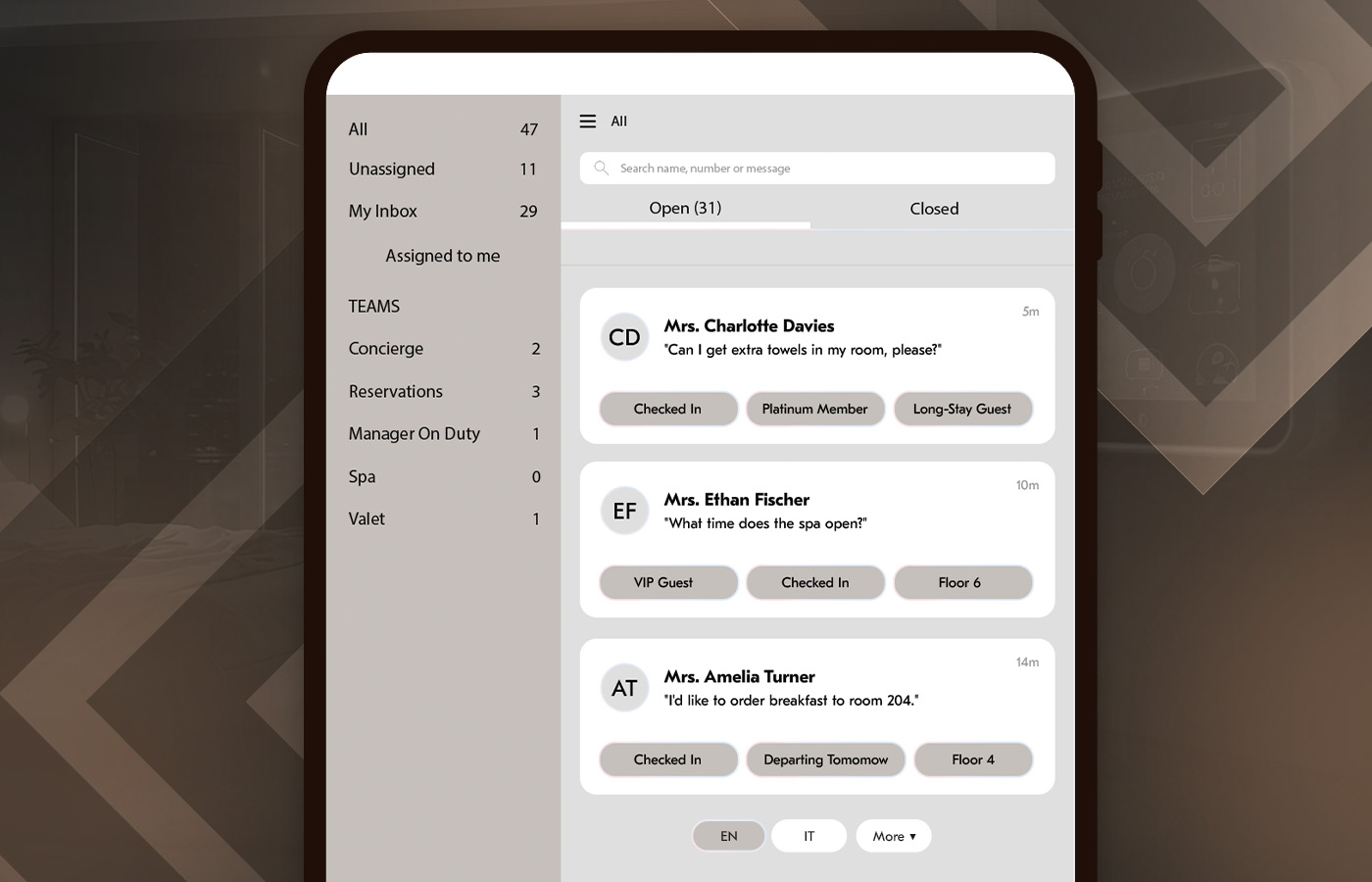
AI digital concierge for a multi-property hotel group (Italy)
The client operates a mix of urban and resort hotels across Italy, serving discerning travelers with curated, high-end stays where personalized service is the brand promise. Their on-premise legacy property management system kept guest data siloed per property, made central reporting impossible, and forced every site to manage check-ins, housekeeping, and upsells through disconnected tools.
Acropolium migrated the PMS to a multi-tenant SaaS architecture, unified guest profiles across all properties, and orchestrated a CrewAI-style concierge crew – agents with explicit roles for check-in, multilingual guest requests, F&B and activity recommendations, housekeeping coordination, and personalized upsells – all sharing context through a state layer with secure RESTful APIs into booking engines, payment gateways, and smart-room controls.
Outcomes:
maintenance overhead dropped by 25%
guest satisfaction rose by 15%
operational efficiency improved by 30%, and
reduced decision latency due to centralized reporting across multiple locations.
Built on OpenAI Agents SDK: handoff-based triage
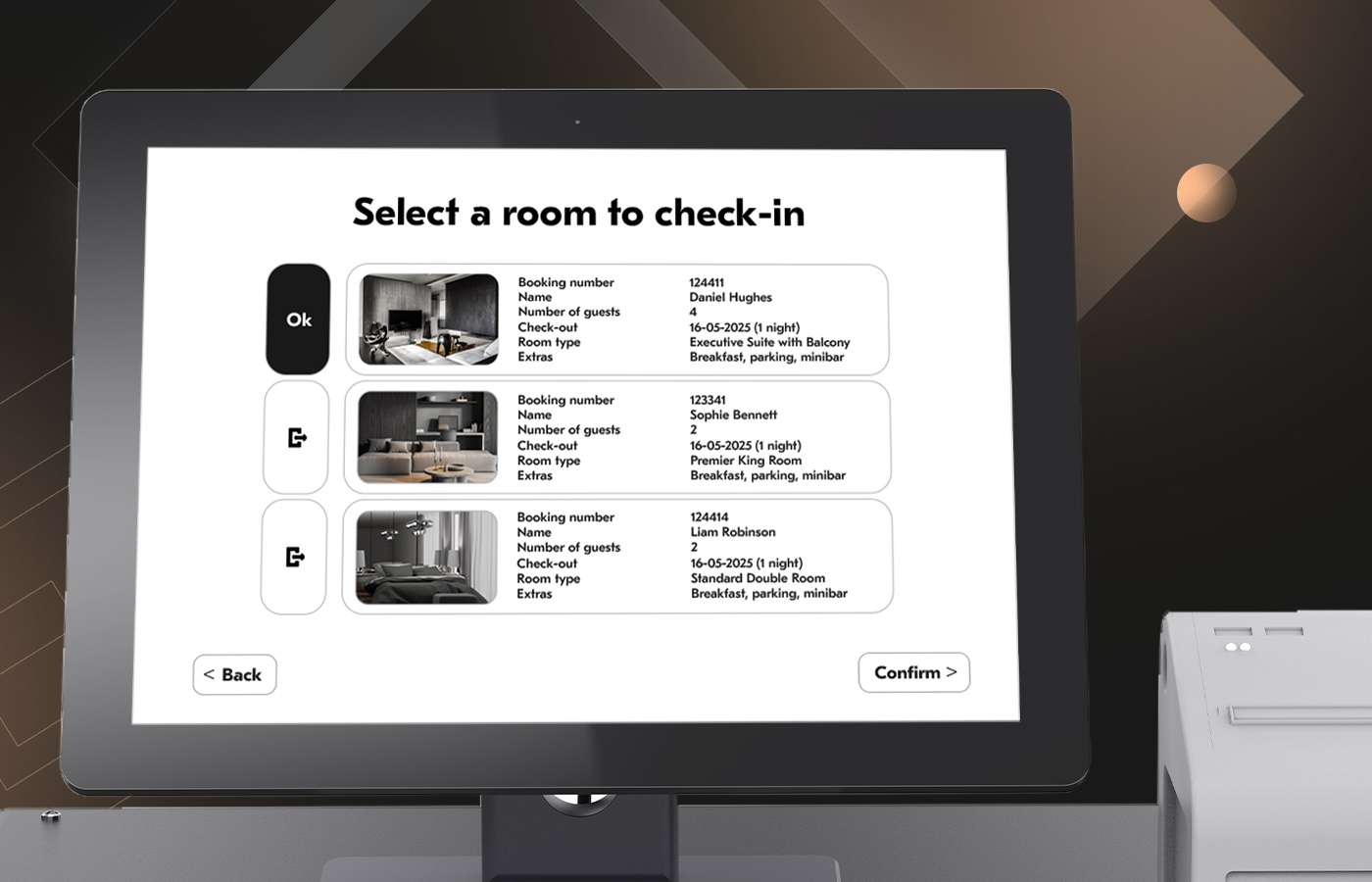
AI-powered hotel self-check-in kiosk software (United Arab Emirates)
Built for a hospitality group operating several 4-star properties facing long queues, error-prone manual ID checks, and front-desk staff too overwhelmed to suggest personalized upgrades to non-English-speaking guests at arrival.
The workflow is classic triage: a triage agent reads guest intent, hands off to ID verification (facial recognition + camera-module ID matching), then to payment processing, then to room assignment – with escalation back to front-desk staff for exceptions. The OpenAI Agents SDK’s handoff primitive maps cleanly to this flow; built-in guardrails make GDPR-compliant biometric handling significantly easier to ship. Encrypted APIs connect to the client’s PMS and CRM.
Outcomes:
30% reduction in average check-in time
25% drop in front-desk workload
18% increase in upsell conversion via contextual upgrade prompts
full GDPR compliance for biometric authentication and facial recognition data
zero downtime during the phased rollout, and
40% guest satisfaction improvement thanks to reduced waiting through queue management.
Built with Microsoft Agent Framework / Semantic Kernel: Azure-native enterprise document workflows
When a client is already deep in Azure + Microsoft 365 – particularly for document analysis and contract automation – we ship orchestration on the Microsoft Agent Framework (the consolidated successor to AutoGen and Semantic Kernel). The integration with Dynamics 365 and SharePoint is the killer feature: you’re orchestrating where the documents already live, not exporting them to a third system. Our representative work in this space is the AI contracting modernization case described above; for clients whose stack is Microsoft-first, the same orchestration patterns translate cleanly to MAF with Azure AI Foundry observability and Dynamics 365 / SharePoint as the document layer.
Built with n8n / Dify: integration-heavy automation
SaaS fleet management and route optimization for a logistics company (Sweden)
When the workflow is integration-heavy (GPS telematics, fuel sensors, ERP, CRM, weather APIs, traffic feeds) and the agentic logic is light, n8n with embedded LLM nodes ships faster than any code-first framework.
We used it as the connector fabric and reserved code-first orchestration for the parts that genuinely needed state and audit.
Outcomes
15% boost in profit margins from fuel and operational cost reductions
25% increase in customer retention via accurate delivery estimates, and
25% improvement in logistics efficiency through real-time vehicle tracking and dynamic route adjustments.
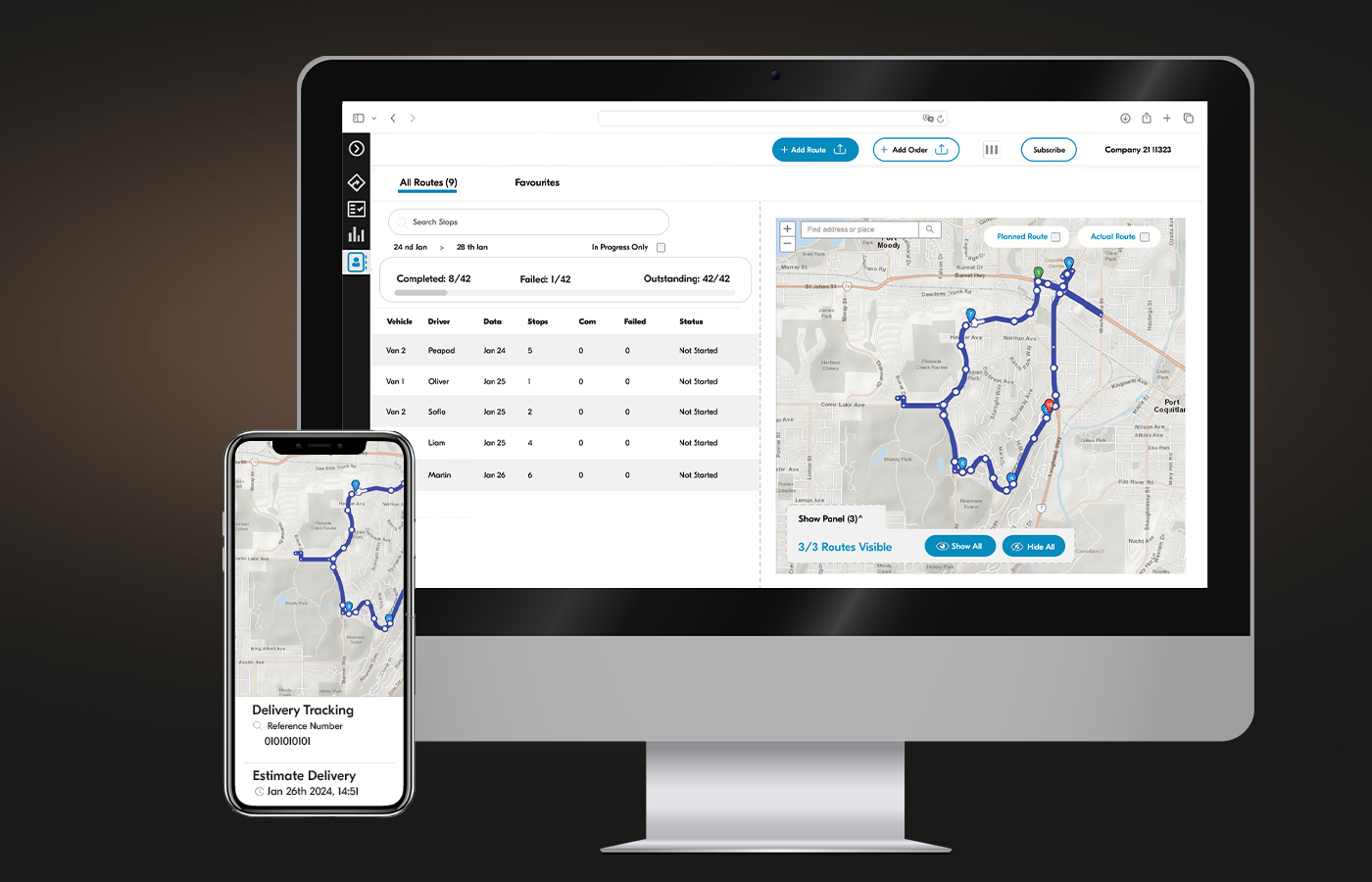
Across every one of these projects, three patterns repeat:
First, we map the workflow on a whiteboard before we open an IDE. The workflow shape decides the pattern. The pattern decides the framework.
Second, we instrument observability from day one, not after the first production incident.
Third, we build the human-in-the-loop primitives before we build the autonomy, because the only way to scale agent authority is to first prove the agent is right.
| If you want the broader architectural argument, our deeper guides on multi-model AI systems for enterprise automation and integrating AI for business applications cover the strategic decisions in more details. |
|---|
Conclusion: Orchestration Is the New Kubernetes
The story of AI in 2026 is not “AI agents got better.” It’s “the orchestration layer became infrastructure.” Gartner’s projection that agentic AI could drive 30% of enterprise application software revenue by 2035 – over $450 billion, up from 2% in 2025 – only happens if orchestration becomes a category in its own right, comparable to what Kubernetes did for container management a decade ago.
The winners of the next two years won’t be the organizations with the most AI agents. They’ll be the ones with the cleanest orchestration: one platform layer, governed handoffs, full traceability, defined ownership, and the discipline to pick the pattern for the workload instead of the workload for the pattern.
The 2026 market of AI agent orchestration frameworks has produced credible options for every workload, stack, and compliance regime. Contact Acropolium to see how we can help to pick the right framework for your workflow, build orchestration that survives production, and hand over a system your team can actually own.