
Fractional AI Engineering Team
Accelerate Product Delivery with a Dedicated Engineering Team That Already Knows How to Build with AI
Recruiting a strong engineer takes months. Onboarding takes more. Your roadmap doesn't pause for either. When you hire a fractional AI engineering team, you're plugging in a team that's already fluent in AI-accelerated delivery – not engineers who need six weeks to learn your codebase and another six to figure out how to work with AI tooling on top of it. As a dedicated team of AI-native developers, Acropolium works as an extension of yours, ships working code in week one and keeps shipping against your roadmap – not a vendor's. You keep control of the roadmap. We take responsibility for turning it into working software.
Flexible Terms for AI-Accelerated Software Development
Our fractional model runs on transparent monthly pricing and quarterly commitments. You know the cost, the team size, and the exit points before we start.

Fractional AI Engineering Team for Startups: From $6,000/Month
Two or more engineers sized for validation-stage work: building an MVP, testing feature hypotheses, and getting real users on the product before your runway runs out.

Fractional AI Engineering Team for SMBs: From $10,000/Month
A balanced squad for growing products: feature streams, integrations, and refactoring in parallel, with enough seniority to make architectural calls without escalation delays.
Fractional AI Engineering Team for Enterprises: From $16,000 /Month
Extended capacity for complex custom platforms: multiple workstreams, legacy touchpoints, security reviews, and coordination with your internal engineering and compliance functions.

Duration: From 3 Months (Rolling)
Begin with a focused scope, then extend, rescale, or wind down at each renewal. No multi-year lock-in and no penalty for changing course when the roadmap does.
What You Get with our Experienced AI-Augmented Development Team
Every engagement is built around throughput you can verify. Here is what an AI-augmented development team from Acropolium delivers sprint after sprint:

Dynamic Squads Built for Your Next Milestone
Execution tailored to your roadmap, not a rigid org chart. We assemble the precise mix of backend, frontend, QA, and DevOps expertise needed to ship this quarter – and fluidly adapt your team as your strategic goals shift.

Composition That Follows Your Priorities
Pivoting from feature work to a migration? Adding an ML component? We rotate specialists in and out within the same budget envelope instead of forcing a new contract cycle.

Weekly Demos and Sprint Reports, No Black Box
Judge progress by working software, not status updates. Every sprint ends with a live staging demo and a detailed written report – giving you total visibility into what’s built, what’s running, and what’s shipping next.

Ship Up to 30% Faster with AI-Accelerated Development Team
AI-assisted code generation, automated test drafting, and machine-supported review compress the routine parts of engineering. Against the conventional baselines from standard software engineering services, that means delivery time reduced by a quarter to a third.

Zero-Friction Visibility: Code, Roadmaps & Blocker Tracking
No gatekeeping, no operational blind spots. We integrate directly into your workflow with open repos, clear sprint priorities, and immediate blocker escalation – functioning as a true extension of your engineering org.

Enterprise-Grade Code Quality & Security Compliance
Speed without compromising security. Automated vulnerability scanning, rigorous peer reviews, and strict compliance protocols are embedded directly into our CI/CD pipelines – delivering secure, audit-ready code with every deployment.
The Advantage: Immediate Velocity
Bypass the recruitment bottleneck. Eliminate hiring fees, onboarding lag, and overhead. We drop a pre-vetted, high-throughput engineering team directly into your workflow so to deliver production-ready code from your very first sprint.


years
projects
client partnerships
Faster Software Delivery with AI – by Industry
Extra engineering velocity converts into different results in every sector. Here is where our AI-assisted development teams are deployed most often, and what each engagement typically returns:
FinTech
- A team embedded in your compliance process from sprint one, so features ship without a late-stage legal review derailing the release date.
- AI-accelerated delivery applied to fraud-detection and underwriting features, cutting a build cycle that used to run a full quarter.
- Engineers who already work inside PCI and SOC 2 constraints, so security review isn't a surprise at the end of a sprint.

Healthcare
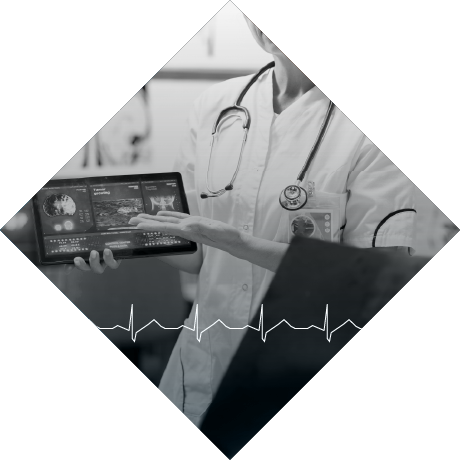
- A team that builds inside HIPAA constraints from day one, instead of retrofitting compliance after a feature is already shipped.
- AI-powered software development solutions applied to clinical documentation and intake tooling, shortening build cycles without shortcutting review.
- Shared roadmap visibility that keeps clinical and product stakeholders reading from the same sprint plan, not two separate timelines.
E-commerce
- Engineers who plug into a live storefront and ship personalization and search improvements without pausing the roadmap for onboarding.
- AI-accelerated delivery on recommendation and merchandising features, so seasonal releases stop missing the season.
- Product-description and content workflows rebuilt around generative AI development, clearing a manual bottleneck most retail teams eventually outgrow.

Logistics
- A rolling team that scales up for peak-season builds and back down after, instead of a headcount you carry all year.
- AI-accelerated delivery on routing and demand-forecasting features, shortening the gap between a planning conversation and a shipped feature.
- Code access and sprint transparency that keeps ops and engineering reading from the same roadmap during high-stakes releases.
SaaS
- A team that extends your existing engineering org rather than operating beside it as an outside vendor – same standups, same backlog.
- AI-accelerated delivery applied to the core product roadmap, not a side project, so velocity gains show up where investors are actually looking.
- Flexible composition that shifts from platform work into AI agents development as the roadmap moves from infrastructure to feature releases.

Manufacturing
- Engineers who work inside existing plant and ERP systems instead of proposing a rebuild before they've shipped anything.
- AI-accelerated delivery applied to predictive-maintenance and quality-inspection tooling, without pulling internal engineers off other priorities.
- A team small enough to embed and large enough to hold its own sprint — sized to the project instead of oversized by default.

Why Companies Hire a Fractional AI Engineering Team at Acropolium
Plenty of vendors rent out engineers by the hour. At Acropolium, we run delivery the way a long-term partner does – and the difference shows up in the codebase, not the sales deck:
Accountability for the Outcome, Not the Hours
We can enter at the level of a business problem, run discovery, design the architecture, and carry it through production and support. The deliverable is a working product – not a timesheet.
AI Where It Pays Back
Before applying any AI tool, we ask what it measurably speeds up in your specific process. If the answer is “nothing,” we don't use it — and we'll show you the comparison.

A Software Engineering Track Record Behind Every Hire
Every engineer we place is backed by the same standards behind our full AI software development practice – this isn't a junior bench cut loose on your codebase.

Engineers Who Build With AI, Not Just on AI Projects
AI-accelerated workflows are how the team already works, on every project – not a pitch reserved for the projects labeled "AI."

No Recruiter Fees, No Bench Time
The team is already assembled and calibrated before you sign. You're not paying to source candidates or waiting for someone to ramp up.

You Own Everything the Team Ships
Code, architecture decisions, and documentation belong to you from the first commit. Nothing is held back for the next engagement.

Where This Model Is the Wrong Fit – and We'll Tell You So
Hardware-Near and Performance-Critical Systems
Embedded code, kernel-level work, and latency-bound systems often demand manual control over every instruction. Here, AI acceleration adds risk without adding speed.
Need a Classic or Ongoing Engagement Instead?
If your regulatory or client agreements restrict machine-assisted code generation, the core advantage of this model disappears. A classic engagement serves you better – and we'll say so on the first call. If you need a reliable software partner for traditional builds, explore our custom software development services or our flexible subscription options.
Certified Safety-Critical Environments
Avionics, medical-device firmware, and similar domains require fully controlled, certifiable pipelines where every artifact's provenance is documented. AI-assisted workflows complicate that certification path.
Contracts That Prohibit AI Tooling
If your regulatory or client agreements restrict machine-assisted code generation, the core advantage of this model disappears. A classic engagement without AI tooling serves you better – and we'll say so on the first call.



Get a free software project consultation
FAQs
- How is a fractional AI engineering team different from regular outstaffing?
How is a fractional AI engineering team different from regular outstaffing?
Outstaffing rents you individuals; you manage them, and their output depends on your oversight. A fractional AI engineering team arrives as a functioning unit with its own delivery discipline, an established AI toolchain, and shared accountability for sprint results. You direct the “what”; the team owns the “how.”
- Which AI tools and code review processes do your developers actually use?
Which AI tools and code review processes do your developers actually use?
AI coding tools and AI coding assistants are part of our delivery stack, alongside automated test generation and machine-supported code review, all governed by an internal policy on what may and may not touch client code. Today, 91% of engineering organizations have adopted AI coding assistants, which is why we treat them as mainstream delivery infrastructure rather than experimentation. This governed development workflow keeps quality, security, and oversight in place from implementation through automated testing.
Daily users can see 60% higher PR throughput, and AI tools save developers an average of 3.6 hours weekly. In some organizations, 22% of merged code is AI-authored, but outputs still remain under team review and policy control. Where a project calls for autonomous components inside the product itself, our AI agents development practice handles that as a separate track to increase development velocity with AI. These tools also support generating documentation and improve documentation quality and architectural clarity. - Is our intellectual property safe during ai augmented software development when your AI-augmented developers use AI tools?
Is our intellectual property safe during ai augmented software development when your AI-augmented developers use AI tools?
Yes. The AI toolchain is agreed contractually before the engagement starts, and AI outputs are governed by approved-tool and policy controls: approved tools only, no client code in public model training, and enterprise-tier configurations with data retention disabled. If a specific AI tool doesn't meet your security bar, it's excluded. The approved stack also has to fit your development environment and broader AI workflows. Any AI generated code remains inside the team's validation process for code quality and security.
- How quickly can your AI-native engineering team start to boost engineering productivity?
How quickly can your AI-native engineering team start to boost engineering productivity?
Scoping takes one or two calls. Because the engineers already work together, the first merged code typically lands within the opening week rather than after a month of onboarding, with shared practices already aligned to your development lifecycle and software development lifecycle. Mature AI-assisted engineering can increase pull request throughput by 60%, helping surface measurable productivity improvements early in the engagement.
- Can the team build AI features into our product, not just develop with AI?
Can the team build AI features into our product, not just develop with AI?
Yes, the same engagement can cover both. Developing with AI speeds up delivery, and AI-assisted development also helps modernize products; developing AI features (assistants, document processing, predictive analytics) extends your product. Many our clients start with the first and add the second once the team knows their domain. We also apply generative AI and machine learning to real-world applications inside products. For legacy systems, the team can use AI-assisted development to extract business logic, analyze and translate outdated languages like COBOL, and generate modern services and APIs.
- What happens if our priorities shift mid-engagement?
What happens if our priorities shift mid-engagement?
The composition flexes. The mix can shift between senior engineers and junior engineers depending on the workstream and the support needed by development teams. At Acropolium, we swap skills, change the workstream split, or resize the squad at the next sprint boundary – inside the same monthly budget wherever possible, with a transparent recalculation when it isn't. We support engineering teams across the full lifecycle with software engineering coverage that includes code generation, code explanation, code scaffolding, unit test generation, technical documentation, and performance analysis.
The team works inside existing patterns used by engineering organizations, which lowers cognitive load for many developers and improves developer productivity. Structured AI adoption and AI usage across development teams are tracked against engineering productivity, AI impact, business outcomes, and competitive edge. Consistent AI-assisted practices can improve code maintainability by 8%, which helps future-proof systems during change. We can also coordinate multiple agents, large language models, and an AI assistant such as Claude Code within the development workflow instead of relying on ad hoc vibe coding or isolated writing code experiments.