Most apps today don’t run on their own code. They run on a network of third-party services such as payment processors, mapping layers, or CRMs. All of them are connected through APIs. When that network works, it’s invisible. When it doesn’t, unfortunately, it becomes your team’s problem.
Third-party API integration seems easy until 3 AM. That’s when you can find yourself looking at a 200 response that has an error. Or you hit a rate limit. Or you might face a checkout flow that fails. The reason for it is usually that a payment gateway updated its authentication without notifying anyone.
At Acropolium, we have built API integrations for payment systems, logistics platforms, CRMs, and data pipelines. Some clients approached us with new projects. Others had outdated systems connected by integrations that nobody fully understood. This guide shares what we learned from our experience in engineering since 2003. We will discuss the protocols, the authentication patterns, the failure modes, and the choices that decide whether an integration works six months after it launches.
What is Third Party API Integration?
Most modern stacks are already built around third-party dependencies such as payment processors or custom SaaS development solutions. Each exposes functionality through APIs that your application connects to.
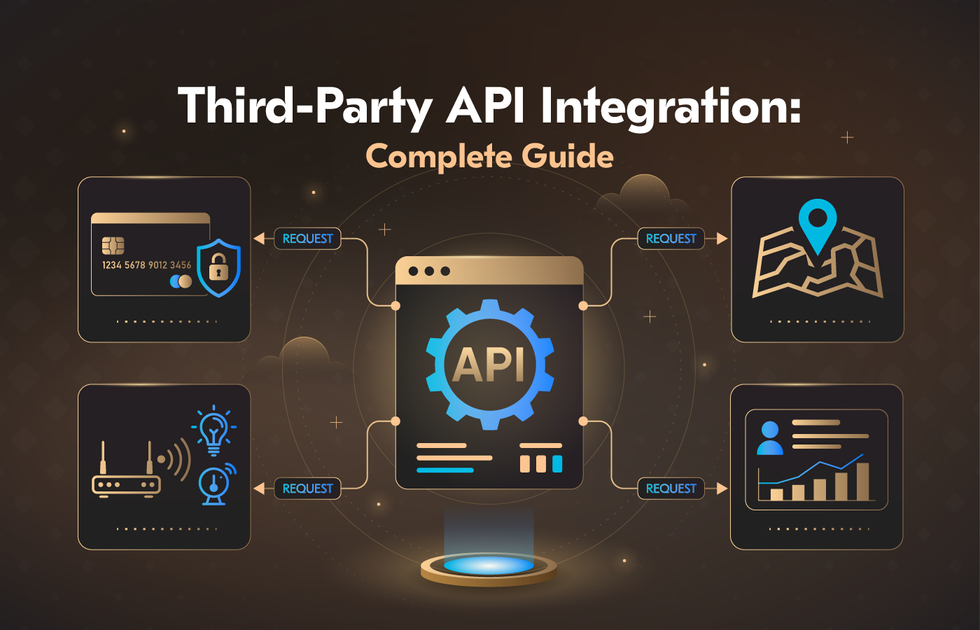
An API (Application Programming Interface) is a contract. It defines what requests a system accepts, what it returns, and under what conditions. Your application sends a structured request to an external endpoint. Then the provider processes it and returns a response your system acts on: a payment confirmation, a geocoded address, a verified identity, a fraud score. The underlying logic stays on the provider’s infrastructure; your system only sees the result.
The business case is clear. Building payment processing from scratch always takes years of PCI compliance work. Additionally, the leaders need to put in place the banking relationships, fraud modeling, and infrastructure investment. Integrating Stripe takes days. Google Maps, Twilio, Salesforce, and SendGrid represent years of engineering now available behind authenticated HTTP calls. APIs are the connective tissue of digital transformation: the mechanism by which legacy systems are extended, data silos are broken down, and modern SaaS capabilities are added to existing infrastructure without rebuilding everything from scratch.
Most production systems handle it in different ways. They route requests through an API gateway or middleware layer that manages authentication, rate limiting, logging, and retry logic before the call leaves your infrastructure. With that structure in place, circuit breakers, fallbacks, and caching isolate your system from upstream failures.
| Working integration | Production-grade integration | |
|---|---|---|
| Auth | Sends API key with request | Handles token expiry, refresh logic, and key rotation |
| Error handling | Catches HTTP errors | Maps provider error taxonomy |
| Retries | None or basic | Exponential backoff with jitter respects Retry-After headers |
| Rate limits | Reacts when hit | Tracks usage proactively, queues requests |
| Failures | Breaks with the provider | Circuit breaker isolates the failure, fallback maintains core functionality |
| Observability | Logs exist | Request/response metadata captured, latency tracked, alerts configured |
At Acropolium, third party API integration workflow work starts with mapping the full surface. That is a must before any first line of code is written by our team: the auth lifecycle, the error taxonomy, the rate-limit structure, and the fallback behavior. That analysis is usually what separates integrations that hold up from ones that generate incidents every few weeks.
Types of Third-Party APIs
REST APIs
REST (Representational State Transfer) is the dominant protocol for web services in 2026. It uses standard HTTP methods and returns responses in JSON. For example, these outputs can be characterized as lightweight, readable, and debuggable at 2 AM. What makes REST practical is statelessness. Each request contains everything the server needs to process it, with no session state stored on the server. That makes REST APIs straightforward to cache, load-balance, and scale horizontally.
Building payment and billing systems software development on top of REST APIs is one of the most common integration patterns. As for the real-world examples, Stripe, PayPal, and Braintree all use REST API. The request-response model maps cleanly onto transaction flows: initiate, confirm, handle the outcome. An Uber API integration follows the same model: platforms embed ride-hailing directly into their product without building their own dispatch, routing, or driver management infrastructure.
For most web and mobile integrations, REST is the right starting point. Unless data requirements push toward GraphQL or real-time requirements push toward webhooks.
SOAP APIs
SOAP (Simple Object Access Protocol) predates REST by nearly a decade. In most modern architectural conversations, it gets treated as a legacy problem to be solved, which is mostly accurate. SOAP uses XML-based messaging with a strict envelope structure. It includes a defined header, a body, and a fault element for errors. Every request and response conforms to a WSDL (Web Services Description Language) contract.
In enterprise environments, particularly SAP ecosystems, SOAP is still common. It handles structured data exchange between core systems through standardized EDI formats and custom backend development integrations. The structure here is predictable. Moreover, it can be battle-tested across systems that have been running for decades on the outdated infrastructure.
The modernization pattern is consistent: wrap the SOAP service in a REST or GraphQL layer, preserving the legacy business logic while exposing it through an interface that modern applications can consume without inheriting the complexity underneath.
GraphQL APIs
GraphQL solves a sophisticated problem that REST APIs handle poorly, namely: over- and under-fetching. Let’s define how GraphQL really works. A single query from the client can request exactly the fields it needs across multiple related resources. After it, the server returns precisely that. That flexibility makes GraphQL a natural fit for MACH architectures in data-heavy third-party API integrations.
It also changes how teams work. In REST architectures, a new frontend data requirement often means a backend change. In GraphQL, the frontend team queries what it needs without blocking on a backend release cycle. A global paints and coatings manufacturer built its entire digital commerce platform on GraphQL for exactly this reason. Multiple business units and markets meant each domain team needed to develop and deploy independently. GraphQL made that possible without creating integration bottlenecks across the platform.
Webhook-Based Integration
REST, SOAP, and GraphQL follow a request-response model: your system asks, the provider answers. Webhooks invert that. The provider pushes data to your system the moment something happens, with no polling and no unnecessary requests. Technically, a webhook is an HTTP POST your system receives. You register an endpoint with the provider; when a defined event occurs on their side, they call yours.
For IoT and sensor-heavy environments, the protocol often shifts from HTTP to MQTT. It is considered as a lightweight publish-subscribe protocol built for low-bandwidth, high-frequency data transmission. In a SmartOffice deployment, desk and room occupancy sensors push real-time status updates via MQTT to a facility management backend. Polling hundreds of sensors every few seconds would generate unnecessary traffic and still deliver stale data.
| REST / GraphQL / SOAP | Webhooks / MQTT | |
|---|---|---|
| Direction | Client pulls data | Provider pushes data |
| Latency | Depends on poll interval | Near real-time |
| Use case | On-demand data retrieval | Event-driven updates |
| Infrastructure needed | API client | Publicly accessible endpoint or message broker |
| Failure handling | Retry on your side | Provider retry logic + your endpoint reliability |
How Third-Party API Integration Works: Step-by-Step Process
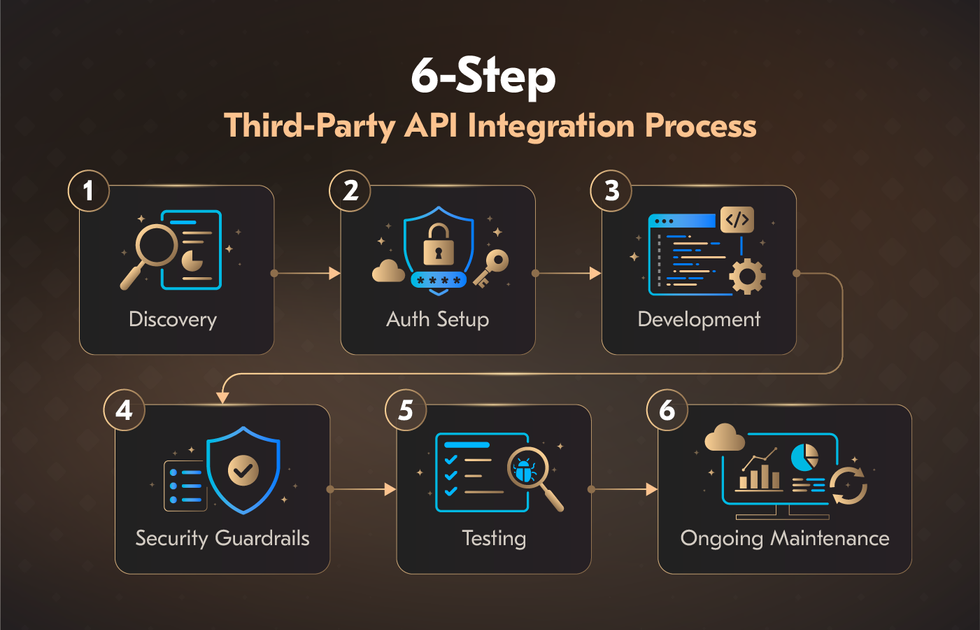 A third-party API integration is a lifecycle. What looks like “calling an endpoint” from the outside involves discovery, authentication architecture, resilience design, testing strategy, and ongoing maintenance. Here’s how each phase works in real life.
Step 1: Discovery
Integration work starts before any code is written. The first question isn’t how to connect to the API. It’s whether the provider’s API actually supports what the product requirements describe. Documentation says one thing; actual API behavior in edge cases often says another. A technical viability assessment covers the provider’s API reference, rate limits, authentication model, data schema, and SLA. For complex integrations, that assessment typically takes one to two months and consistently costs less than discovering incompatibilities mid-development.
Step 2: Provider Registration and Authentication Setup
Every API call requires authentication. Developers register the application with the provider and receive credentials: an API key, an OAuth client ID and secret, or both.
What happens next depends on the authentication model. API keys are stored in a secrets manager and never hardcoded or committed to version control. OAuth 2.0 requires implementing the full authorization flow, including token storage and refresh logic for when access tokens expire. JWT requires handling token signing and short expiry windows with appropriate refresh cycles.
Step 3: Development
With auth configured, development follows a consistent pattern. The team installs the provider’s package, which abstracts lower-level HTTP handling and provides typed interfaces for the API’s resources. Also, they manage it via a dependency manager along with the rest of the application’s dependencies.
Developers integrate requests using standard HTTP methods: GET retrieves data, POST creates or triggers actions, and PUT updates. Responses are returned in JSON by most modern APIs. The critical work is what happens to that response before it reaches application logic:
Validate the HTTP status code
Check for errors embedded in a 200 response body (more common than it should be)
Validate the response structure against the expected schema
Transform the provider’s data model into your internal representation in a dedicated layer
Step 4: Security Guardrails
A production-grade third-party API integration handles everything else on the security front. In third-party API integrations, “everything else” happens regularly enough that it needs to be designed for upfront.
Error handling and retry logic
Not all errors are equal, and the retry strategy needs to reflect that.
| Error type | Examples | Correct response |
|---|---|---|
| Client errors | 400 Bad Request, 401 Unauthorized, 403 Forbidden, 404 Not Found | Do not retry. The request is malformed or unauthorized: sending it again produces the same result. Fix the request. |
| Server errors | 500 Internal Server Error, 502 Bad Gateway, 503 Service Unavailable | Retry with backoff. The provider is temporarily unavailable. |
| Rate limit errors | 429 Too Many Requests | Retry after the window specified in the Retry-After header. |
For server errors and rate limit responses, exponential backoff with jitter is the standard pattern. The system waits progressively longer between attempts, with a small random delay added to prevent synchronized retry storms when multiple instances hit the same failure simultaneously. A practical sequence: 1s, 2s, 4s, 8s, 16s, capped at a maximum wait time with a defined retry limit. Beyond that limit, the request fails, the failure is logged with full context, and an alert fires.
Idempotency is non-negotiable for retry logic on write operations. If your system retries a payment request after the first response times out, even though the first request succeeded, the user is charged twice. Providers that support idempotent requests accept an idempotency key with each call; submitting the same key twice returns the result of the first request. If the provider doesn’t support idempotency keys natively, that logic needs to live on your side.
Rate limiting and throttling
Every production API enforces rate limits. Exceed the threshold and the provider returns a 429, temporarily blocking further requests. Most teams treat this as something to react to. By the time a 429 arrives, requests are already failing, retry queues are filling up, and the application is degrading. The better approach is proactive tracking via the rate-limit headers returned with every response, throttling before the limit is triggered. For integrations with strict per-second limits, a token bucket or leaky bucket algorithm precisely controls the outbound rate, absorbing bursts and smoothing the outflow before it reaches the provider.
A spike in 429s is a signal worth investigating. The cause may be a change in traffic patterns, a runaway process, or an integration being called more frequently. Catching it in monitoring is always better than discovering it when a feature stops working.
API gateway integration
At enterprise scale, individual services calling third-party APIs directly become unmanageable fast. An API gateway handles authentication and rate limiting. Sometimes, it also addresses logging and protocol translation in one place. When a provider updates their auth mechanism or changes an endpoint, the update happens at the gateway.
Step 5: Testing
Testing an API integration requires more than unit tests against mocked responses. Contract testing validates that the actual API behaves as documented and catches provider-side breaking changes before they reach production. Integration tests run against the provider’s sandbox using real HTTP calls, covering authentication flows, error responses, rate-limit behavior, and edge cases. Performance testing under load reveals whether retry logic causes a thundering herd problem, whether the queue handles backpressure, and whether latency remains within acceptable bounds.
All of this runs in isolated environments before anything touches production, and solid DevOps services infrastructure makes contract testing and integration validation routine parts of the release cycle.
Step 6: Ongoing Maintenance
Once deployed, the integration needs to be actively monitored. Centralized logging should capture every request and response: timestamps, endpoint called, response status, latency, and enough context to reconstruct what happened when something goes wrong. In microservices architectures where multiple services touch the same third-party API, that logging is what makes incidents diagnosable. Real-time alerting for error-rate spikes and rate-limit events gives teams the visibility to catch degradation before users do.
APIs evolve on the provider’s schedule. Providers deprecate endpoints, introduce breaking changes, and occasionally sunset services with little warning. Tracking which API version each integration uses, monitoring deprecation notices, and maintaining internal migration guides help prevent those changes from becoming production incidents.
How to Handle Timeouts, Failures, and High Load During Third-Party API Integration
Third-party APIs don’t fail dramatically. They slow down. Response times that averaged 80ms start creeping toward 400ms, then 2 seconds, then the connection times out entirely. By the time an alert fires, the failure has usually been building for a while: traffic grew faster than the provider’s infrastructure scaled, a database backing the provider’s service started lagging, or a serverless function hit a cold start at exactly the wrong moment.
The problem with tight coupling to an external service is that its performance becomes your performance. A provider degrading from 100ms to 3 seconds makes your application three seconds slower. A provider that stops responding makes your application stop responding. That’s the failure mode worth designing against.
Start with timeouts and fallbacks
The first decision that matters is where your system stops waiting. Every external call needs a timeout, a deliberate one based on what response latency is actually acceptable to the user. A timeout without a fallback just trades an infinite wait for a fast error. What comes after the timeout determines whether the user notices at all.
Know when to stop retrying
Retry logic with exponential backoff handles transient failures well. If a provider is genuinely down and your system keeps retrying every few seconds, you’re filling retry queues and adding load to infrastructure that’s already struggling.
The Circuit Breaker pattern is built for exactly that situation. Once failures exceed a defined threshold, the breaker opens, and requests stop reaching the provider entirely. Your system returns a fallback response immediately rather than waiting on a service that isn’t going to answer. After a recovery period, a small number of test requests go through. If those succeed, normal traffic resumes. If they fail, the breaker stays open. Your application remains responsive during a provider outage.
Cache what you can
If frequently requested data is already in an in-memory store like Redis, many read operations never reach the provider at all. The data is available regardless of whether the API responds. Caching doesn’t eliminate the need for fallback handling. However, it significantly narrows the surface area where provider availability really affects the user. The design question is staleness tolerance. Real-time pricing data has different TTL requirements than a user’s profile or a list of supported currencies. Getting that wrong in either direction creates its own problems: too short and the cache doesn’t buffer effectively; too long and users see stale data without knowing it.
Design the degraded experience intentionally
When the cache is empty and the circuit is open, what the user sees depends on what fallback behavior was designed into the integration. The options for it are:
Default values: Return an acceptable placeholder until the service recovers.
Graceful degradation: Disable the feature that depends on the provider while keeping the rest of the application functional.
Explicit messaging: Display a clear UI message.
All three are better than a timeout or a broken state. A map integration that can’t reach its provider should show a last known position or a static view.
Make failures visible before users report them
Centralized logging across every external call, distributed tracing that maps latency to its source, and alerting on error rate spikes, latency percentiles, and circuit breaker state changes are what make an incident diagnosable. The difference for third-party API integration shows up in mean time to resolve: teams with full observability go straight to the problem; teams without it spend the first hour figuring out what broke before they can start fixing it.
What Are Third-Party API Integration Best Practices?
Design for replaceability
The biggest architectural mistake in third-party integration is building too tightly around a specific provider’s interface. When that provider changes their API, raises prices, or shuts down a service, the cost of switching is proportional to how deeply their specifics are embedded in your code.
Define your internal interface first. Establish what your system needs the integration to do, then build the provider-specific implementation behind that contract. Swapping providers amounts to replacing one implementation. When services communicate through well-defined event contracts, third-party dependencies remain at the edges of the system.
Test the contract
Unit tests that mock API responses confirm that your code runs. Unfortunately, they don’t confirm that the provider’s API still behaves the way your code expects. The solution here is contract testing, which validates the actual request and response schema. When a provider quietly renames a field, adds a required parameter, or changes a response structure as part of a minor version bump, contract tests catch it in the pipeline.
Treat authentication as least privilege
The credential itself is only part of the security surface. You should scope the access to the minimum permissions the integration needs at any given time. An API key with write access to everything has a significant blast radius if it leaks. Every API interaction, internal or external, should require verified credentials. The assumption that traffic inside the network perimeter is inherently safe is precisely what makes lateral movement so damaging when a breach occurs.
Build security into the pipeline
Security reviews that happen after development is complete find problems at the most expensive possible moment. Embedding static analysis, dependency scanning, and vulnerability assessment directly into the CI/CD pipeline catches issues when they’re cheapest to fix.
With 35% of organizations’ third-party vendors reporting a cybersecurity breach in the past year, according to Wipro, the risk is concrete. Maintaining a Software Bill of Materials (SBOM) gives you a documented inventory of every third-party component the system depends on. When a critical CVE drops for a library or API used across multiple integrations, the exposure is immediately visible.
What Are Real-World Third-Party API Integration Examples?
JPMorgan
JPMorgan integrated Kinexys Digital Payments directly with its FX Services. The integration needed to handle cross-border foreign exchange transactions in near real time. Two systems with fundamentally different data models and transaction logic needed to exchange information reliably. The API layer had to handle authentication, transaction state, error recovery, and audit logging with financial-grade precision. Each transaction either settled or it didn’t.
Paints & Coatings Manufacturer
This third-party API integration example is a leading global manufacturer that built its digital commerce platform on a MACH architecture. It integrates Commercetools as the commerce engine alongside Azure, GraphQL, and Angular. GraphQL was the right choice for that complexity. Multiple business units and markets meant the organization needed each domain team to develop and deploy independently.
SmartOffice
In a custom SmartOffice deployment, virtual sensors compile input from multiple physical sensors and push real-time updates to a facility management backend via MQTT and WebSocket APIs using SignalR. The key decision was inverting the data flow. That cuts unnecessary traffic, reduces latency, and decouples the physical layer from the backend. If the management application goes down temporarily, sensor data queues.
From custom CRM development to logistics platforms and IoT pipelines, the integration patterns that arise are consistent across industries. Acropolium has worked across similar integration surfaces: payment systems, logistics platforms, enterprise CRMs, and IoT deployments, including digital payment system upgrade and custom API data integration projects. We’ve seen these patterns across industries. Our team handled the authentication design, failure handling, and early architectural decisions for clients of different sizes. 
How Acropolium Approaches API Integration Projects
API integration work looks straightforward on paper and reveals its complexity in production. Since 2003, with 450+ delivered projects and clients ranging from early-stage startups to Fortune 500 companies, we’ve seen what separates integrations that hold up from ones that hold a business back.
Before writing the first request, we map the full integration surface based on the assessment. Our integration team at Acropolium maps the authentication lifecycle and defines the error taxonomy for each specific use case. After it, we move forward to design the rate-limit structure and fallback behavior for every failure mode worth anticipating.
The implementation follows from that robust foundation. We implement an API gateway as the single entry point. We also build in circuit breakers and retry logic built in from the start. All of it is built around specific goals: caching designed for actual staleness tolerances, and contract testing built into the CI/CD pipeline.
If you’re planning an integration project, whether that’s connecting a new payment provider, building on top of an enterprise platform, or bringing order to a set of third-party dependencies that have gotten away from you, we’re happy to talk through the architecture before any commitments are made. Get in touch with Acropolium’s team to start the conversation.