Why Getting Your AI Budget Right in 2026 Is More Critical Than Ever
According to Gartner, worldwide AI spending will total $2.52 trillion in 2026, a 44% year-over-year increase [1]. Generative AI model spending alone is growing at 80.8% [2]. Those numbers are staggering, but they mask a painful truth: the majority of enterprise AI pilots still fail to reach production scale. The reason is rarely technology. It is a budget planning that was either too optimistic, too vague, or built on outdated data.
In 2026, AI budget decisions are no longer optional sideline conversations. They sit at the center of boardroom strategy. Gartner describes this year as a “Trough of Disillusionment” phase for AI: enterprises are moving away from experimental moonshots and demanding proven ROI before they scale [1]. That shift changes everything about how you should approach your AI software development cost planning.
This article gives you practical framework to budget your AI investment accurately. Whether you are planning your first AI app development cost estimate or reviewing an existing cost of AI development across multiple departments, you will find concrete answers here.
AI Development Cost in 2026: The Quick Overview
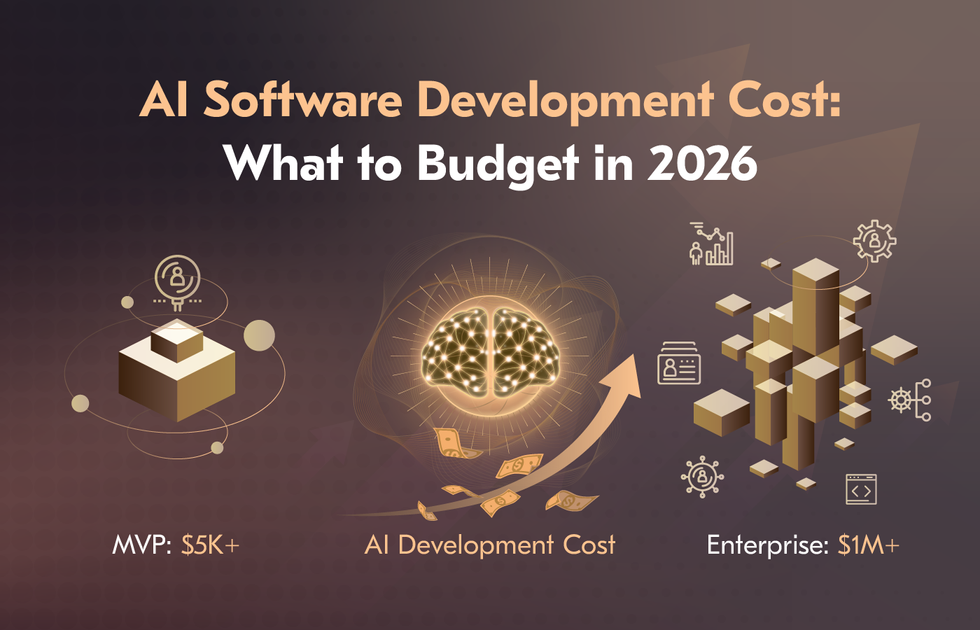
How much does AI cost to build in 2026? Based on industry-estimate ranges, the answer is anywhere from $5,000 to $5 million or more, depending on what you are building. Simple rule-based systems and off-the-shelf integrations sit at the low end. Enterprise-grade platforms with custom model training, multi-system integration, and regulatory compliance push into the millions.
Here is a fast-reference overview of AI software cost by project tier:
| Project Tier | Typical Cost Range | What You Get |
|---|---|---|
| Basic / Prototype | $5,000 to $30,000 | Rule-based bots, simple API integrations, proof-of-concept |
| Standard / Mid-Market | $30,000 to $150,000 | Custom ML models, LLM-powered chatbots, CRM integrations |
| Advanced / Enterprise | $150,000 to $500,000 | Deep learning, computer vision, multi-system AI automation |
| Enterprise Platform | $500,000 to $5M+ | Custom LLM training, multi-agent systems, regulated industry AI |
The cost of AI depends on six primary inputs: solution complexity, data readiness, team geography, model type, integration depth, and ongoing infrastructure. Each of those factors gets its own analysis below.
One critical point before you plan: the published AI development cost breakdown figures you see most often understate total investment by 30 to 50%. That gap comes from hidden lifecycle costs that appear only after launch. Budget for those from day one.
What Drives AI Software Development Costs? 7 Key Factors
The Goodfirms Custom Software Development Cost Survey 2026, drawn from 100+ global development firms, identified three cost drivers with supporting data: project complexity (cited by 95.3% of respondents), technology stack (79%), and the use of senior or cross-functional teams (72%) [3]. Beyond those three, the factors below consistently move AI project budgets across the industry.
Factor #1. Project Complexity and Solution Type
Complexity is the single largest driver of AI software development cost. A rule-based FAQ bot costs roughly $3,000 to $15,000. An LLM-powered customer service platform with fine-tuning and CRM integration costs $50,000 to $150,000. A custom computer vision system for medical imaging can run from $150,000 to $1.2 million. The gap is not about vendor markup. It is about the number of engineering hours, data pipelines, model iterations, and testing cycles required to hit production quality.
Factor #2. Data Quality and Preparation
Poor data quality is a second driver of AI project failure and cost overruns. According to Gartner, data readiness issues contribute to up to 50% of generative AI project failures [4], and organizations without AI-ready data risk abandoning as many as 60% of their AI initiatives. [5] Data-related work accounts for 15 to 35% of total project costs in most builds. Companies with clean, well-labeled data pipelines can reduce data preparation costs by up to30 to 50%. If your organization relies on legacy systems or unstructured data, expect to add approximately $30,000 to $100,000+ in data engineering costs, based on typical ranges for data pipeline development, cleaning, and system integration.
Factor #3. Model Type: API, Fine-Tuned, or Custom-Built
Your choice of AI model development cost path falls into three tiers. Using pre-built APIs like OpenAI or Anthropic costs between $0.10 and $15.00 per million input tokens (depending on the model tier), but expenses scale quickly at enterprise volumes ($1,000 to $50,000 per month for high-traffic apps). LLM Customization through fine-tuning balances cost and control: it requires 1,000 to 10,000 labeled examples and adds $20,000 to $80,000 to your build. Training a model from scratch is only justified when pre-trained alternatives cannot meet your performance requirements. That path starts at $100,000 and routinely exceeds $500,000.
Factor #4. Team Location and Seniority
US AI/ML engineer salaries in 2026 range from $134,000 to $193,250 with Glassdoor putting the average at $177,000 and top earners above $220,000. Eastern European AI/ML engineers offer a significant cost alternative. Senior AI/ML specialists in Central and Eastern Europe charge $50 to $90 per hour, with mid-level engineers in the $40 to $90 range. In-house US hiring also carries overhead: benefits and taxes add roughly 30% above base salary, and administrative costs add another 10 to 25%, making the true annual cost of a single mid-level US AI engineer closer to $180,000 to $250,000 all-in.
Factor #5. Integration Complexity
Every system your AI needs to connect to adds cost. Legacy system integration, including custom middleware for older platforms without APIs, typically adds $30,000 to $100,000. The more data sources, databases, CRMs, ERPs, and third-party services involved, the higher your AI integration cost. Plan for integration to represent approximately 15% to 25% of your total AI build budget on mid-complexity projects, based on industry cost breakdowns of integration engineering and deployment phases.
Factor #6. Regulatory and Compliance Requirements
AI projects in healthcare and finance rarely come in under $20,000 because of compliance requirements alone. HIPAA, GDPR, and sector-specific regulations add non-trivial cost for audits, governance frameworks, and potential redesigns. A diagnostic imaging AI needing FDA approval in the United States can add six to twelve months and hundreds of thousands of dollars to the timeline.
Factor #7. Infrastructure and Cloud Costs
Cloud GPU costs for AI training range from $0.66 per hour on specialized providers to $6.98 per hour on Azure for comparable hardware. AWS cut H100 pricing by up to 45% in June 2025, which lowers training costs, but inference costs at enterprise scale still run $1,000 to $50,000 per month depending on traffic volume and model size. Plan for infrastructure to represent 10 to 20% of your annual AI implementation cost.
Cost Breakdown by AI Solution Type
Different AI products carry fundamentally different cost profiles. The AI development cost breakdown below covers the most common solution types. You can use this as your first-pass scoping tool.
| Solution Type | Development Cost Range | Monthly Inference / Ops | Key Cost Driver |
|---|---|---|---|
| AI chatbot development cost ****(rule-based) | $3,000 to $15,000 | $200 to $1,000 | Flow logic, CMS integration |
| AI chatbot development cost ****(LLM-powered) | $50,000 to $150,000 | $1,000 to $10,000 | Fine-tuning, multi-channel support |
| ML prediction / classification | $30,000 to $150,000 | $500 to $5,000 | Data prep, feature engineering |
| Computer vision system | $80,000 to $500,000+ | $2,000 to $20,000 | Labeled training data, GPU compute |
| Generative AI product | $75,000 to $300,000 | $3,000 to $50,000 | API costs, fine-tuning, safety layers |
| AI agent development cost ****(simple) | $15,000 to $40,000 | $500 to $3,000 | Tool calling, orchestration logic |
| AI agent development cost ****(enterprise multi-agent) | $100,000 to $200,000+ | $5,000 to $30,000 | Multi-model routing, failure handling |
| Custom LLM (fine-tuned) | $50,000 to $200,000 | $2,000 to $15,000 | Training data curation, evaluation |
| Custom LLM (trained from scratch) | $500,000 to $5M+ | $10,000 to $100,000+ | GPU compute, PhD-level research team |
| RPA with AI enhancement | $20,000 to $100,000 | $500 to $5,000 | Process mapping, bot orchestration |
A Note on Pricing Methodology: The cost figures presented here draw on publicly available pricing data from software development consultancies, market research firms, and industry benchmarks published between 2025 and 2026. [6][7][8][9][10] They are calibrated to reflect what mid-market and enterprise organizations typically encounter across comparable project scopes.
Important: No two AI projects carry identical price tags. The ranges shown are working estimates – your actual investment will shift depending on factors like the state of your existing data infrastructure, applicable compliance or regulatory obligations, the specific development partner or internal team you engage, and how deeply customized the solution needs to be. Use these figures as a planning baseline, not a final budget.
Hidden Costs of AI Software Development Most Companies Miss
Post-launch lifecycle costs, including model maintenance, retraining, monitoring, and operational support, often represent a substantial portion of total enterprise AI expenditure and are frequently underestimated in initial budgets. Total cost of ownership analyses show that initial development expenses may comprise only a fraction of the full lifecycle cost. [11] These are the line items that kill AI ROI before it gets a chance to prove itself.
Model maintenance and retraining: Budget 15 to 25% of your initial development cost annually. AI models drift as real-world data changes [12]. Retraining cycles for production AI models typically cost $2,000 to $15,000 per quarter.
Data labeling and annotation: Ongoing labeling for continuously AI learning systems costs from $0.05 per data point at scale [13]. For a fraud detection system processing 100,000 new examples monthly, this adds up fast.
MLOps and monitoring infrastructure: Production AI requires dashboards, alerting, model registries, and A/B testing pipelines. This infrastructure costs $1,000 to $20,000 per month depending on the number of models and traffic volume.
Security and compliance updates: Brookings Institution’s research shows companies with high cybersecurity exposure see roughly 0.33% lower monthly stock market returns. [14] AI systems handling sensitive data need encryption upgrades and access control audits on a recurring basis.
Scope creep: The Goodfirms 2026 survey found scope creep increases development costs by 10 to 25% on average. [3] Locking down requirements before development starts is the single most cost-effective decision you can make.
Integration upgrades: When third-party systems update their APIs or schemas, your AI integrations break. Plan for 40 to 80 hours of engineering time per year per external integration to maintain compatibility.
Quick Rule of Thumb: Take your build cost. Add 20% for year-one post-launch costs. Then budget 15 to 25% of the build cost as an annual recurring line item from year two onward. That’s your real AI software cost over three years.
In-House vs Outsourcing for AI Development: Which Model Saves More?
This is one of the most consequential decisions when you estimate a cost of AI development. Each model has genuine advantages and genuine risks. Here is a direct comparison.
| Factor | In-House Team | Outsourced Partner | Hybrid Model |
|---|---|---|---|
| Upfront cost | High ($180K to $300K+ per senior AI engineer annually) | Lower (project-based or monthly retainer) | Medium |
| Speed to start | Slow (3 to 6 months to hire) | Fast (2 to 4 weeks) | Medium |
| Control | High | Lower | High for strategy, lower for execution |
| Expertise depth | Depends on hiring quality | Immediate access to specialists | Blended |
| Long-term cost | Lower at scale if team is retained | Can accumulate with ongoing contracts | Often optimal at $500K+ project scale |
| Risk | Key-person dependency | Vendor lock-in, IP concerns | Balanced |
| Best fit for | Large enterprises with multi-year AI roadmap | SMEs, first projects, specialized builds | Mid-market companies scaling AI gradually |
In-house AI specialists cost $80,000 to $180,000 per year in base salary, plus roughly 30% in benefits and overhead. That means a three-person AI team costs $310,000 to $700,000 annually before a single line of code is written. For companies with a clear multi-year AI roadmap, that investment makes sense. For a first project or a focused build, partnering with a dedicated AI software development firm is typically the faster and more cost-efficient path.
The Software Dev as Subscription model offers a middle path: predictable monthly costs, on-demand access to specialists, and no hiring overhead. Good fit for companies iterating on AI continuously without wanting to grow headcount.
AI Pricing Models: How AI Development Companies Charge
Understanding the AI pricing model your vendor uses is as important as the headline number. The structure of pricing determines how risk is distributed between you and the development partner.
| Pricing Model | How It Works | Best For | Risk Profile |
|---|---|---|---|
| Fixed price | Agreed scope, one total fee | Well-defined small and medium projects | Low cost risk for buyer if scope is locked |
| Time and material | Hourly or daily rate, billed on actual hours | R&D, evolving requirements, complex builds | Budget can grow with scope changes |
| Dedicated team | Monthly retainer for a named team of specialists | Long-term AI product development | Predictable monthly cost, flexible scope |
| Subscription | Ongoing monthly fee covering development, maintenance, and updates | Companies needing continuous AI iteration | Lowest financial risk, highest flexibility |
| Outcome-based | Fees tied to measurable business results (e.g., cost savings, accuracy targets) | Mature vendors with proven delivery history | Hard to define KPIs upfront; disputes happen |
How to Budget for AI: A Practical Framework
Building your AI budget in phases is the most reliable approach for reducing financial risk. Here is a framework used by companies that successfully scale AI from pilot to production.
Phase 1: Discovery and Scoping ($5,000 to $25,000)
Define the business problem, audit your existing data, map integration requirements, and assess build-versus-buy options. This phase eliminates the surprises that blow budgets later.
Phase 2: MVP or Proof of Concept ($20,000 to $100,000)
Build a working prototype focused on the core use case. Test it with real users and measure against your baseline metrics. Use this phase to validate your ROI assumptions before committing to full-scale development.
Phase 3: Production Build ($50,000 to $500,000+)
Scale the MVP into a production-ready system with proper data pipelines, security layers, monitoring, and integration with existing systems. This is where the bulk of your AI software development cost lands.
Phase 4: Ongoing Operations (monthly, 15 to 25% of build cost annually)
Cover monitoring, retraining, maintenance, compliance updates, and feature enhancements. This is the phase most initial budgets miss entirely. Budget for it from day one or your ROI numbers will be wrong.
Practical Tip: When presenting your AI business case internally, use a three-year total cost of ownership model, not just the initial build cost. This gives leadership a realistic view of commitment and makes your ROI case more credible.
For guidance on bringing AI into existing business systems without rebuilding from scratch, read our blog: AI Integration Guide that covers architecture patterns and integration cost drivers in practical detail.
Build vs Buy: When Custom AI is Worth the Investment
Off-the-shelf AI tools and SaaS platforms are the right choice for many use cases. They cost $20 to $1,500 per month per user and remove infrastructure responsibility entirely. But they also limit differentiation, create dependency on third-party roadmaps, and accumulate costs faster than expected at scale.
Custom AI Software Development makes financial sense when at least two of these conditions are true:
Your use case involves proprietary data that off-the-shelf tools cannot access or process safely.
Your transaction or query volume is high enough that API costs at scale exceed a custom build within 18 months.
Your industry has compliance requirements that standard SaaS platforms cannot satisfy.
The AI capability is a competitive differentiator that needs to be uniquely yours.
You need deep integration with legacy systems that standard tools cannot connect to.
A useful benchmark: if your projected monthly API or SaaS cost exceeds $5,000 and you expect that number to grow, run a build-versus-buy analysis. At $10,000 per month in SaaS costs, a $150,000 custom build pays for itself within 15 months, not counting the additional control and competitive advantages.
For enterprises running multiple AI systems, multi-model AI integration and model orchestration architecture decisions made early have a direct impact on long-term cost. To see how this plays out in practice, enjoy reading our blog: Multi-Model AI Automation.
Real-World AI Cost Examples by Industry
Abstract cost ranges are useful. Real company numbers are more useful. Here is how actual organizations across industries are spending on AI in 2025 and 2026.
Financial Services
JPMorgan Chase’s AI system, known as COiN (Contract Intelligence), reviews 12,000 commercial credit agreements per year. Before it, the same work required 360,000 lawyer hours. [15] The upfront cost was significant. The payback was fast.
Goldman Sachs rolled out its GS AI Assistant across its global workforce of more than 46,000 employees in 2025, providing a secure, internal environment for interacting with large language models.[16] The firm has also partnered with Anthropic to develop autonomous AI agents, with embedded engineers co-building systems designed to automate tasks such as trade accounting, transaction reconciliation, and client onboarding. They’re expected to significantly reduce the time required to complete core operational processes. [17]
Healthcare
Diagnostic imaging systems using computer vision typically run $150,000 to $1.2 million to develop and deploy. The high cost reflects FDA approval pathways, extensive clinical validation, and integration with existing PACS and EHR systems. Patient triage bots and virtual health assistants fall in the $80,000 to $300,000 range. Drug discovery AI platforms that assist with molecular modeling routinely exceed $1 million because of the dataset size and the specialized research expertise required.
Retail and E-Commerce
McKinsey analysis shows generative AI alone could unlock $240 to $390 billion in value for retailers. [18] Walmart, for example, has invested heavily in AI-powered demand forecasting and inventory optimization, which analyzes historical sales, online search trends, weather, and events to forecast demand at a granular level. AI has helped Walmart to significantly reduce stockouts by an estimated 30%, leading to happier customers and higher sales, while also to cut excess inventory by 20-25%. [19]
Personalization AI engines at large retailers typically require $150,000 to $500,000 to build and cost $20,000 to $80,000 per month to run at scale. According to Bain & Company, early adopters of AI in retail are already pulling ahead of competitors, capturing disproportionate value through improved efficiency, personalization, and faster decision-making. [20] As AI adoption accelerates, this gap between leaders and laggards is expected to widen. 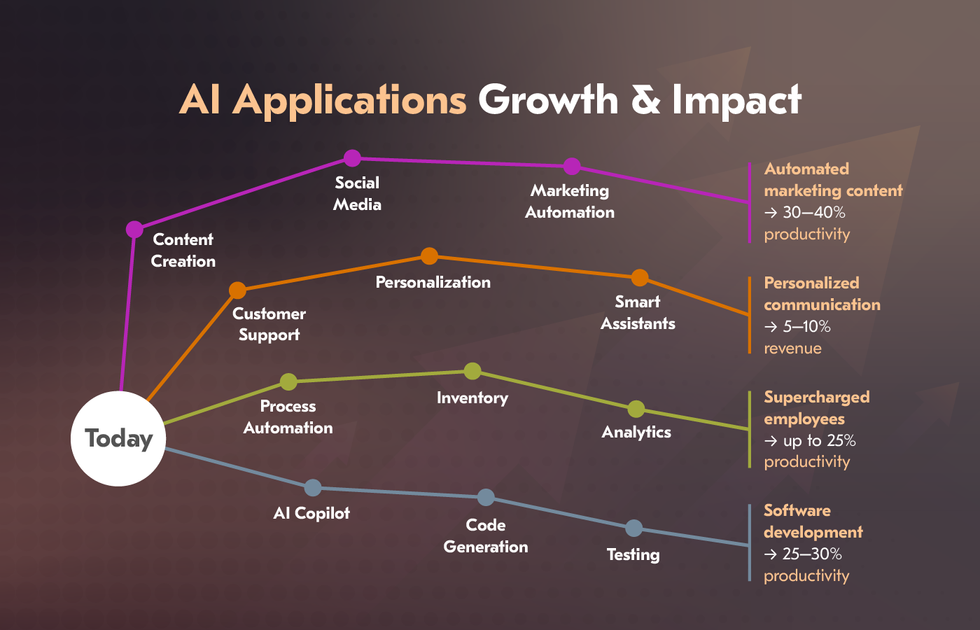
Manufacturing and Logistics
Toyota built an in-house AI platform that puts machine learning tools directly in the hands of factory workers, without requiring AI engineering expertise. The platform is deployed across all ten of Toyota’s car and unit manufacturing facilities in Japan and saves an estimated 10,000 hours of manual work annually.
Workers use it to build their own models for specific production problems: detecting adhesive application defects on back doors, flagging anomalies in injection molding machines [21], and monitoring die-casting equipment by analyzing up to 40,000 data points per production cycle. That last application contributed to a significant reduction in defects across Toyota’s die-casting operations. [22]
For businesses exploring process automation, RPA development with AI decision-making layers is often the most cost-efficient entry point into AI-driven operations. AI connectors reduce the integration effort significantly by providing pre-built connections to common enterprise systems.
How to Reduce AI Development Cost Without Cutting Quality
Reducing AI spending does not mean building less capable systems. It means making smarter architectural and operational decisions. The Goodfirms 2026 survey confirmed that 61% of respondents expect AI to reduce software project budgets by 10 to 25% through better tooling and processes [3]. Here is how you apply that in practice:
- Start with pre-trained models
Use existing foundation models via API before considering fine-tuning or custom training. This reduces initial cost by 60 to 80% and cuts time to market from months to weeks. Generative AI development built on foundation models typically costs a fraction of equivalent custom builds.
- Invest in data quality early
Clean, well-labeled data reduces model training iterations and cuts total AI implementation cost by 30 to 50%. Skimping on data preparation is the single most common source of blown AI budgets.
- Use prompt caching and model efficiency techniques
Anthropic’s caching capability offers 90% savings on cached input tokens. [23] At enterprise API usage levels, this alone can save $10,000 to $50,000 annually.
- Lock scope before development begins
Scope creep adds 10 to 25% to development costs. [3] A well-run discovery phase is the most cost-effective investment you will make.
- Consider nearshore or offshore engineering talent
Eastern European AI teams offer rates of $40 to $90 per hour versus $150 to $290 in North America, with comparable technical quality on many project types. This difference can cut your total build cost by 40 to 60%.
- Adopt ML development best practices from day one
MLOps pipelines, automated testing, and model registries reduce long-term maintenance costs significantly. Teams that skip this infrastructure pay for it with higher operational costs within 12 months of launch.
- Use agentic AI selectively
AI agents development is powerful but introduces cost complexity through multi-step tool calling and orchestration overhead. Design AI agents for specific, high-value workflows rather than broad general-purpose use.
Why Acropolium is the Smart Choice for AI Development
When budget efficiency matters, the partner you choose has to bring more than promises – they need a track record, a tested process, and a pricing model that doesn’t punish growth. Acropolium, being a top-rated software development company, checks all three boxes.
Acropolium has delivered 450+ applications over 22 years across various industries. Our approach to AI development covers every phase from brainstorming and proof of concept through to deployment and ongoing improvement, and our highly-skilled engineers build AI systems that run in production, processing millions of transactions monthly, where downtime costs real money and errors create regulatory problems.
Some successful AI projects crafted by Acropolium:
Real-time AI fraud detection for a digital bank (Sweden)
A fast-growing digital bank was running rule-based fraud detection that couldn’t keep pace with rising transaction volumes or increasingly sophisticated attacks. Acropolium built a unified platform covering payments, accounts, lending, and crypto trading in a single system, with a rules- and ML hybrid engine, behavioral analytics, automated case management, and AML/KYC compliance baked in. 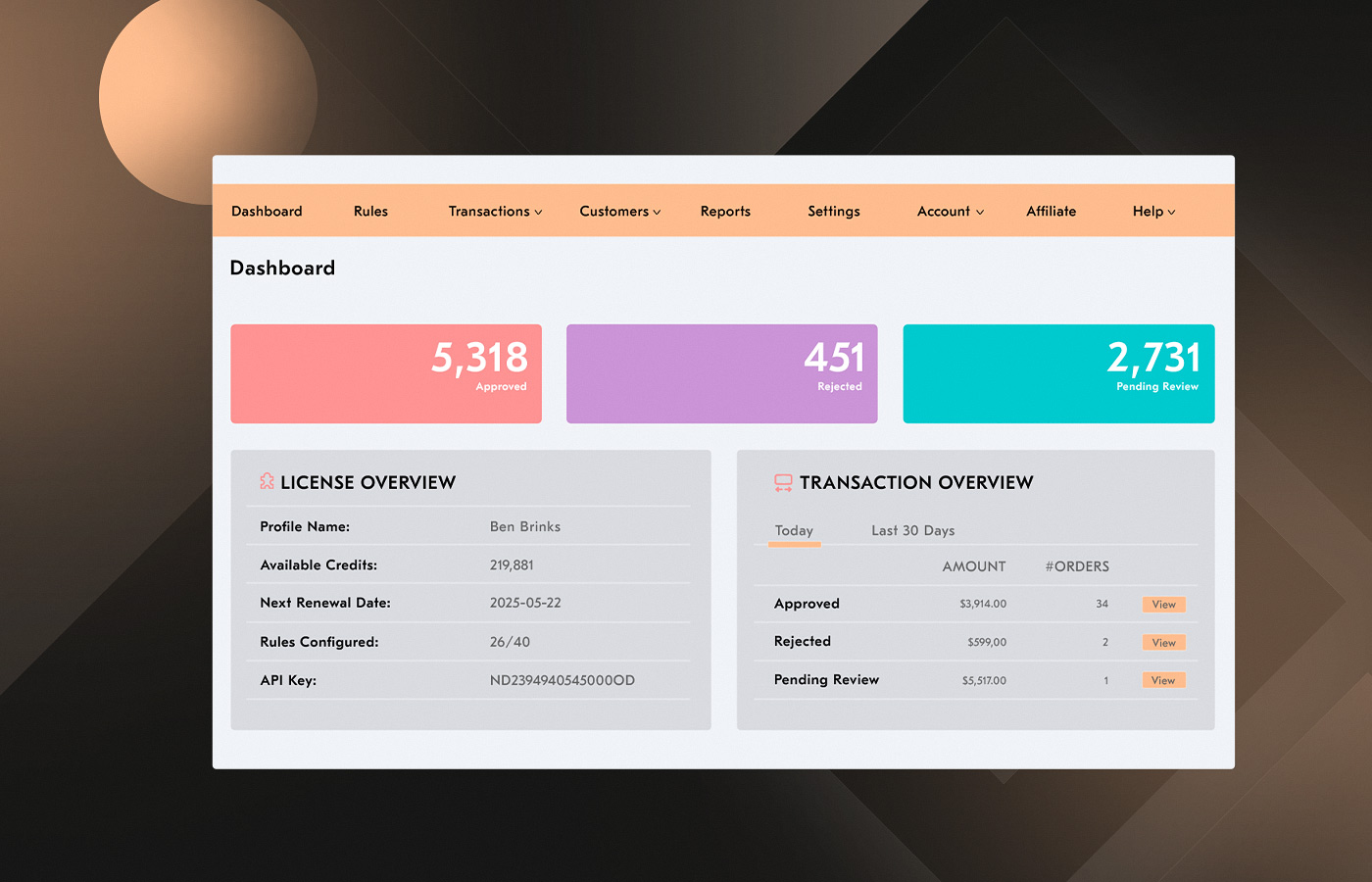
Outcome: 40% reduction in fraudulent transactions, 30% increase in operational efficiency, 25% decrease in compliance costs.
Legacy-to-SaaS migration with AI concierge for a Hotel Group (Italy)
A hotel group expanding through franchising was running an on-premise system that couldn’t share data across properties, broke during peak booking periods, and required manual patching at every location. Acropolium migrated the platform to a cloud-native SaaS architecture, built a multilingual AI concierge using NLP, and set up CI/CD pipelines that eliminated manual update downtime. 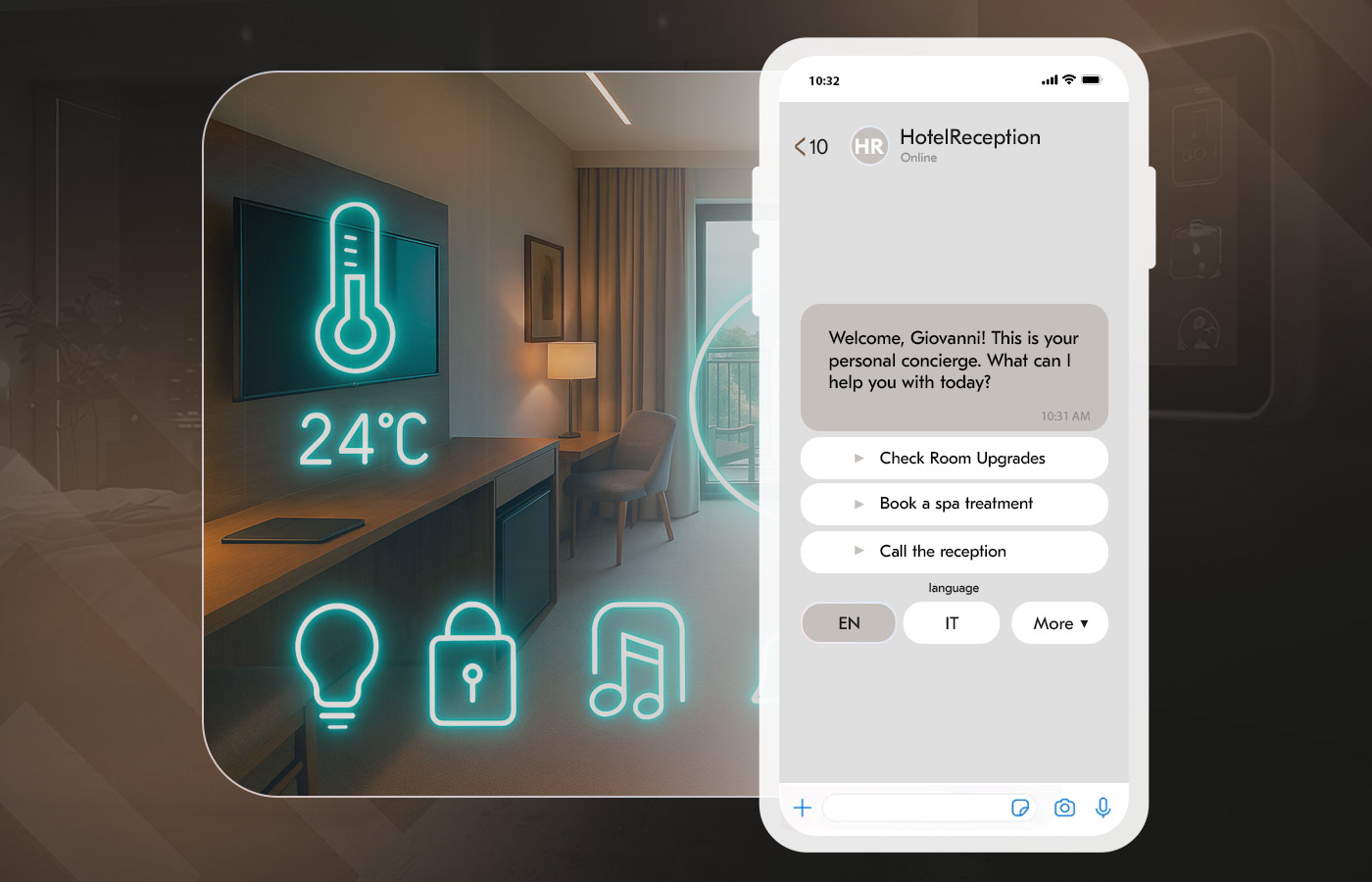
Outcome: guest satisfaction up 15%, operational efficiency up 30%, continuous updates now deploy without service interruption across all properties.
Predictive analytics for patient demand for a hospital group (Belgium)
A hospital needed to move from reactive resource planning to anticipatory workflows, predicting patient demand before it caused overcrowding or equipment shortages. Acropolium built an automated predictive analytics platform integrating ML algorithms for demand forecasting, interoperating with existing clinical tools while maintaining HIPAA and GDPR compliance. 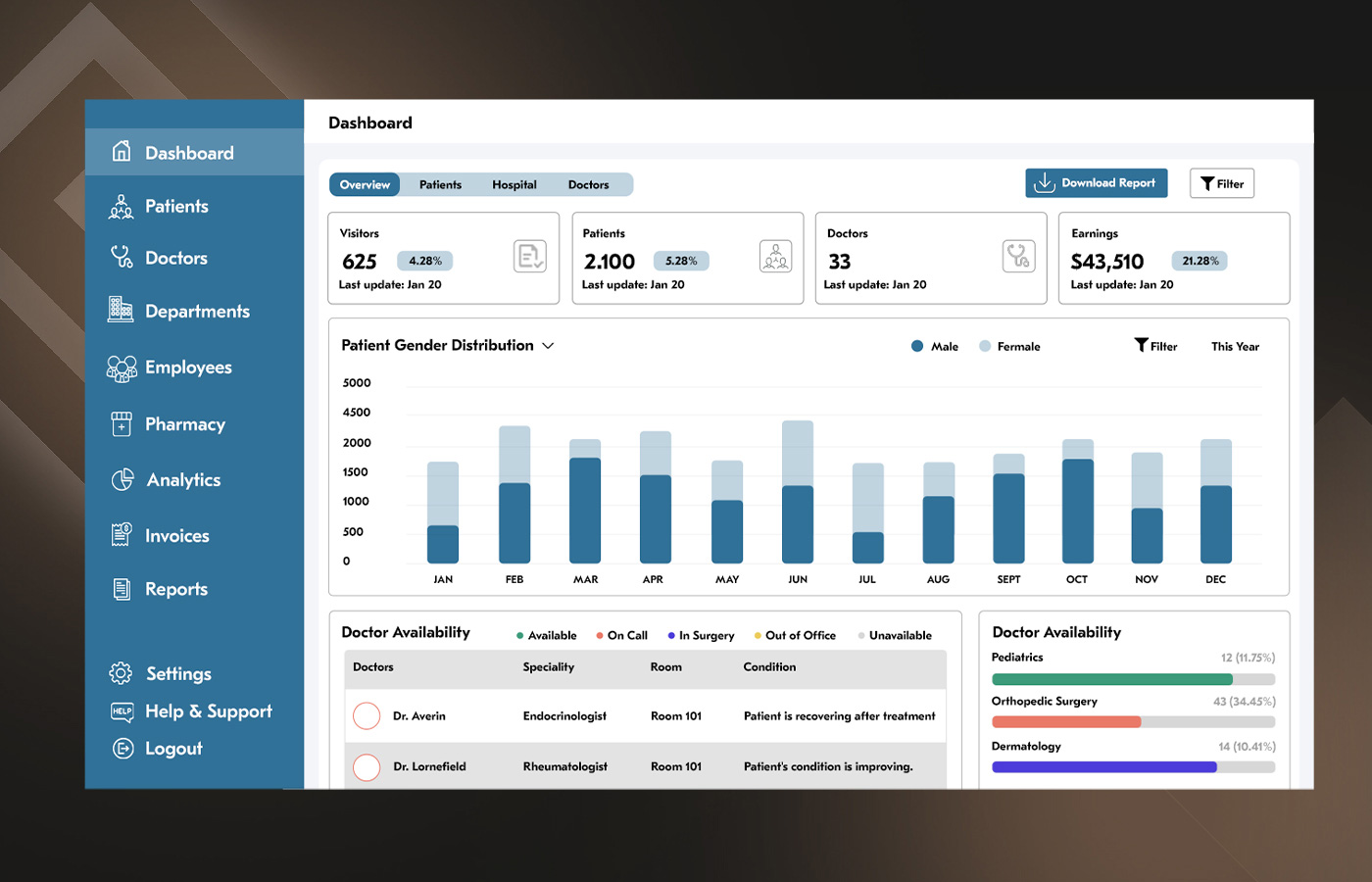
Outcome: Overall efficiency increased by 25%, 30% decrease in delays due to reduced patient wait times and faster access to medical care, and a 15% boost in employee satisfaction thanks to balanced workloads.
Final thought: In 2026, the question is no longer whether to invest in AI. It is whether your budget reflects the true cost of doing it well. The companies that get this right will not just spend less. They will build systems that work in production, deliver measurable returns, and create durable competitive advantages. Start with verified data, honest scope, and a partner who has done this before.
Contact Acropolium to get a clear AI development cost breakdown before any code is written, with risk assumptions and ROI benchmarks included.
Reference List
Gartner, Gartner Says Worldwide AI Spending Will Total $2.5 Trillion in 2026 https://www.gartner.com/en/newsroom/press-releases/2026-1-15-gartner-says-worldwide-ai-spending-will-total-2-point-5-trillion-dollars-in-2026
Gartner, Gartner Forecasts Worldwide IT Spending to Grow 10.8% in 2026, Totaling $6.15 Trillion https://www.gartner.com/en/newsroom/press-releases/2026-02-03-gartner-forecasts-worldwide-it-spending-to-grow-10-point-8-percent-in-2026-totaling-6-point-15-trillion-dollars
Goodfirms, Custom Software Development Cost Survey 2026 - What Startups and SMEs Need to Know https://www.goodfirms.co/resources/custom-software-development-cost-survey
Gartner, Why 50% of GenAI Projects Fail – And How to Beat the Odds https://www.gartner.com/en/articles/genai-project-failure
Gartner, Lack of AI-Ready Data Puts AI Projects at Risk https://www.gartner.com/en/newsroom/press-releases/2025-02-26-lack-of-ai-ready-data-puts-ai-projects-at-risk
Coherent Solutions, AI Development Cost Estimation, Pricing Structure & ROI, 2025 https://www.coherentsolutions.com/insights/ai-development-cost-estimation-pricing-structure-roi
SumatoSoft, A Complete Breakdown of AI Software Development Cost https://www.linkedin.com/pulse/complete-breakdown-ai-development-cost-2025-sumatosoft-ctxhf
Crescendo AI, How Much Do AI Chatbots Cost? Estimates for 2026 https://www.crescendo.ai/blog/how-much-do-chatbots-cost
ITRex, Assessing the Cost of Implementing AI in Healthcare https://itrexgroup.com/blog/assessing-the-costs-of-implementing-ai-in-healthcare/
Cleveroad, AI Agent Development Cost and Process, 2025 https://www.cleveroad.com/blog/ai-agent-development/
Ivchenko, O. (2026). AI Economics: Total Cost of Ownership Models for Enterprise AI – A Practitioner’s Framework. AI Economics Series https://hub.stabilarity.com/ai-economics-tco-models-for-enterprise-ai-a-practitioners-framework/
RTInsights, How Real-Time Data Helps Battle AI Model Drift https://www.rtinsights.com/the-industry-is-designing-ai-for-machines-not-for-humans-that-is-not-a-mistake/
GIS, Data Annotation and Labeling Market Analysis and Forecast to 2035 https://www.globalinsightservices.com/reports/data-annotation-and-labeling-market/
Brookings Institution, Counting AI: A blueprint to integrate AI investment and use data into US national statistics https://www.brookings.edu/articles/counting-ai-a-blueprint-to-integrate-ai-investment-and-use-data-into-us-national-statistics/
Independent, JPMorgan software does in seconds what took lawyers 360,000 hours https://www.independent.co.uk/news/business/news/jp-morgan-software-lawyers-coin-contract-intelligence-parsing-financial-deals-seconds-legal-working-hours-360000-a7603256.html
Reuters, Goldman Sachs launches AI assistant firmwide https://www.reuters.com/business/goldman-sachs-launches-ai-assistant-firmwide-memo-shows-2025-06-23/
Reuters, Goldman Sachs teams up with Anthropic to automate banking tasks with AI agents https://www.reuters.com/business/finance/goldman-sachs-teams-up-with-anthropic-automate-banking-tasks-with-ai-agents-cnbc-2026-02-06/
McKinsey, LLM to ROI: How to scale gen AI in retail https://www.mckinsey.com/industries/retail/our-insights/llm-to-roi-how-to-scale-gen-ai-in-retail
Tensor Strategy Group, Case Study: AI-Enabled Demand Forecasting and Inventory Optimization in Retail https://www.scribd.com/document/925621236/Casestudy-Walmart
Bain and Company, Retail and Gen AI: Now Scale Those Terrific Early Returns https://www.bain.com/insights/retail-and-gen-ai-now-scale-those-terrific-early-returns/
Google Cloud, Toyota shifts into overdrive: Developing an AI platform for enhanced manufacturing efficiency https://cloud.google.com/blog/topics/hybrid-cloud/toyota-ai-platform-manufacturing-efficiency
Toyota, Toyota Industries Corporation and Siemens cooperate on digital transformation for die casting https://www.toyota-industries.com/news/2021/04/12/005049/
Anthropic, Prompt caching with Claude https://claude.com/blog/prompt-caching