The more critical your application becomes to daily operations, the less tolerance you have for the cost of keeping it running.
US federal agencies spend up to 80% of their IT budgets maintaining legacy systems. It leaves almost nothing for new capabilities. Technical debt can consume significant IT resources and limit capacity for new initiatives. The gap between where enterprises are and where they need to be is real, measurable, and expensive.
Enterprise application modernization is how organizations close that gap. This guide walks through the full picture: what modernization entails, how to recognize when it’s overdue, how to plan and execute it without derailing operations, and how to measure its effectiveness.
The strategies, risks, and best practices covered here draw from 20+ years of enterprise software delivery, and modernization engagements across logistics, oil & gas, manufacturing, and beyond. That’s the experience Acropolium brings to every client’s engagement.
What Is Enterprise Application Modernization?
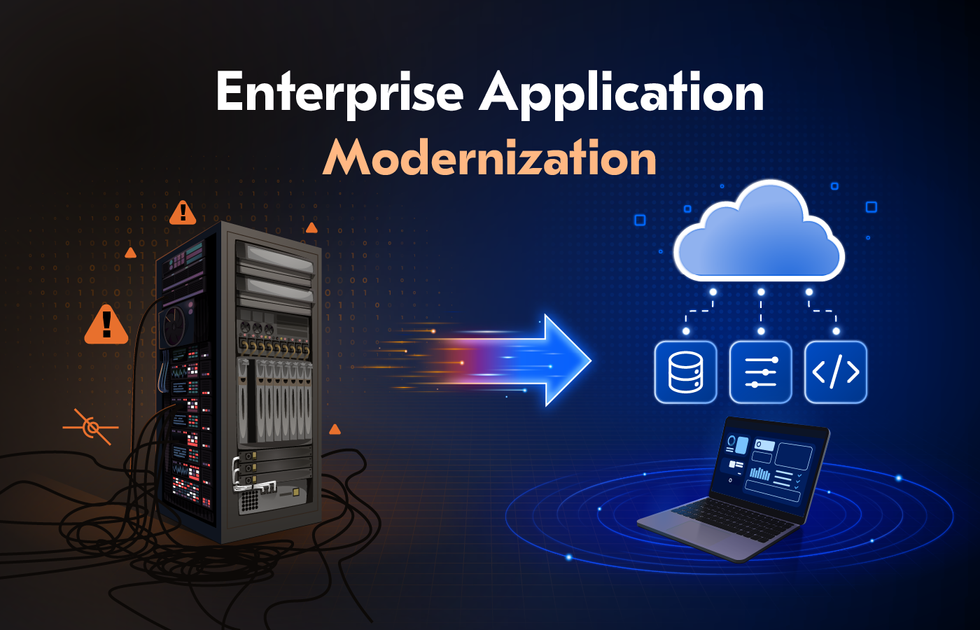
Enterprise application modernization is the process of updating, restructuring, or extending legacy software to meet current technical and business requirements, without necessarily rewriting it from the ground up.
Legacy enterprise applications tend to accumulate problems gradually. A system built in the early 2000s may still process transactions reliably, but struggle to scale under peak load, resist integration with modern APIs, or require specialized knowledge that fewer and fewer developers carry. None of those are reasons to replace the system outright. There are reasons to modernize it.
The goal of the enterprise modernization approach is software that handles today’s workloads, talks to the tools the business already depends on, and can be changed next quarter without a six-figure bill.
7 Signs Your Enterprise Needs Application Modernization
Most organizations don’t decide to modernize because they have a strategic epiphany. They decide because something broke, slowed down, or got expensive enough that ignoring it stopped being an option. The hard part is catching the signals before they turn into crises.
1. Rising maintenance costs
When a system starts consuming a disproportionate share of the IT budget just to stay operational, that’s a structural problem, not a temporary one. The pattern is consistent: the older the system, the more it costs to keep running, and the less it delivers in return. At some point, maintenance stops being an investment and becomes a drain.
2. Performance and scalability issues
A system that runs fine under normal load but degrades under peak demand will eventually fail at the worst possible moment. Legacy architectures were typically built for predictable, fixed workloads, whereas modern businesses operate under dynamic conditions. When performance issues start affecting operations, customer-facing services, or internal productivity, these issues quickly affect financial goals.
3. Integration failures
Enterprise software doesn’t operate in isolation. It connects to CRMs, ERPs, third-party APIs, partner systems, and data pipelines. When a core application struggles to exchange data reliably with surrounding systems, teams start building workarounds: manual exports, middleware patches, duplicate data entry. Each workaround adds fragility. Over time, the integration layer becomes as much of a liability as the application itself.
4. Security and compliance gaps
Legacy systems present a specific category of security risk that’s difficult to mitigate without architectural changes. Outdated dependencies, unsupported frameworks, and architectures that predate modern secure software development practices create exposure that patches alone can’t close.
5. Poor user experience
When employees need workarounds to complete routine tasks, or when customers abandon processes because the interface is slow or confusing, the impact on the cost is real. Even if it doesn’t appear on a maintenance invoice. Outdated UX can also be a retention issue: talent increasingly factors in tooling quality when they make employment decisions. Nobody wants to spend their day fighting software that belongs in a different decade.
6. Talent shortage
A 2023 EvolveWare report found that 81% of companies report difficulty hiring or retaining developers with legacy programming expertise. The pool of engineers who know COBOL, older Java frameworks, or proprietary enterprise stacks shrinks every year. When the people who understand how a system works retire or leave, institutional knowledge walks out with them, and the cost and risk of any future change increase significantly. Modernization is partly a knowledge risk management exercise.
7. Slow time-to-market
When deploying a new feature takes weeks of coordination and sign-off from multiple teams to push a minor change, the architecture is working against the business. Organizations that have modernized report a significantly shorter time-to-market. The competitive implication is straightforward: the longer a release cycle takes, the longer it takes to respond to market changes, customer feedback, or new opportunities.
Any one of these signals is worth attention. When several appear together, the case for modernization stops being a discussion and starts being a timeline.
Why To Invest in Enterprise App Modernization
Modernization is a business decision with measurable financial and operational consequences. The returns show up in operating costs, release velocity, customer retention, and competitive positioning, often within the first year.
Reason 1: Agility and faster time-to-market
Legacy architectures impose release cycles that few modern businesses can afford. Tightly coupled components, manual deployment processes, and fragile integration layers mean that shipping a new feature can take weeks of coordination and testing. In our transportation management system modernization project, adding AI-powered route optimization and real-time analytics to a legacy TMS gave the client capabilities that would have taken years to deliver on the old architecture. The modernized system by our team supported continuous feature delivery without the deployment freezes that the previous codebase required.
Reason 2: Improved customer experience
Slow interfaces, frequent downtime, and workflows that force staff to jump between disconnected tools all carry a customer-facing cost. In our hotel management system modernization project, an Italian hotel group replaced its on-premise legacy platform with a cloud-based SaaS system and AI concierge. Guest satisfaction scores rose by 15% and operational efficiency improved by 30%. The gains came from unifying data that had previously been siloed across properties.
Reason 3: Cost efficiency
Running a legacy system is expensive in ways that rarely appear in a single line item. Server infrastructure, specialized maintenance contracts, manual ETL work, and developer hours spent on workarounds all add up quietly. EY reports that 65% to 70% of its legacy application modernization contracts are now outcome- or gain-share-based, a pricing model that directly aligns service delivery with the client’s business results.
In our warehouse management system modernization for a European logistics provider, the client cut inventory holding costs by 20% and improved operational efficiency by 25%. Acropolium’s team eliminated the manual data reconciliation that had been consuming planner time every day.
Reason 4: Security and compliance
Outdated dependencies, unsupported frameworks, and architectures that predate modern security standards are difficult to patch into compliance. Modernization addresses security at the architectural level. In our custom API and data integration project, replacing a brittle, manually maintained integration layer with a secure, documented API architecture reduced exposure.
Reason 5: Scalability
Legacy systems were built for predictable, fixed workloads. When demand spikes, they degrade. Cloud-native architectures can scale with load, dynamically allocate resources, and maintain idle capacity sized for peak demand. For the e-commerce platform migration project, we moved a legacy retail platform to a modern architecture, allowing the client to handle traffic peaks that would previously have caused outages.
Reason 6: Innovation enablement
When engineering teams spend most of their time keeping aging infrastructure alive, little capacity remains for building new capabilities. Modernized systems create the conditions for AI integration, big data analytics, legacy ERP modernization, and IoT connectivity. Without the underlying infrastructure to support them, those capabilities stay on the roadmap indefinitely.
The pattern across industries is consistent: organizations that modernize reduce costs and recover the capacity to build. If you are evaluating what modernization could look like for your environment, our legacy software modernization services cover the full scope from audit through delivery. A free consultation is a practical starting point before committing to a direction, don’t hesitate to contact us.
Core Aspects of Application Modernization for Enterprises
Modernization touches more than code. A successful initiative requires deliberate decisions across five interconnected layers, and weakness in any one of them limits what the others can deliver.
Architecture: whether to decompose a monolith into services, how to define API contracts, and how to manage the complexity that distributed systems introduce.
Infrastructure: how compute, storage, and networking are provisioned, whether on-premise, cloud, or hybrid, and how deployments are managed across environments.
Data layer: how legacy schemas are restructured, how read and write workloads are separated, and how data quality is established as a foundation for analytics and AI.
Integration: how the application communicates with surrounding systems, whether through versioned APIs, event-driven messaging, or a centralized API gateway.
Security and compliance: how authentication, authorization, encryption, and audit logging are built into the architecture.
Each of these layers intersects with the others. One pattern we see repeatedly across modernization engagements is that organizations treat the five layers above as a sequential checklist. Architecture gets redesigned, infrastructure gets migrated, and then six months in, the team discovers the data layer was never properly assessed, and the new architecture is running on the same schema debt as the old one. The layers have to be planned together from the start.
How to Plan Enterprise Application Modernization
Audit legacy landscape
Before any architectural decision can be made responsibly, the current state of the portfolio must be documented precisely. That means inventorying every application, but the entire stack, including internal tools, middleware, and integrations that teams have quietly come to depend on. For each application, the assessment should capture:
Usage metrics and resource utilization (to identify underused or overprovisioned systems)
Maintenance cost and frequency of incidents
Security posture and compliance status
Business criticality and downstream dependencies
Technical debt and codebase health
Stakeholder interviews are as important as the technical audit. Business owners and operational teams often have knowledge about how applications are actually used that isn’t documented. Skipping those conversations leads to modernization plans that look correct on paper and break in practice.
Define business goals
Modernization without defined success criteria drifts. Scope expands, timelines slip, and at some point, the business loses confidence in the initiative. Not because the technical work is wrong, but because there is no agreed standard for whether it is right. Before a single line of architecture changes, the organization needs a baseline. From there, define what improvement looks like in measurable terms:
Infrastructure cost per transaction
Deployment frequency and lead time
Mean time to recovery
System uptime and SLA compliance
User satisfaction scores
Categorize each application
Not every application warrants the same treatment. Rather than full or partial legacy software modernization across the portfolio, most enterprises categorize applications into five strategic paths based on value, risk, and required effort:
Rehost: move the application to cloud infrastructure with minimal code changes, preserving existing logic while reducing data center dependency.
Replatform: make targeted adjustments to run on a cloud platform without a full architectural overhaul, capturing some cloud benefits at lower cost and risk.
Refactor: restructure the codebase to improve performance, maintainability, and portability.
Rebuild: redevelop the application from scratch using modern architecture, typically when the existing codebase is too degraded to extend cost-effectively.
Replace: retire the legacy system entirely and adopt a modern SaaS or commercial off-the-shelf product that covers the same business function.
Align stakeholders before execution
Modernization touches every part of the organization: IT, operations, finance, legal, and the business units that depend on the changing systems. Without explicit alignment across those groups, friction accumulates at every decision point.
Implement iteratively
The most reliable modernization programs run incrementally. The walk-run-fly model reflects this well. Start by modernizing one or two carefully selected applications to establish the path to production, validate the approach, and generate early ROI data. Then expand to a broader set while systematizing delivery. Then scale across the portfolio with automation and self-service tooling.
Build CI/CD and automated testing from day one
The value of a modern architecture depends entirely on the ability to change it reliably and frequently. That requires two things in place before go-live: automated testing coverage built alongside the modernization work and CI/CD pipelines that make deployment routine.
Monitor, measure, and optimize continuously
A modernized system left without active monitoring accumulates the same technical debt and operational opacity that made the legacy system a problem in the first place. Observability needs to be built in from the start:
Distributed tracing to understand how requests move through the system;
Centralized logging for consistent visibility across services;
Real-time alerting tied to the KPIs defined at the outset;
Dashboards that give technical and business stakeholders a shared view.
Post-deployment, the focus shifts to optimization. Compare actual performance against the baseline, identify bottlenecks, and run continuous improvement cycles.
5 Core Strategies of Enterprise Modernization
Choosing the right modernization strategy for each application is one of the highest-leverage decisions in the entire program. Pick the wrong one among legacy system modernization approaches, and you either over-invest in a system that didn’t need it or under-invest in one that did. The five strategies below cover the full spectrum, from minimal intervention to full replacement.
Rehosting
Rehosting moves an application from on-premises infrastructure to cloud infrastructure without changing the code, architecture, or runtime behavior. The application runs in the cloud, but it runs exactly as it did before. The primary gains are operational: lower infrastructure cost, reduced data center footprint, and access to cloud-native backup and disaster recovery capabilities. Rehosting is the right call when an application is stable and business-critical.
Replatforming
Replatforming involves making targeted changes to an application so it can run on a modern platform without touching the core architecture. A typical example is migrating from a self-managed database to a managed cloud database service. For applications that are functionally sound but run on expensive or difficult-to-maintain infrastructure, replatforming often delivers the best return on the effort invested.
Refactoring
Refactoring restructures the internal design of an application without changing its external behavior. What changes is how that logic is organized, how components communicate, and how the codebase is structured for maintainability and performance. It is particularly valuable when an application has accumulated years of technical debt but still has a long operational life ahead.
Rebuilding
Rebuilding means developing the application from scratch using modern architecture and technology. The existing system serves as a functional reference, but the codebase, data model, and infrastructure design are new. Rebuilding is the most expensive and highest-risk strategy.
Replacing
Replacing the legacy system entirely and adopting a modern SaaS or commercial off-the-shelf product that covers the same business function. Running a custom-built expense management system or a bespoke HR tool when mature SaaS alternatives exist is difficult to justify on cost or capability grounds. Replacing those systems frees engineering capacity for the applications that actually differentiate the business.
The table below maps each strategy against the key decision factors that most organizations consider when rationalizing their application portfolio.
| Strategy | Code changes | Architecture changes | Time to value | Cost | Best suited for |
|---|---|---|---|---|---|
| Rehost | None | None | Fast | Low | Stable apps on aging infrastructure |
| Replatform | Minimal | Minimal | Moderate | Low to medium | Functional apps with high operational overhead |
| Refactor | Significant | Partial | Moderate | Medium | Apps with heavy technical debt but long operational life |
| Rebuild | Complete | Complete | Slow | High | Critically degraded systems with strong business future |
| Replace | None | None | Moderate | Medium | Non-differentiating functions with strong SaaS alternatives |
Risks of Application Modernization for Enterprises And How Acropolium Mitigates Them
Outdated tech stack and integration risks
Legacy systems often run on frameworks, languages, and dependencies that are no longer actively maintained. That creates a compounding problem: the skills to work with the existing stack are increasingly rare. Another issue is the fragile integration built on top of that foundation.
At Acropolium, the technical audit phase maps every dependency and data flow before any architecture decisions are made. Where integrations need to be rebuilt, we prioritize API-first design with versioned interfaces.
Data integrity and loss during migration
Schema debt, inconsistent data formats, undocumented business rules embedded in legacy queries, and years of accumulated quality issues all become visible the moment data moves. Our approach runs data migration in parallel with the existing system. Validation pipelines compare source and target data continuously throughout the migration, catching discrepancies before they reach production.
Stakeholder misalignment
Technical teams move forward on architectural choices while business stakeholders are still evaluating priorities. We address this risk. Our teams establish a governance structure at the start of every engagement: defined decision rights, regular cross-functional reviews, and a communication cadence. Our main goal is to keep business and technical stakeholders aligned throughout the delivery process.
Monolith-to-microservices orchestration
The step of migrating monolith to microservices is one of the most technically demanding modernization paths. The failure mode we see most often is decomposing too aggressively and too quickly. Acropolium uses the strangler fig pattern as the default approach: new services are built alongside the existing monolith, taking over specific functions incrementally while the legacy system continues to run.
Budget overruns
Many run longer and cost more because the scope was underestimated at the start, hidden complexity surfaced mid-delivery, or the program attempted too much at once. Our budget discipline starts with the assessment phase. We scope each phase to deliver independent value. If priorities shift, the work completed to that point is not wasted.
Security and compliance gaps
Security in legacy systems is often perimeter-based and poorly documented. When those systems are refactored, migrated, or decomposed, the implicit security assumptions built into the original architecture must be made explicit in the new architecture. Acropolium holds ISO/IEC 27001 certification for information security management. Security in our company is a baseline operating standard applied across every engagement.
Proven Best Practices for Enterprise Application Transformation in 2026
The difference between modernization programs that deliver and those that stall rarely comes down to technology choices. It comes down to discipline in how the work is scoped, sequenced, and governed. The practices below reflect patterns from engagements across major industries.
Start with a discovery phase. Jumping straight from “we need to modernize” to architecture decisions is one of the most reliable ways to create expensive rework. A structured discovery phase, auditing the existing system, mapping dependencies, interviewing stakeholders, and establishing baseline metrics, takes time upfront and saves significantly more of it later. In our experience of following the enterprise app modernization trends, the complexity that surfaces in discovery is the kind that would otherwise appear mid-delivery, at a point when it is far more disruptive to address.
Iterate. The instinct to start fresh is understandable, but full rewrites carry a failure rate the industry has documented repeatedly. We default to the iterative approach on almost every engagement unless there is a specific, well-justified reason to do otherwise.
Establish CI/CD and automated testing early. Automated testing and deployment pipelines are not things to add once the architecture is stable.
Prioritize data integrity throughout. Data problems discovered after migration are expensive. Data problems discovered in production are more expensive to resolve. We have seen otherwise well-executed modernization programs lose organizational trust in weeks. The reason for it is the data quality issues surfaced after go-live that should have been caught during migration testing.
Plan for change management explicitly. New systems require new ways of working. Teams need training. Workflows need to be redesigned. In our view, change management is one of the most consistently underbudgeted workstreams.
If you are mapping out a modernization program and want a second opinion on your approach, scope, or sequencing, we are happy to take a look. Acropolium has led modernization engagements across logistics, hospitality, oil and gas, retail, and other enterprise-heavy industries for over two decades. The assessment is free.
Key Technologies Powering Enterprise App Modernization
Modern enterprise systems are built on a stack of interdependent technologies. The modernization path an organization takes determines which of them become relevant and in what order.
| Technology | What it enables |
|---|---|
| Cloud platforms (AWS, Azure, GCP) | Elastic compute, managed services, reduced infrastructure overhead |
| Containerization (Docker, Kubernetes) | Portable deployments, independent scaling, zero-downtime releases |
| Microservices architecture | Independent service deployment, isolated failures, faster release cycles |
| AI and machine learning | Predictive analytics, intelligent automation, faster codebase analysis |
| IoT integration | Real-time operational data from physical assets fed into enterprise systems |
| Big data analytics | High-volume data processing, separated analytical workloads, real-time insights |
None of these technologies operates in isolation. At Acropolium, we approach the technology stack as a layered system. Organizations that try to layer AI onto a legacy foundation without first modernizing the data layer spend significant budget and arrive at poor results.
How to Measure the Success of Enterprise Application Modernization
Measuring outcomes of modernization starts with knowing what you set out to achieve. Across every engagement, the metrics that consistently matter to leadership come down to four questions.
Did it reduce costs? Total cost of ownership is the baseline financial measure: infrastructure, licensing, maintenance, and support before and after.
Did it make the business faster? Deployment frequency and lead time from feature request to production are the clearest indicators of whether the architectural changes translated into real agility.
Is the system more reliable and secure? Uptime against SLA targets, mean time to recovery, and the number and severity of security incidents tell the operational story. A modernized system that goes down as often as the legacy one or introduces new security exposure has not delivered what it promised.
Are the people using it? User adoption rates and support ticket volume are the most honest signals of whether the modernization landed. A technically excellent system that staff work around, or that generates more support requests than the old one, has a problem that uptime and deployment metrics will not surface.
Track all four consistently, and compare against the baseline established before the program began. Without that baseline, the numbers after delivery exist in isolation, and isolated numbers are easy to present selectively and hard to act on.
How Acropolium Approaches Enterprise Application Modernization
Every engagement starts with discovery: a structured audit of the full application portfolio, dependency mapping, codebase health review, and stakeholder interviews across business and technical teams. From there, we build a roadmap where each decision is tied to a business objective and a measurable outcome, then deliver iteratively with CI/CD and automated testing in place from the first sprint, and business stakeholders involved throughout.
Over 20 years, we have run modernization engagements across logistics, hospitality, oil and gas, retail, fintech, healthcare, and construction. Acropolium holds ISO 9001:2015 certification for quality management and ISO/IEC 27001 for information security, meaning security is a baseline standard across every engagement. Four Fortune 500 clients, five contracts in enterprise development services exceeding 10 years, and 450+ delivered projects reflect the kind of trust that only comes from consistently getting this work right.
Modernization is one of the highest-stakes decisions an enterprise makes. If you want a frank assessment of your current landscape, a realistic view of what modernization would involve, and a team that has done it across industries, the first conversation is free.