Why Generic CRMs Fail Logistics Teams
Universal CRM platforms work properly for companies that sell something, track leads, close deals, and move on. That approach is applicable to software subscriptions, real estate, or consulting, but it can hardly suit the logistics and transportation industry.
In a logistics business, a “customer” may be a shipper you’ve served for three years across hundreds of lanes or a freight broker you’re negotiating spot rates with weekly. Deals don’t close and disappear, but evolve into long-running operational relationships with SLAs, delivery windows, carrier contracts, and claims to manage.
Generic CRMs don’t serve any of that. They can’t connect to your transportation management system, see your active loads, flag a customer who’s had three damaged shipments this quarter, or alert your sales rep that a key account’s volume dropped 40% last month. You end up with a traditional CRM that is almost useless for your team and return to spreadsheets to run your business operations, frequently missing revenue because of blind spots.
That’s why CRM logistics software adoption is accelerating, and why the off-the-shelf vs. custom debate is more heated than ever. The global logistics CRM software market is forecasted to reach $7.8 billion by 2033, growing at a CAGR of 9.8% compared to 2024 data. Companies are ready to invest in logistics technology purpose-built to handle the unique logistics complexities of supply chain operations that generic software can’t.
In this guide, we’ll take a closer look at the tasks CRM in logistics needs to handle, feature-rich platforms worth using in 2026, their cost, and situations when none of them will be enough.
What Is CRM in Logistics and What Problems Does It Solve
CRM in logistics goes beyond “contact database.” A logistics CRM is a specialized platform that manages the full spectrum of commercial and operational customer relationships, including prospecting shippers, retaining carriers, coordinating quotes, tracking service performance, and automating follow-up customer interactions across every touchpoint.
In a freight-focused logistics business, this spans more relationships than most industries. Shippers, consignees, freight brokers, carriers, dispatchers, customs agents, and warehouse operators interact with your service in different ways at different times. A transportation CRM is the connective platform that keeps all those relationships visible, documented, trackable, and actionable.
The best CRM for the logistics industry tackles multiple tasks:
Consolidates customer data. Without a centralized system, customer history lives in email threads, driver notes, billing software, and someone’s memory. A logistics CRM solution gathers contact records, shipment history, rate agreements, complaint logs, and renewal dates in one searchable place. Thus, logistics professionals have instant access to the information they need.
Automates follow-up and protects revenue. Freight sales processes move fast. If a prospect requests a quote on a lane and your team doesn’t follow up within hours, a competitor will. Sales management tools in a logistics CRM automate follow-up sequences, flag aging opportunities, and keep sales pipeline visibility sharp enough to catch revenue leaks early.
Monitors customer health in real time. Volume fluctuations, SLA breaches, and claim patterns are early warning signs of churn, but only if you can see them. CRM in logistics and supply chain management connects operational data to relationship data, so your account management team can identify trends act on signals before a logistics customer walks away.
Brings order to carrier relationships. CRM for freight brokers specifically needs to track carrier capacity, lane preferences, performance scores, and service agreements. Without dedicated tooling, brokers rely on whiteboards, group texts, and tribal knowledge that disappear if an employee resigns.
Unifies disconnected systems. A logistics management system only fulfills its potential when it syncs with existing systems. When quoting, booking, and consistent communication with customers live in isolated silos, every handoff costs time and accuracy across the entire supply chain.
Key Features a Logistics CRM Must Have
Logistics operations have specific requirements that some CRM platforms treat as secondary or ignore entirely. When choosing the right CRM software for logistics, you need to define the capabilities that will have a direct impact on your commercial performance. The following functions are the bare minimum your pipeline CRM system should have.
Shipment and load tracking integration. A logistics CRM integration with the transportation management system or dispatch system ensures you have live shipment status directly in the customer record. Delivery tracking data means that when a shipper calls for an update, the support or sales team has the answer on the same screen without switching between platforms.
Lane and rate management. A transportation CRM must store and surface lane-specific pricing at the account level. Rate history, contract negotiations, accessorial charges, and market benchmarks belong in the customer profile, accessible during any client conversation without digging through email chains or shared drives.
Multi-party relationship mapping. A single shipment typically involves a shipper, a consignee, a carrier, a broker, and a dispatcher. Each of them has a different role and authority levels. The CRM needs to reflect that structure accurately, distinguishing decision-makers from operational contacts rather than collapsing everyone into a flat contact list.
Quote-to-contract workflow automation. CRM software for logistics should carry an inquiry through to a signed rate agreement without manual re-entry at each stage. That includes auto-generating quotes, routing them for approval, logging acceptance or rejection, and triggering onboarding sequences automatically.
Carrier and broker profile management. CRM for freight brokers and 3PLs requires carrier profiles that go beyond basic contact details. It is helpful to have MC numbers, insurance expiry, preferred lanes, on-time performance by route, and payment terms stored at hand.
Customer health and retention dashboards. Volume trends, SLA compliance rates, claim frequency, and satisfaction scores need to surface actionable insights in the CRM daily. They are of little help when compiled into quarterly review decks after the relationship has already deteriorated. Operations teams and account managers need to act on problems early only when the data is visible early.
TMS and ERP integration. The best freight CRM software operates as part of connected business systems. Tight logistics API integration with platforms like McLeod, MercuryGate, or Oracle TMS, alongside ERP systems handling billing and accounts payable, ensures your data is consistent across the operation. Existing CRM workflows can also be preserved during migration.
Document management. Bills of lading, rate confirmations, carrier contracts, and claims documentation should be attached directly to the relevant shipment or customer record and retrievable in seconds. Documents stored elsewhere create delays and compliance issues that affect service delivery across the entire supply chain.
Pipeline and forecasting tools. Freight revenue forecasting is complicated by volume fluctuations tied to market conditions, fuel prices, and shifting customer demand. A pipeline CRM for logistics should model the pipeline by lane, mode, and customer segment. Therefore, leadership gets not just a list of open deals but accurate forward visibility into complex sales processes.
Mobile Access. Dispatchers, drivers, and field sales representatives work away from a desk. So, they need a CRM that is always within easy reach to capture data and make decisions at the dock, on the road, during shipper visits, at carrier yards, and between stops.
Benefits of Using CRM in Logistics
If you choose a good logistics CRM platform aligned to your business models and operational needs, you’ll notice results in more than one place at once. Retention, sales management, carrier relationships, and forecasting accuracy improve when the right data is visible to the right people at the right time. For most freight operations, the numbers speak for themselves.
Higher retention rates are the clearest starting point. Businesses can generate approximately $3.10 in value for every $1 invested in CRM, although actual returns vary depending on implementation, user adoption, data quality, integrations, and the effectiveness of the company’s sales and customer-service processes. In freight, where a single shipper account can represent millions in annual revenue, holding one account for an additional year covers the system cost many times over.
Stronger sales performance is another benefit of using CRM in logistics. Sales management tools within a logistics CRM can improve operational efficiency across lead management, customer interactions, and follow-up processes. For logistics sales teams specifically, that improvement comes from tighter pipeline discipline, fewer missed follow-ups, and faster quote turnaround. These are the areas where freight operations have historically leaked revenue through manual processes and fragmented tooling.
Beyond sales performance, a centralized logistics CRM software can speed up business operations. When customer information, shipment history, and pricing are locked in separate systems, every rep wastes time reconciling records instead of selling or solving problems. Eliminating repetitive tasks through workflow automation solves that at scale, while improved customer service follows naturally from having complete data in one place.
Businesses using transport and logistics CRM also report better market responsiveness. Live lane volume data and carrier capacity signals allow commercial teams to manage leads, reprice, and reallocate ahead of competitors still generating reports manually. The ability to identify trends early is a huge competitive advantage.
Carrier relationships benefit as well. CRM for freight brokers and asset-light operators that tracks carrier performance, capacity commitments, and payment history provides the foundation for preferential treatment in constrained markets. Consistent communication, documented through a CRM, builds the trust that carriers reward with priority access.
Finally, using logistics CRM solutions, leadership can manage teams and forecast revenue efficiently. Deal stages, follow-up activity, and the sales team’s performance are visible in real time. With freight volumes feeding directly into pipeline CRM data, leadership can plan capacity and staffing around real numbers.
Best CRM Options for Logistics Companies
No two logistics workflows or business models are identical, which means no single CRM is the right answer for everyone. A freight brokerage running high-volume spot transactions has different priorities than a regional carrier managing long-term shipper contracts.
When looking for the best CRM for logistics companies in 2026, you have probably come across the following names. Check the info below to learn more about their features, pros and cons, as well as prices.
HubSpot CRM
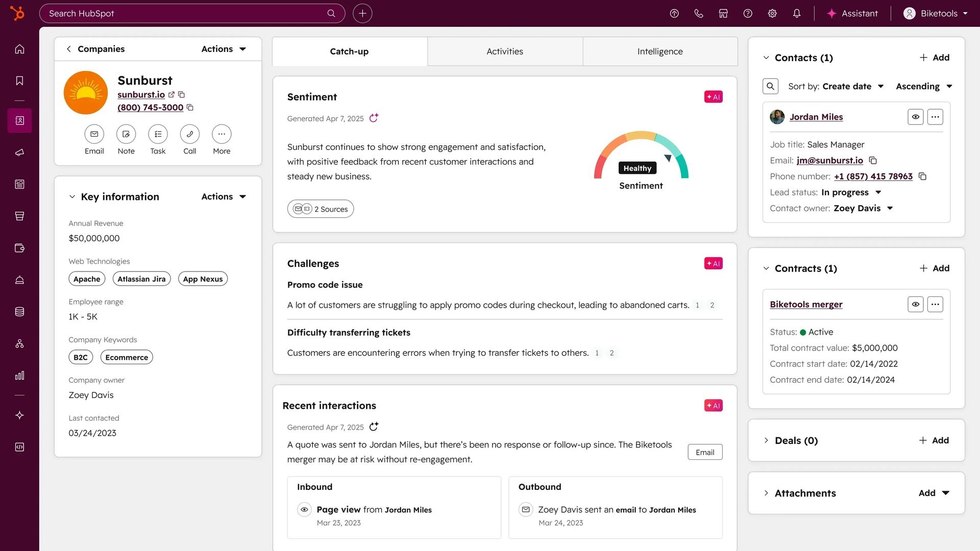
Price: Free plan available; paid tiers from $15/user/mo (Starter) to $120+/user/mo (Enterprise).
G2 Rating: 4.4/5
| Pros: | Cons: |
|---|---|
| • Useful free entry tier • Strong marketing automation on paid plans • High customizability • Large integration ecosystem | • No freight-native data model • TMS integration requires middleware • Few industry-specific features for high-volume or carrier-heavy operations |
HubSpot is a practical starting point for small to mid-sized logistics businesses that need a logistics CRM up and running quickly. Its free tier covers customer management, deal tracking, and email sequences, while paid tiers layer in pipeline CRM customization and reporting. Workflow automation helps operations teams reduce repetitive tasks, and it connects to a transportation management system via Zapier or a native connector.
It is possible to configure lane records, carrier contacts, and load-related activity without heavy development work. The ceiling becomes visible once freight volumes grow and carrier network complexity increases. HubSpot doesn’t model those relationships natively, and every workaround adds maintenance overhead for logistics professionals.
Pipedrive
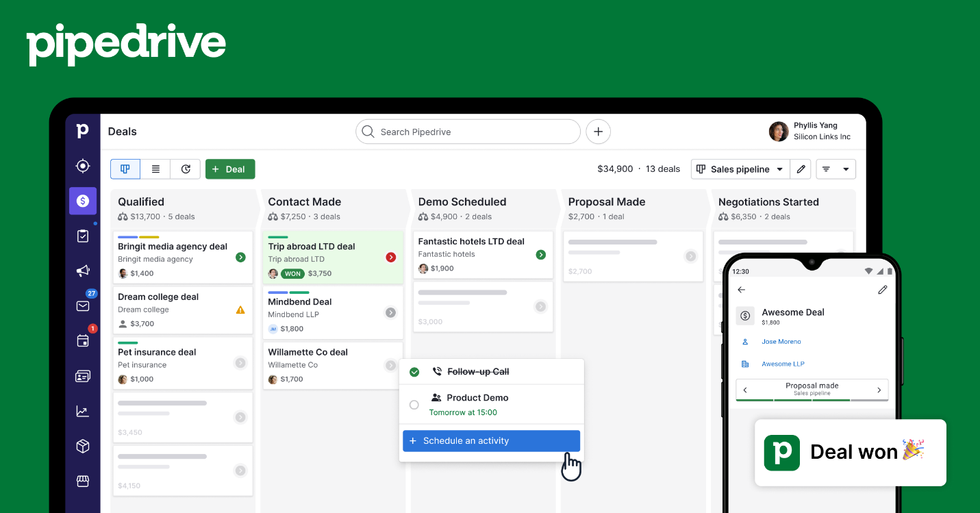
Price: From $14/user/mo (Essential) to $79/user/mo (Enterprise).
G2 Rating: 4.3/5
| Pros: | Cons: |
|---|---|
| • Best visual sales pipeline interface in the category • Strong mobile app • Competitive pricing • Solid workflow automation features | • Main focus on sales management • No built-in delivery tracking or carrier management • TMS integration requires custom work |
Pipedrive was ranked #6 on G2’s Best Sales Software Products list for 2026. This recognition is grounded in usability. Thanks to visual deal boards, logistics professionals on sales teams can track and manage leads, lane opportunities, shipper prospects, and renewal conversations at a glance.
The automation is solid, and the mobile app holds up in the field. The tradeoff is that Pipedrive stays firmly on the commercial side. If you need tight logistics CRM integration with a transportation management system or live shipment data visible inside the customer record, you have to build or purchase those connections separately.
Zoho CRM
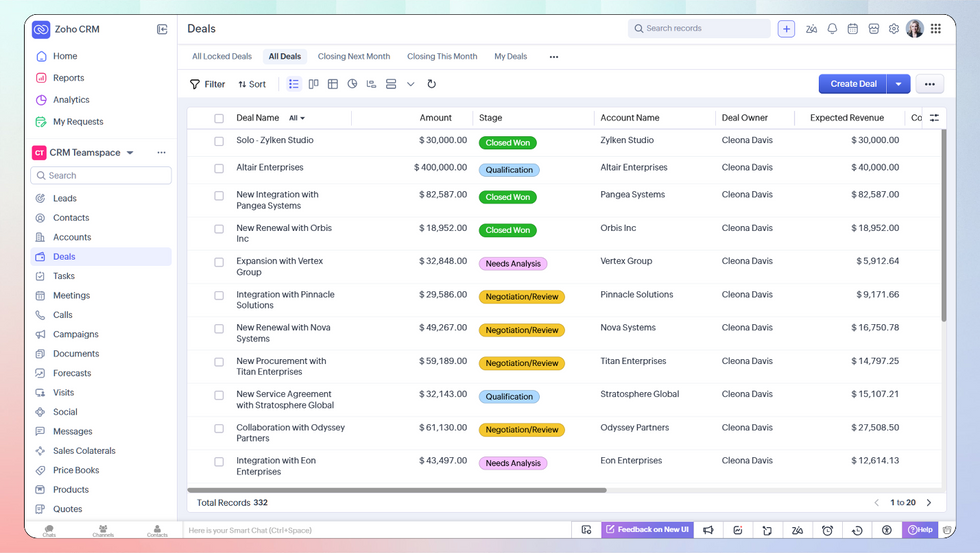
Price: Free version available; paid plans from $14/user/mo (Standard) to $52/user/mo (Ultimate).
G2 Rating: 4.1/5
| Pros: | Cons: |
|---|---|
| • CRM, Desk, Books, Analytics under one vendor • Strong API connectivity to existing systems • Highly configurable • Competitive pricing | • Interface lacks visual polish • Requires time to approximate freight-specific workflows |
Zoho’s appeal for the logistics and transportation industry is its breadth. The full suite covers most of a freight company’s business functions within one ecosystem. Its logistics CRM software capabilities include strong workflow automation, good API connectivity, and configurable layouts that can approximate freight-specific logistics workflows given sufficient setup investment.
The interface requires patience, and the configuration may tire some users. Still, for cost-conscious operators, Zoho delivers more industry-specific features per dollar than most alternatives at its price point.
Salesdash
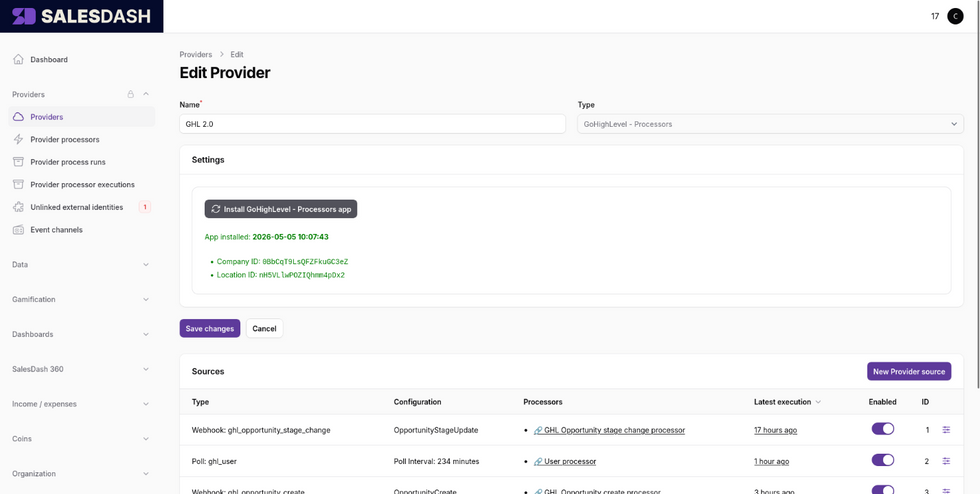
Price: From $59/user/mo.
G2 Rating: 4.6/5 (limited review base)
| Pros: | Cons: |
|---|---|
| • Freight-native data model • No configuration required for core workflows • Carrier and load management tracking out of the box • Follow-up automation tuned to complex sales processes | • Narrow integration ecosystem • Primarily suited to freight brokers and agents rather than carriers or 3PLs |
Salesdash is one of the few CRM for freight brokers that requires no translation between what the software does and how freight sales processes work. Shipper profiles, carrier networks, lane-based quoting, and follow-up cadences structured around brokerage workflows are present by default.
Logistics professionals at freight brokerages and agencies will find that Salesdash reflects their day-to-day more accurately than any general-purpose platform. The caveat is scope. It is aimed at brokerage sales, so organizations with broader supply chain operations and customer management needs may find it limiting.
Salesforce + Logistics Cloud
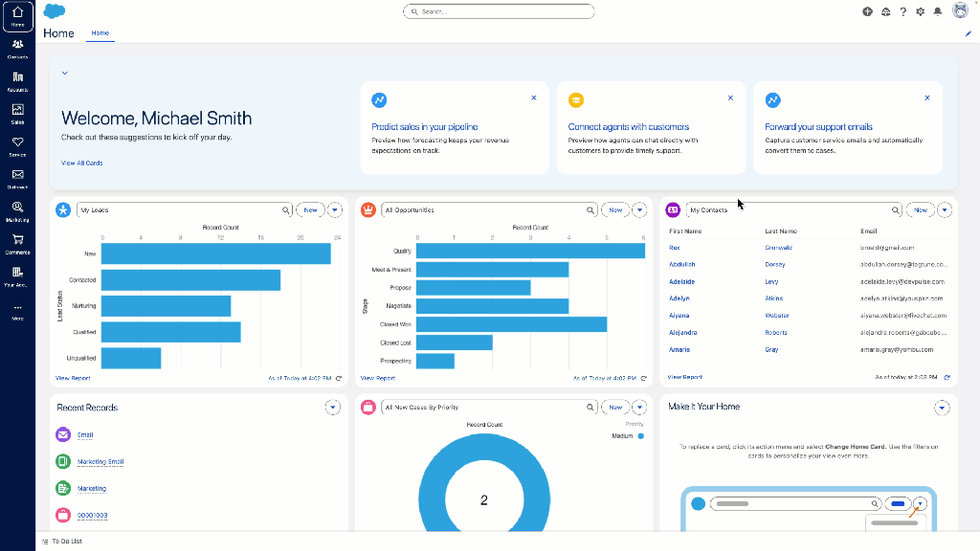
Price: From $25/user/mo (Starter) to $165+/user/mo (Enterprise); Logistics Cloud licensing is additional.
G2 Rating: 4.5/5
| Pros: | Cons: |
|---|---|
| • Most capable pipeline CRM at enterprise scale • Dedicated Logistics Cloud module with delivery tracking, carrier management, and supply chain analytics • Extensive customization and integration options • Strong campaign management and actionable insights | • High price • Implementation complexity • Requires dedicated admin resources • Multi-month deployment timelines |
Salesforce is the leading CRM software for logistics industry at enterprise scale, and the Logistics Cloud module adds industry-specific features that general-purpose CRM platforms cannot match. You get shipment visibility, carrier management, load management, dock scheduling, and actionable insights within a single environment. The platform integrates natively with transportation management system solutions and can connect to tools like Microsoft Dynamics for a fully unified business systems stack.
For large 3PLs, carriers, and freight forwarders with complex sales processes and extensive service agreements, it is the most complete option available. The investment reflects that position. A full Salesforce + Logistics Cloud deployment is a six-figure, multi-month project that requires ongoing administration. It fits organizations that have outgrown every other option, not those looking for a fast commercial win.
Comparison Table
Best CRM for Logistics Industry
| CRM /Feature | HubSpot | Pipedrive | Zoho CRM | Salesdash | Salesforce + Logistics Cloud |
|---|---|---|---|---|---|
| Freight-native data model | No | No | Partial | Yes | Yes (Logistics Cloud) |
| TMS integration | Via middleware | Via middleware | Via API | Limited | Native |
| Carrier management | Basic | Basic | Moderate | Yes | Yes |
| Pipeline management | Strong | Very strong | Strong | Good | Strong |
| Customizability | High | Moderate | High | Low | Very high |
| Mobile app | Good | Very good | Good | Good | Good |
| AI & automation | Good | Moderate | Good | Basic | Very strong |
| Pricing (per user/mo) | Free–$120+ | $15–$99 | $14–$52+ | $45–$65 | $150–$300+ |
| Best for | SMB logistics | Sales-first teams | Budget-conscious | Freight brokers | Enterprise 3PL/carrier |
How Much Does a Logistics CRM Cost
Logistics CRM software pricing varies depending on the complexity of your operation and the software you buy to tackle it. Here’s an approximate breakdown of costs for you to plan your expenses.
Off-the-shelf SaaS. Entry-level plans from HubSpot, Pipedrive, and Zoho run $14–$50 per user per month. Teams of 10–20 users can expect $3,000–$12,000 annually for a solid mid-tier plan, plus integration and implementation costs. Enterprise tiers (Salesforce, HubSpot Enterprise) climb to $100–$300+ per user per month, and large logistics organizations often spend $100,000–$500,000 annually once professional services, custom integrations, and training are factored in.
Industry-specific platforms. Salesdash and similar freight-first tools typically land in the $45–$65 per user per month range. For a 20-person brokerage, that’s $10,800–$15,600 per year. The price is reasonable if the software caters to your business needs and simplifies the full logistics workflows.
Custom CRM development. Custom-built logistics CRM solutions require a larger upfront investment – typically $80,000–$350,000 depending on scope and complexity. However, in this case, you don’t have to cover per-seat licensing fees. Generally, the total cost of ownership often beats enterprise SaaS over a 3–5-year horizon. More importantly, a tailor-made system gives you a data model, integrations, and workflows your operation requires.
The true cost of the wrong CRM rarely shows up on a pricing page. But you’ll notice it in hours lost re-entering data across disconnected existing systems, broken service delivery workflows, missed follow-ups, and silent logistics customer churn.
When Off-the-Shelf CRM Is Not Enough
Generic CRM platforms are created to serve the broadest possible market. That works well enough for companies with standard sales processes and simple pipelines. Logistics is neither. When your operation runs on lanes, loads, carriers, and tight delivery windows, you’ll quickly notice the limits of a traditional CRM. If the following apply, custom CRM development may be the right move.
Your workflows don’t fit any template. If your team has built workarounds for every major CRM task, e.g., custom spreadsheets for lane management or external tools for carrier tracking, your current CRM can’t satisfy your operational cycle.
Integration causes problems. Logistics technology integration with a transportation management system, ERP, or warehouse management system should be tight and real-time. If your team manually reconciles records between existing systems, the architecture isn’t fit for purpose.
There are many redundant features. If you pay $200/user/month for Salesforce while your team uses 15% of its features, and still can’t see real-time carrier capacity, it is a clear signal you need bespoke tools.
Data model limitations hamper growth. Traditional CRM platforms model the world as companies, contacts, and deals. Logistics and transportation industry operations also include lanes, loads, carriers, modes, accessorials, and claims. When your data is forced into the wrong model, you get unreliable insights and incomplete reports, and your sales team’s performance suffers accordingly.
Compliance and data security inconsistencies. Enterprise shippers increasingly require logistics professionals to meet specific data handling standards for service agreements. A custom system grounded in your security model can meet those requirements, while general solutions may cause issues.
Scaling constraints. Per-seat CRM pricing can become a meaningful budget line as you grow from 20 to 200 users. A custom system’s cost doesn’t scale linearly when more experts join your operations teams.
If two or more of these apply to your logistics business, you should seriously think about custom CRM development services.
How Acropolium Builds Logistics Software
Acropolium has been offering transportation and logistics software development assistance for over 20 years. With 455+ delivered projects and deep domain expertise in fleet management, dispatch, transportation management system platforms, and supply chain operations, our engineers understand how to build logistics solutions that logistics professionals can use effectively.
We always start with a discovery phase to map out workflows that align with how clients really manage their business processes. Seasoned engineers work directly with dispatchers, account managers, and operations teams to understand data flows, decision-making stages, and desired outcomes. We pair robust backend development services with the core integrations for logistics ecosystems – TMS platforms, ERP systems, telematics providers, and third-party data feeds.
Whether you need custom tools for certain tasks, full-scale enterprise software development for a complex multi-entity operation, or legacy software modernization of an aging CRM that’s holding your operation back, the Acropolium team builds to your requirements.
Here’s what that looks like in practice.
SaaS Fleet Management Platform for a Logistics Provider
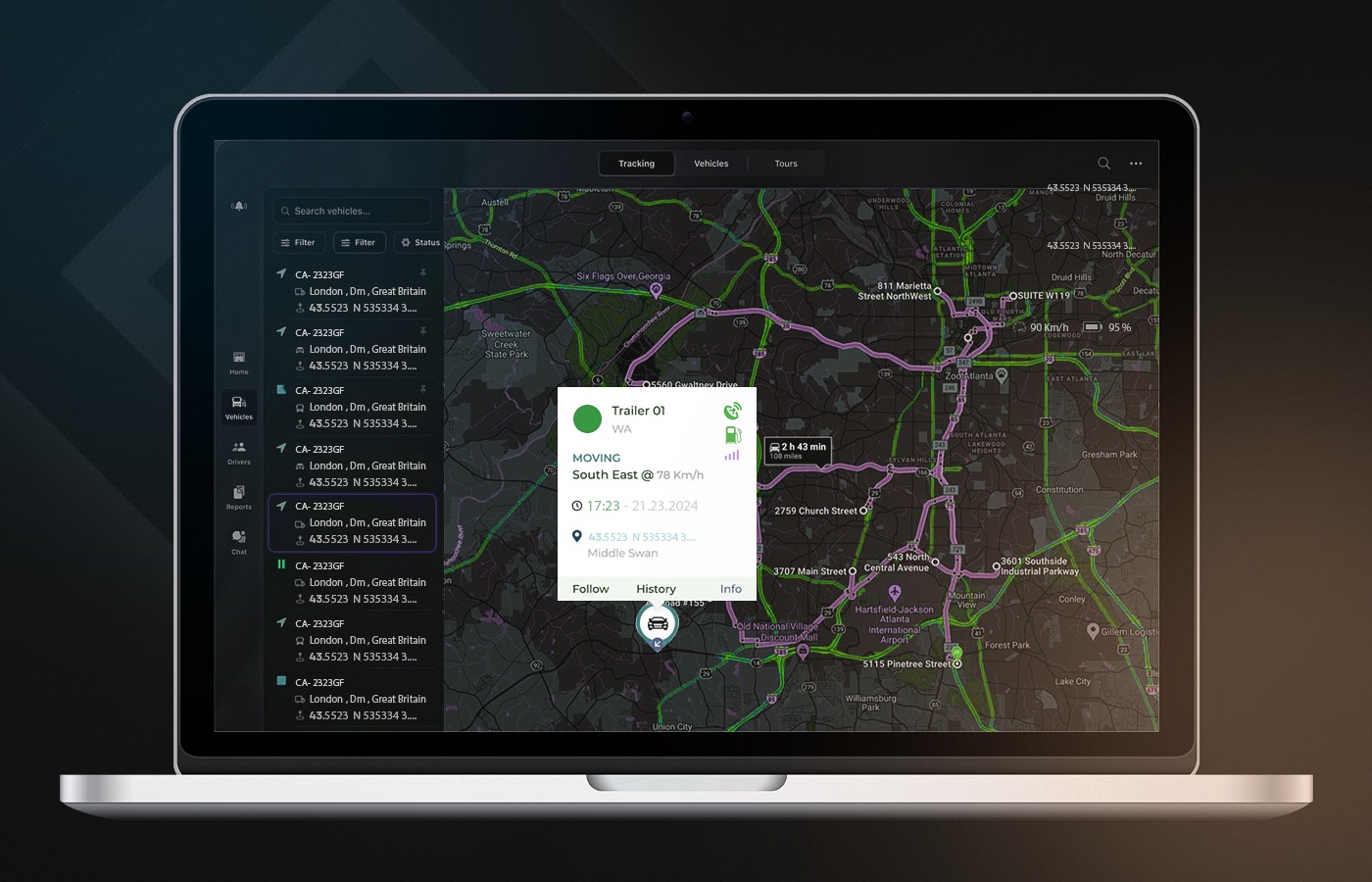
A US-based logistics company (500–1,000 employees) needed a full-featured fleet management SaaS to replace fragmented manual processes. The platform had to cover real-time GPS delivery tracking, predictive maintenance alerts, fuel monitoring, driver behavior analysis, and analytics – accessible to logistics operators of any size on a subscription basis.
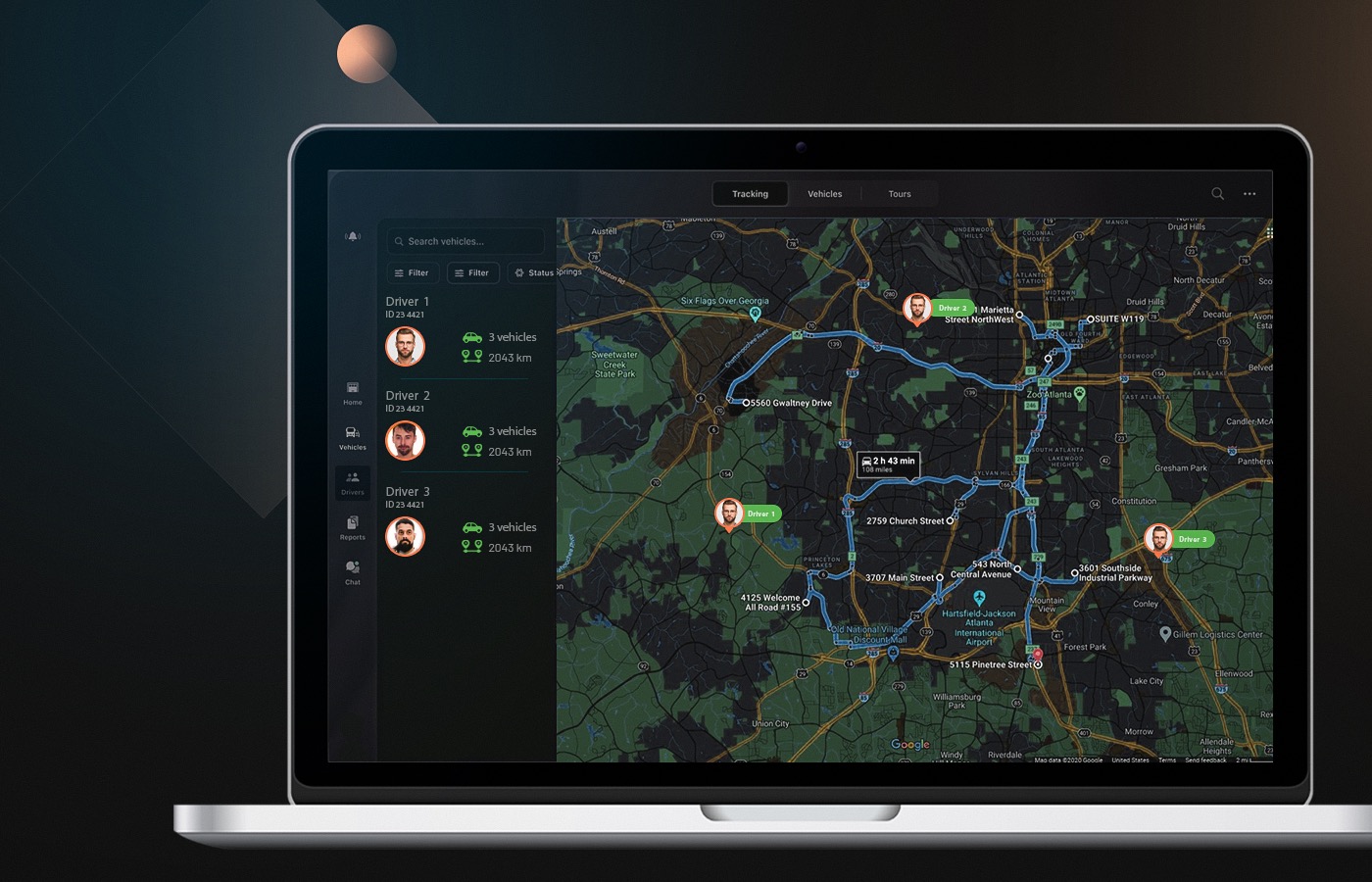
Acropolium built the SaaS fleet management platform for a logistics provider, using Python, Django, Vue.js, PostgreSQL, and AWS. There were 7 members in the team, who fulfilled the task within 21 months.
In the end, the client got a 31% reduction in delivery time, a 14% decrease in fuel consumption, and a 28% increase in customer satisfaction scores.
Trucking Dispatch System Modernization
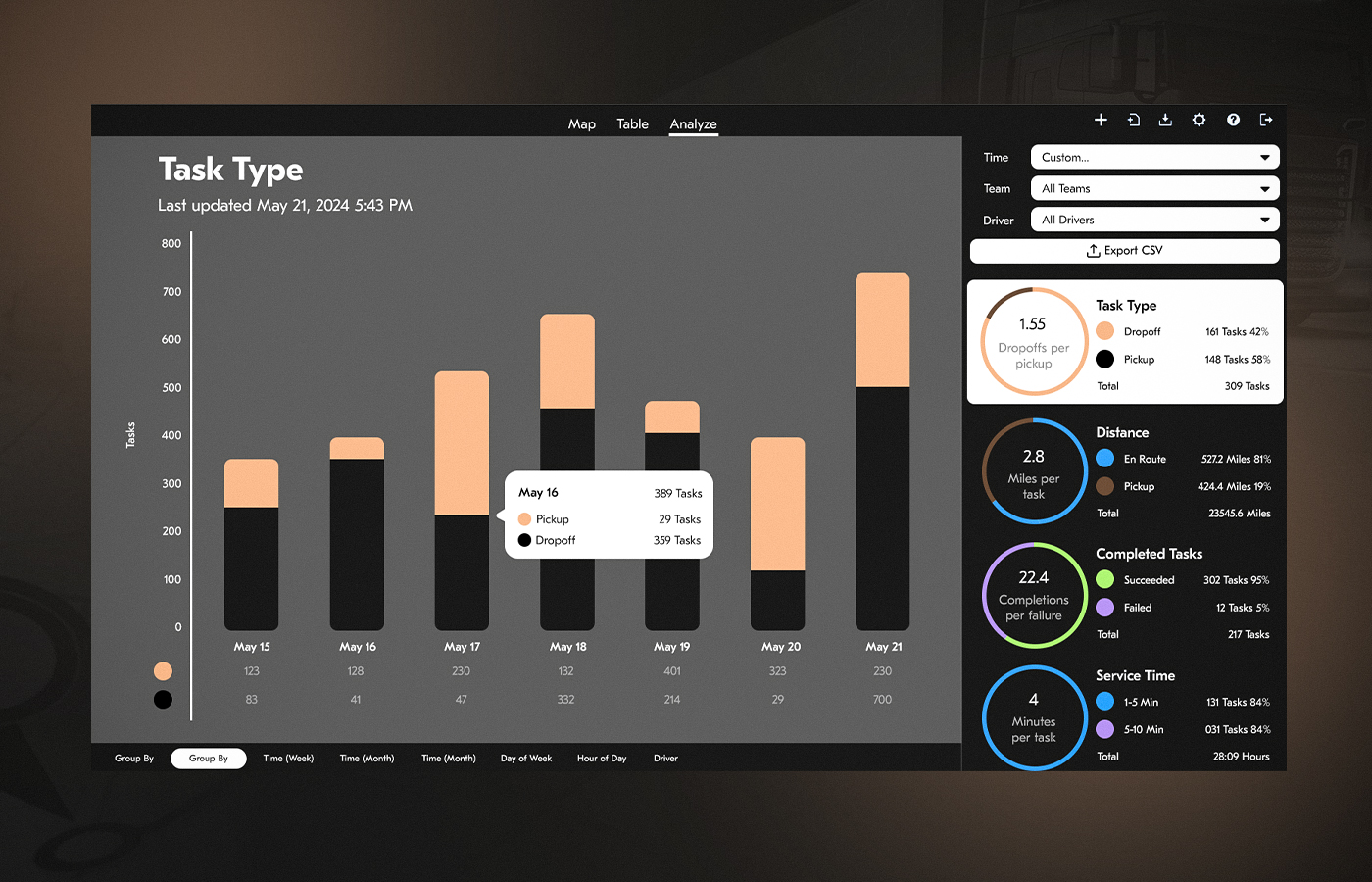 A Canadian trucking company (70 employees) was running on legacy manual dispatch processes that couldn’t keep up with growth. Main problems were manual route planning, absent real-time data, and minimal fleet visibility. The business was interested in trucking dispatch system modernization that could scale with them.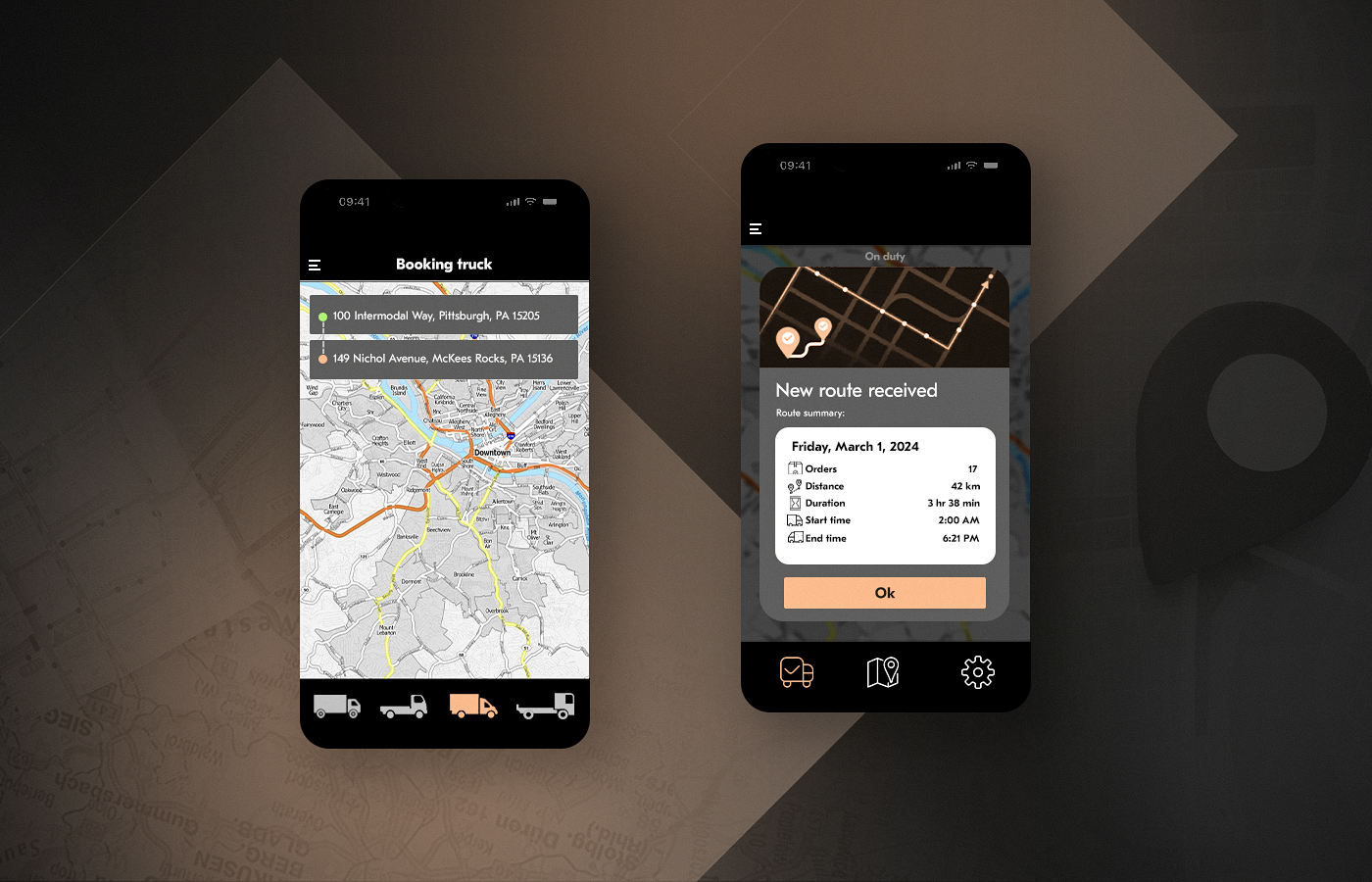
Acropolium upgraded the dispatch system using Node.js, NestJS, React.js, Flutter, TensorFlow, and Google Maps API. Our 8 specialists worked on the project over 28 months. The new system replaced manual dispatching with ML-powered dynamic route planning and integrated real-time traffic, weather, and road condition feeds. Fuel consumption improved by 15%, delivery times dropped by 20%, and on-time deliveries increased by 30%.
TMS Modernization for a Transportation Company
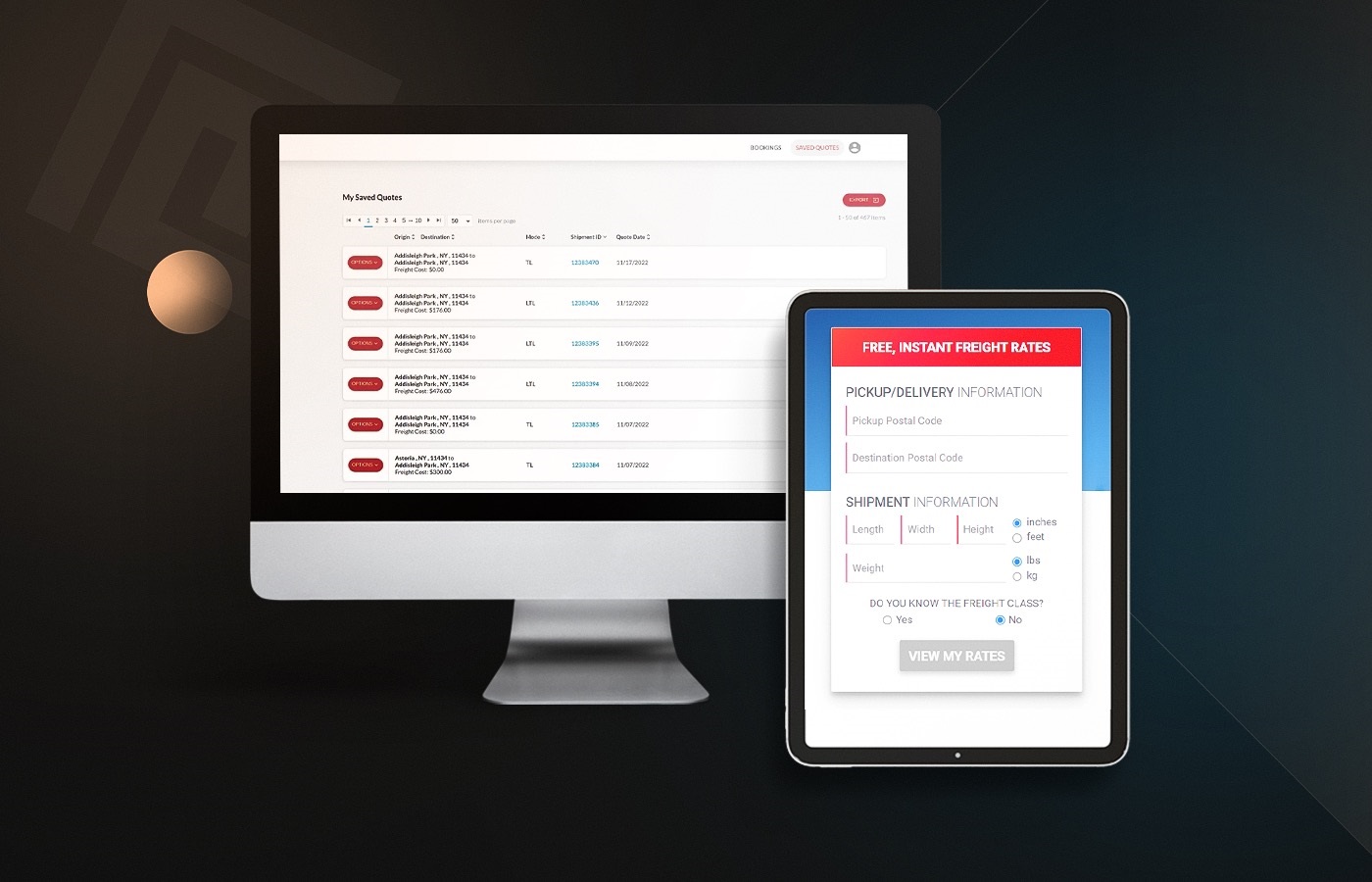 A North American freight forwarding company with 100+ employees came to Acropolium after two previous vendors had failed to stabilize their transportation management system. The legacy system suffered from poor architectural decisions, a 504 Gateway Timeout Error that appeared regularly under load, and data desynchronization across two backend services managing over 10 billion records.
 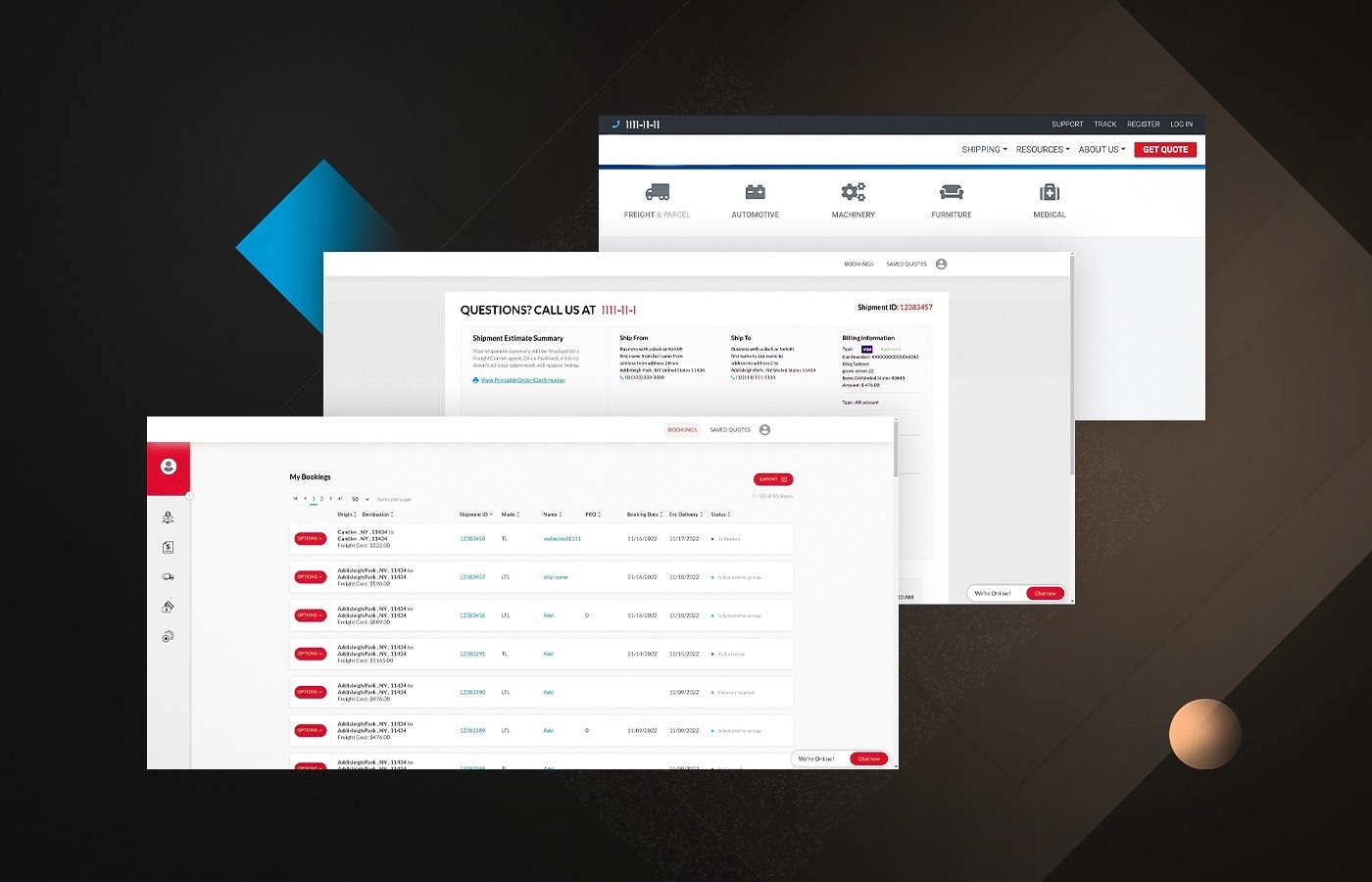 Our team completed TMS modernization for a transportation company in just three months, using PHP, Node.js, React.js, and Elasticsearch. We resolved the OPCache issue, fixed the data desync through Elasticsearch reindexing and a new consistency service, and migrated from the Google API to an in-house ZIP code database. By doing so, we saved the client over $5,000 monthly. Moving the platform to AWS saved an additional $10,000 annually, and the customer base grew to serve over 1 billion shippers.
Route Planning Tool for Fleet Optimization
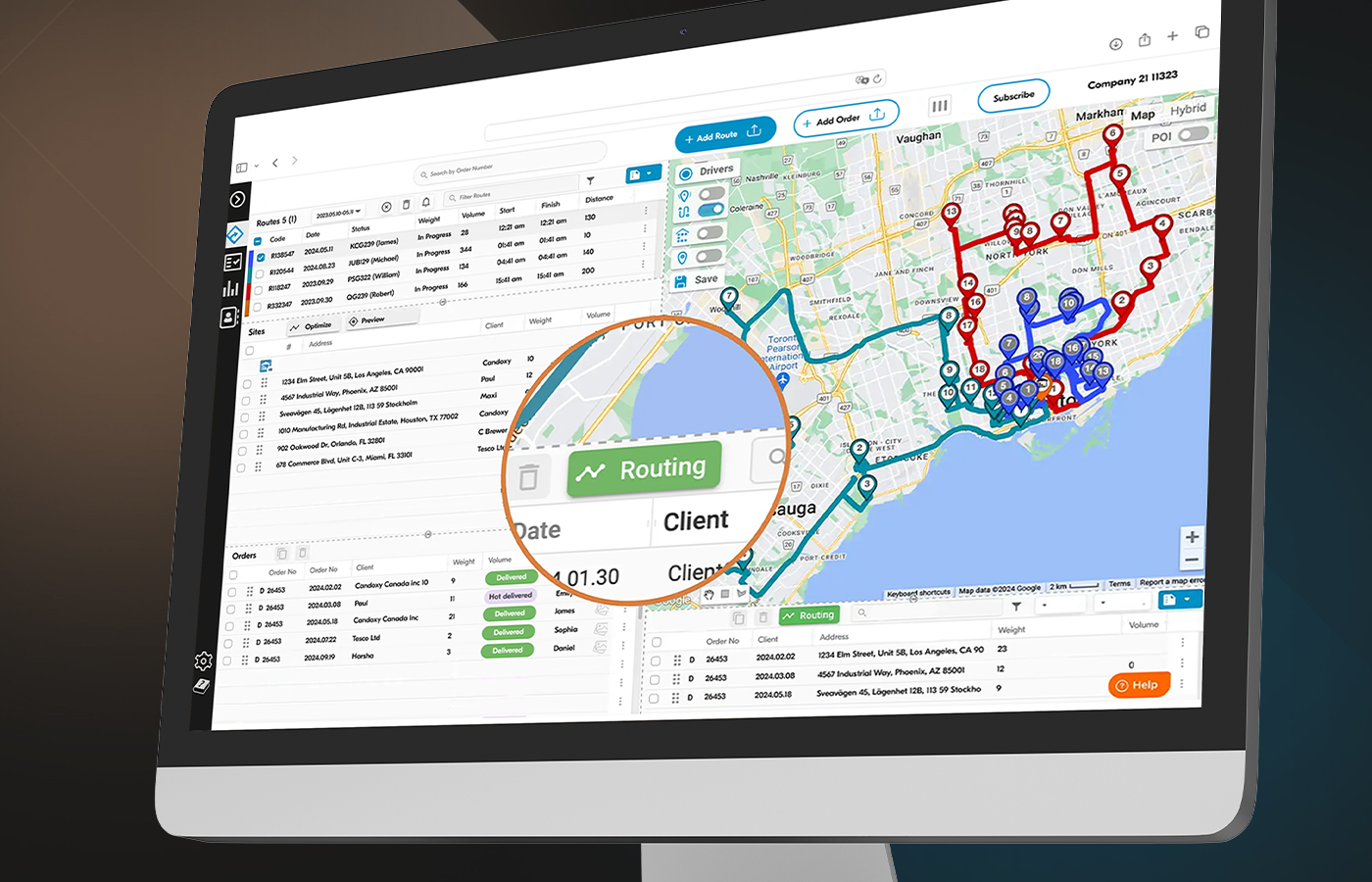 A Swedish transportation provider (60 employees) serving e-commerce platforms and retail brands was drowning in manual route planning as delivery volumes expanded. The lack of real-time data integration meant drivers couldn’t adapt to traffic or weather conditions, and fleet managers had no centralized visibility into vehicle locations or performance.
 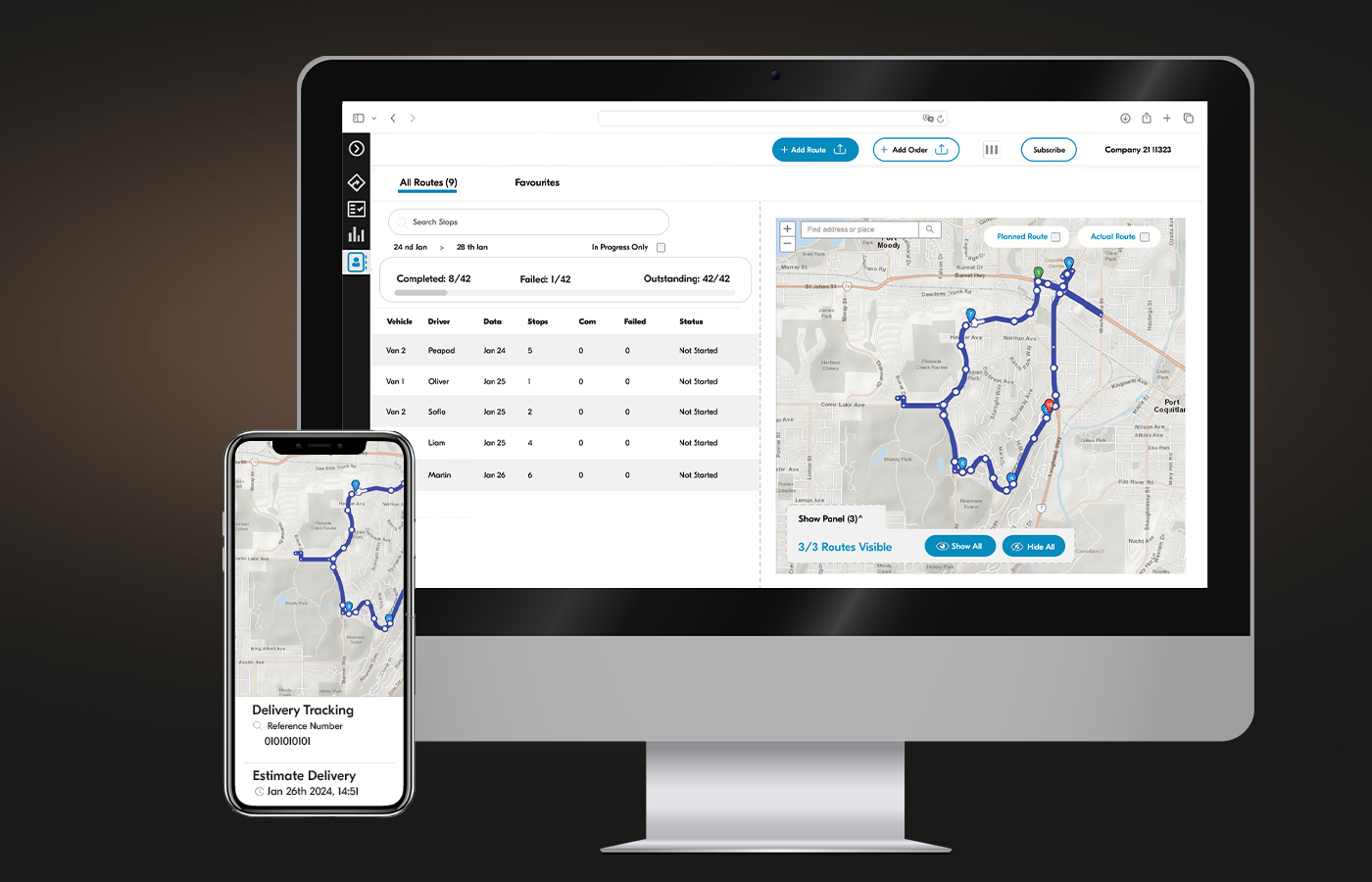 Acropolium’s team built a cloud-native SaaS route planning tool for fleet optimization, using AWS, TensorFlow, Google Maps API, Node.js, GraphQL, React.js, MongoDB, and PostgreSQL with PostGIS. The whole project took 21 months. ML algorithms continuously improve operational efficiency based on performance data, while WebSockets enable real-time updates across the fleet. The client achieved a 15% boost in profit margins, a 25% improvement in customer retention, and a 25% boost in logistics efficiency.
IoT-Based GPS Fleet Tracking App
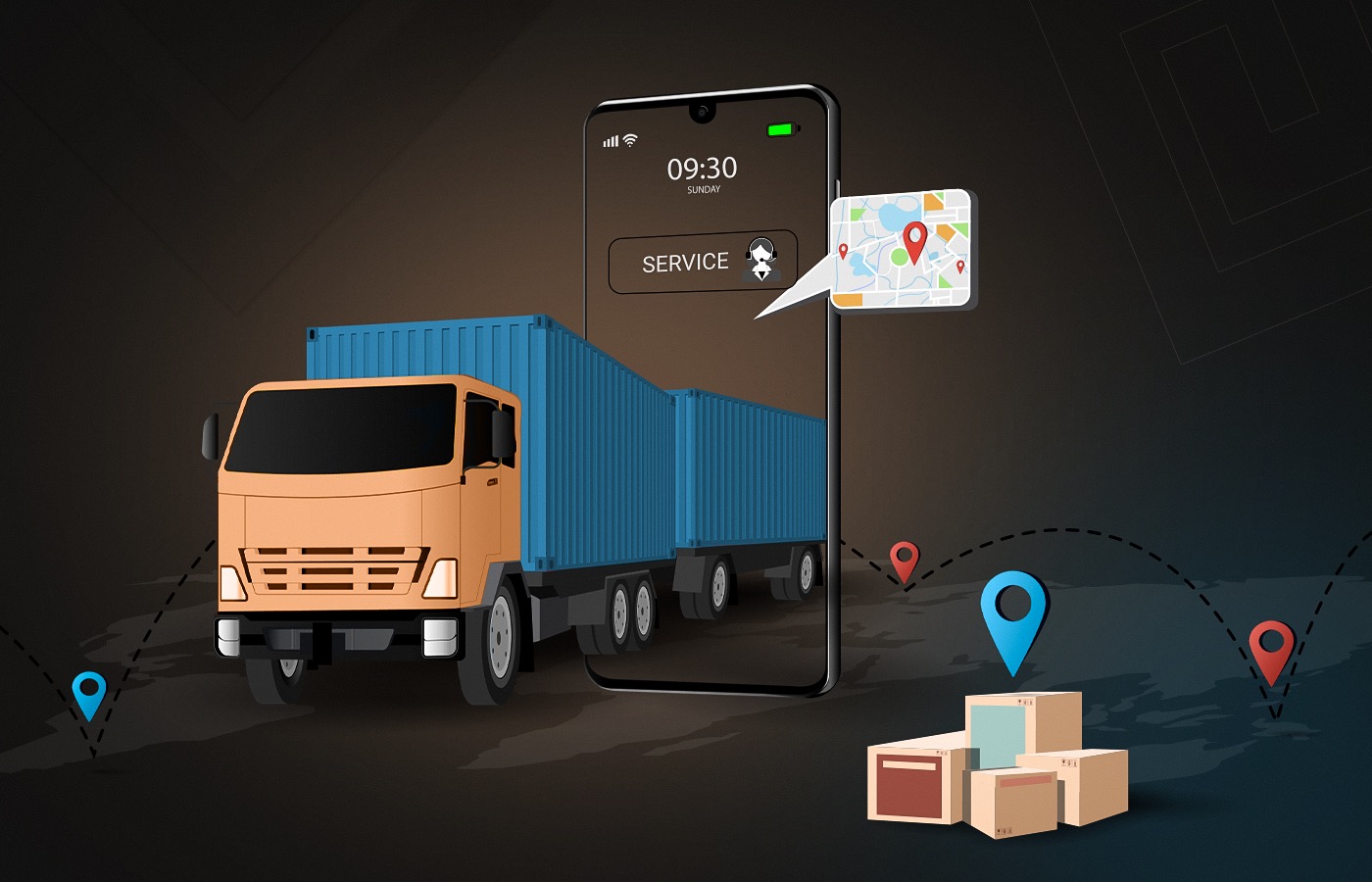 A logistics operator needed a comprehensive real-time fleet tracking system – not just GPS pings, but full telemetry with CAN bus and OBD-II integration, driver behavior scoring, fuel monitoring with theft alerts, geofencing, and ELD/IFTA compliance for US operations. The system also required video streaming from vehicle cameras and automated export of reports in CSV and PDF formats.
 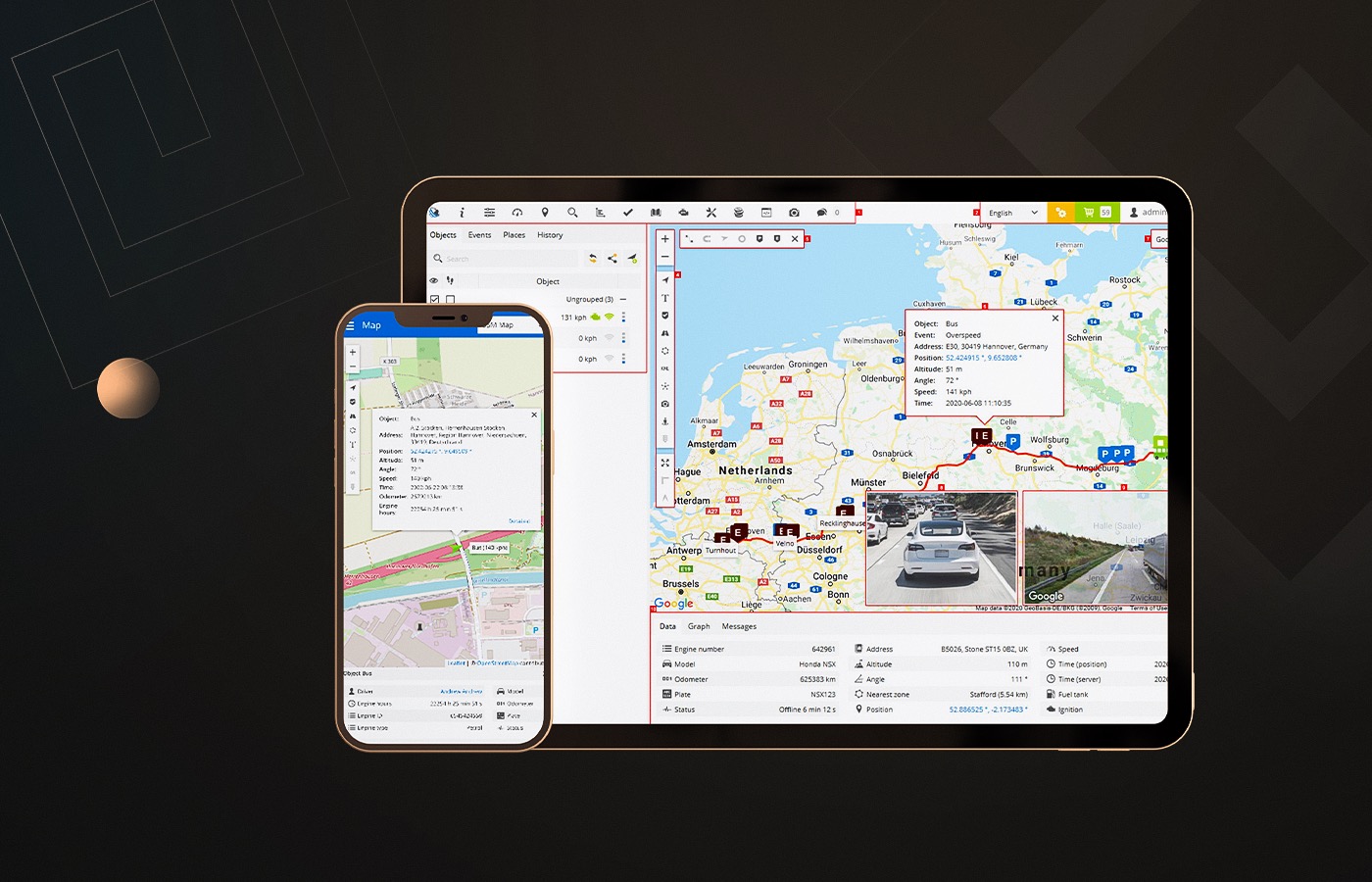 We delivered a production-grade IoT-based GPS fleet tracking app with API integrations into the client’s ERP and TMS, WebSocket-based real-time map updates, and robust privacy and security controls. Fleet managers could track driver behavior and fuel spend in real time, which was impossible before.
Conclusion
Logistics CRM is not a nice-to-have anymore. In a market defined by tight freight margins, competitive carrier relationships, and rising logistics customer expectations, you need industry-specific features and dedicated logistics technology to handle your commercial and operational relationships quickly and accurately.
When choosing a CRM for logistics companies, it is common to start with ready-to-use solutions like HubSpot, Pipedrive, Zoho, Salesdash, Salesforce, etc. Still, these platforms can’t fully support logistics operational cycles.
That’s why many logistics businesses invest in custom-made logistics CRM solutions that correspond to their business models, integrations, data processing cycles, and challenges. Acropolium has extensive custom software development experience to get it right, so don’t hesitate to reach out to us.




![Fleet Fuel Management System [Complete Guide]](/img/articles/build-a-fuel-management-system/img01.jpg)

![Logistics Management System [2025 Guide]: Use Cases Included](/img/articles/logistics-management-system/img01.jpg)