Why Remote Development Teams Are the Default in 2026
Most growing companies don’t need 20 in-house engineers. They need the right engineers, working on the right product, without the overhead of recruiting, HR, benefits, office space, and the inevitable “why do we have 7 developers but nothing ships?” crisis at the all-hands.
The decision to hire a remote development team instead of building an internal IT department is one of the smartest structural moves a founder, CTO, or product leader can make in 2026 – if they do it right. Done right, it gives you access to senior-level talent at a fraction of domestic cost, with the flexibility to scale as your product evolves.
Done wrong? It means missed deadlines, ownership disputes over code, and a vendor relationship that costs twice what you budgeted and delivers half of what you scoped.
Companies like GitLab, Automattic, Shopify, and Basecamp have been fully distributed for years – not because they couldn’t afford office space, but because distributed engineering consistently outperforms co-located models when managed correctly. GitLab, which operates across 65+ countries with no headquarters, has shipped 100+ consecutive monthly product releases with a fully remote software development team. That is not a coincidence. It is a systematic, engineered approach to distributed work.
The question is no longer whether to hire a remote development team – it is how to do it without losing velocity, quality, or control.
This guide answers that question with precision.
What Is a Remote Development Team?
A remote development team is a group of software engineers, architects, QA specialists, DevOps engineers, and product roles who work for your organization – either as employees, contractors, or through a vendor – from locations outside your central office, often across different time zones, countries, or continents.
They use the same tools your in-house team would use – Jira, GitHub, Slack, Figma, Zoom – and they operate under contracts that define scope, deliverables, IP ownership, and working rhythms.
The difference between this and “hiring freelancers on Upwork” is significant. A proper remote development team is a coordinated unit with a tech lead, defined processes, and accountability structures. It is not five individuals working in isolation toward a shared Trello board.
The model exists in several forms:
Freelance developers – individuals hired on a project or hourly basis (Upwork, Toptal).
Dedicated remote teams – a structured team assembled and managed by a vendor partner, aligned exclusively to your roadmap (see Dedicated Team).
Staff augmentation – specific roles bolted onto your existing team to close skill gaps.
Offshore development centers (ODCs) – a captive team established in another country, owned or co-managed by the client.
IT Outsourcing – delegating an entire workstream or product to an external partner who manages delivery end-to-end.
For enterprise and scaling SaaS companies, the dedicated remote development team model and the managed IT outsourcing model tend to deliver the strongest outcomes because they combine accountability, continuity, and operational structure.
Step 1: Define Your Project Requirements and Team Structure
The most expensive mistake you can make when you hire remote developers is starting the search before you have defined what you actually need. Vague requirements attract generic talent. Precise requirements attract specialists.
Map the Technical Scope
Before posting a single job description or briefing a vendor, document:
Product type: SaaS platform, mobile app, embedded system, API-first product?
Tech stack: Be specific – “React + Node.js + PostgreSQL + AWS” is far more useful than “full-stack JavaScript.”
Scale expectations: How many users? What is the expected traffic growth curve?
Integration complexity: Legacy systems, third-party APIs, data pipelines?
Security and compliance requirements: HIPAA, GDPR, SOC 2, PCI-DSS?
Enterprise discovery Questions
Beyond technical scope, answer the following in writing before any vendor conversation begins. Vendors will fill scope gaps with assumptions, and those assumptions will be wrong.
Product questions
What phase is the product in? Greenfield MVP, feature expansion, legacy migration, or performance optimization? Each demands a different team shape and different seniority levels.
What does “done” look like in 90 days? If you cannot answer this, you are not ready to engage a vendor yet – and that is okay, but be honest about it.
Who owns product decisions? An in-house product manager? A founder? If the answer is “we’ll figure it out,” your remote team will spend a meaningful share of its time waiting for direction.
Technical questions
What is your current stack? Or, if greenfield, what stack are you committed to? This narrows the talent pool significantly and affects rates.
What does your infrastructure look like? AWS, GCP, Azure, hybrid? On-prem legacy systems that need integration?
Are there compliance requirements? HIPAA, GDPR, PCI-DSS, SOC 2? These constraints affect where code can be written, stored, and accessed – not just how.
Define Your Team Structure
A production-grade remote team for software development typically includes:
| Role | Responsibility |
|---|---|
| Tech Lead / Solution Architect | System design, technical decisions, code review |
| Senior Backend Engineers | Core business logic, API development, database design |
| Frontend Engineers | UI implementation, performance optimization |
| QA Engineer | Test automation, regression, performance testing |
| DevOps / SRE | CI/CD, infrastructure, monitoring, reliability |
| Product Owner (optional) | Backlog management, stakeholder alignment |
| Pro Tip: Don’t hire for headcount – hire for capability gaps. If your internal team has strong frontend skills but weak cloud infrastructure experience, target DevOps and backend specialists externally. Over-hiring in areas of existing strength burns budget without adding velocity. |
Choose Your Engagement Model
Fixed-price: works for well-defined, bounded projects with low ambiguity.
Time-and-materials: best for exploratory products and agile roadmaps.
Dedicated team retainer: optimal for long-term product development and scaling SaaS.
For most enterprise software products in 2026, the dedicated team retainer model outperforms fixed-price because it allows you to pivot without renegotiating the entire contract.
Step 2: Choose Between Offshore, Nearshore, and Onshore
Geography determines cost, communication overhead, and cultural alignment. The three models each serve different use cases. 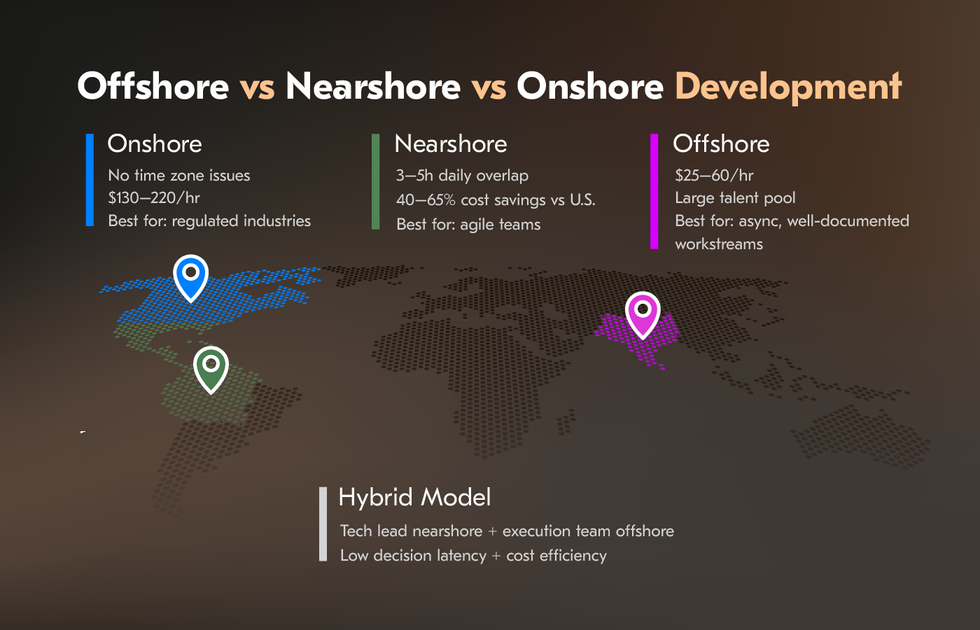
Onshore (Same Country)
Pros: no time zone issues, maximum legal and cultural alignment, easiest stakeholder communication.
Cons: highest cost – U.S. senior engineers command $130–$220/hour in 2026.
Best for: regulated industries, government contracts, products requiring on-site presence.
Nearshore (Adjacent or Overlapping Time Zones)
For U.S. companies, nearshore typically means Latin America (Mexico, Colombia, Argentina, Brazil). For European companies, nearshore spans Eastern Europe (Poland, Ukraine, Romania, Bulgaria, Czech Republic).
Pros: significant cost savings (40–65% vs U.S. rates), 3–5 hours of daily overlap, strong English proficiency, cultural proximity.
Cons: slightly higher cost than offshore Asia; political/economic risk varies by country.
Best for: agile product teams that need real-time collaboration.
Central and Eastern Europe (CEE) produces a substantial pipeline of technical graduates each year, with countries such as Poland, Romania, and Ukraine hosting large and well-established software engineering talent pools, according to regional education and workforce data from sources including Eurostat.
Offshore (Distant Time Zones)
Primarily India, the Philippines, Vietnam, and increasingly Bangladesh and Indonesia.
Pros: lowest hourly rates ($25–$60/hr for senior engineers in India), massive talent pool.
Cons: 8–12 hour time zone gaps, cultural communication differences, asynchronous-only collaboration for most working hours.
Best for: long-term, well-documented workstreams where async delivery is viable; Offshore software development works best when specs are tight and review cycles are structured.
| Pro Tip: Don’t let the price tag drive the decision alone. A $25/hr developer, regardless of a country, who requires 3x the rework and 2x the management overhead costs more in total than a $75/hr developer who ships clean, well-tested code. Calculate true cost of ownership – including management time, QA rework, delayed launches, and context-switching – before comparing rates. |
The Hybrid Approach
The most sophisticated enterprises in 2026 are running hybrid geo-distributed teams: a technical lead and product owner in the same time zone as the client, backed by a nearshore or offshore software development team for execution. This model captures the cost benefits of distributed hiring while keeping decision-making latency low.
Step 3: Source and Vet Remote Developers
This is where most companies either win or waste months. The sourcing and vetting phase is not a formality: it is your single biggest risk-mitigation investment. A poorly vetted remote software development team looks great on paper and falls apart in sprint three.
Where to Find Highly-Skilled Developers
Dedicated development vendors (recommended): Companies like Acropolium maintain pre-vetted bench talent. Time-to-team is 1–2 weeks. The developer you’re getting has already been screened for technical skills, English proficiency, client communication, and async discipline. You skip the “bad hire” tax.
Vetted talent platforms: Toptal (claims top 3% of applicants), Arc.dev, and Turing are solid for individual specialist roles. Harder to build cohesive teams at scale through these channels.
LinkedIn / We Work Remotely / Stack Overflow Jobs: Direct sourcing works if you have a recruiter bandwidth and a robust internal screening process. The average time-to-hire for senior engineering roles in the United States typically ranges from 35 to 50 days, depending on role complexity and hiring process structure. Budget accordingly.
Developer community referrals: Engineering communities in CEE and Latin America are tight-knit. A warm referral from a trusted engineer carries more predictive value than any cold application.
How to Vet Remote Developers Technically
A 4-stage technical evaluation process used by engineering-led companies like Stripe and Atlassian typically looks like this:
Async technical screen (45–90 min): language-specific coding challenge on a platform like Codility. Evaluates syntax fluency, problem-solving, and code cleanliness.
Architecture review (60-min video call): candidate walks through a system design problem relevant to your actual stack. Evaluates systems thinking, scalability awareness, and communication quality.
Code review exercise: candidate reviews a piece of deliberately flawed production-like code and documents issues. This reveals code review culture and attention to detail better than any green-field exercise.
Cultural and async communication screen: a 48-hour async written exercise – answer a technical question or document a design decision in written form. In a remote software development team, written communication is infrastructure. It must be evaluated like a technical skill.
The paid trial project
Automattic, which has operated a fully distributed team of 1,000 people across 80+ countries since 2005, requires a paid trial project before every full offer. The mechanism is worth borrowing. A 2-to-4-week paid trial surfaces work style, communication rhythm, and delivery quality before you are committed to a long-term contract – and most reputable vendors actively support this structure for new client engagements.
| Pro tip: Always evaluate written English communication separately from spoken English. In distributed teams, Slack messages, pull request comments, Confluence docs, and async Loom videos carry the majority of information transfer. A developer who communicates brilliantly in person but writes vague descriptions will create bottlenecks at scale. |
Vetting Vendors and Agencies
When evaluating a vendor to hire a dedicated remote development team, apply the following checklist:
Do they have case studies in your industry vertical?
Can they provide references from clients in the U.S. or Europe?
What is their internal retention rate? (Below 80% annual retention is a red flag.)
What is their bench depth – can they replace a developer within 2 weeks if someone leaves?
Do they run their own QA, DevOps, and architecture practices, or do they rent out developers without structure?
Step 4: Set Up Contracts, IP Protection, and Legal Compliance
This is where most companies get burned. Hiring remote talent across borders introduces legal complexity that requires deliberate structuring, not standard contractor agreements copy-pasted from domestic templates.
Key Contract Components
- Intellectual Property Assignment
Every contract must include an explicit IP assignment clause stating that all work product – code, designs, documentation, trade secrets – created under the engagement belongs exclusively to the client. This clause must comply with local law in the developer’s country. In some jurisdictions (notably Germany and France), standard-form IP assignment is insufficient; local legal counsel review is mandatory.
- Non-Disclosure Agreement (NDA)
A strong bilateral NDA should be executed before any technical discussion. For enterprise engagements involving proprietary algorithms, customer data, or regulated information, include specific provisions for data handling, storage location restrictions, and breach notification timelines.
- Non-Solicitation Clause
Prevent the vendor from poaching your internal team members and prevent your team from directly recruiting vendor engineers for a defined period (typically 12–24 months post-engagement).
- Data Processing Agreement (DPA)
For any company operating under GDPR (which covers any product with EU users), a DPA is legally required when a vendor processes personal data on your behalf. This is not optional – GDPR fines for inadequate DPAs have reached €20 million or 4% of global annual turnover under Article 83.
- Service Level Agreements (SLAs)
Define measurable commitments: sprint velocity benchmarks, bug resolution timelines, deployment frequency, uptime commitments (if applicable), and escalation paths.
Operational IP Safeguards
Contractual language alone is not enough. The strongest protection comes from how the engagement is operated day-to-day:
All code lives in your repository, not the vendor’s. You should retain full administrative access to the codebase at all times.
Least-privilege access controls. No developer should have broader system access than their role requires. Revoke credentials immediately on offboarding.
Code escrow for high-value engagements. For projects above $500K, consider a third-party escrow arrangement. Setup costs $2,000–$5,000 and provides critical protection if the vendor relationship terminates unexpectedly.
Documented offboarding procedures. Every vendor contract should specify exactly what happens to access, credentials, and in-flight work when an engineer rotates off the project.
Structuring Payments Internationally
Payment structures for international remote teams typically use:
Wire transfers via SWIFT (for larger vendors with formal invoicing)
Deel or Remote (platforms that handle international payroll, compliance, and local employment law for contractor and employee arrangements)
Wise Business (for smaller engagements and freelancers).
| Pro Tip: Do not classify employees as contractors to reduce cost. The IRS in the U.S. and equivalent bodies in the EU (particularly in France, Germany, and the Netherlands) aggressively pursue misclassification. Penalties include back taxes, fines, and mandatory employee benefit payments retroactively. Platforms like Deel explicitly help you navigate this distinction by acting as an Employer of Record (EOR) in 150+ countries. |
Step 5: Onboard Your Remote Team for Success
The first 30 days of a new remote team onboarding experience determine whether the engagement succeeds or fails. Most failed remote engagements aren’t caused by bad hiring decisions – they’re caused by poor onboarding that creates confusion, misalignment, and early disengagement.
Week 1: Start with the product, not the tickets
Before a new remote team member sees a single Jira ticket, they should understand:
What the product does and who uses it
What problem it solves and why users care
How the business makes money and what metrics matter most
What technical decisions have already been made and why
Engineers who understand the why make better technical decisions than engineers who only know the ticket. This is especially true for a remote software development team that cannot absorb business context through ambient office conversations.
Week 2: Environment and tooling
Everything needed to go from “new laptop” to “first commit” must be documented before the team arrives. If it takes a 2-hour onboarding call to set up a development environment, that is a documentation problem – use this moment to fix it. Your future self will thank you when the fourth person joins 6 months later.
Week 3: First meaningful contribution
Target a first pull request merged to main within the first 2 weeks. Not a toy task – something real, something that ships. This builds confidence, surfaces tooling friction early, and establishes the code review dynamic on healthy terms from the start.
Week 4: Relationship anchoring
Schedule direct one-on-ones between the remote team lead and each key internal stakeholder. These relationships will carry the engagement through difficult moments – and there will be difficult moments in every long-running software project.
Pro Tip: Record every onboarding session and store it in a shared library. In a reliable remote development team, you will onboard new members regularly as the team scales. A structured, self-serve onboarding library reduces time-to-productivity by 40% for subsequent hires (based on data from GitLab’s internal engineering handbook).
Step 6: Manage and Scale Your Remote Development Team
How to manage remote developers is the question every CTO eventually googles at 11pm. The answer isn’t a single tool or a single process – it is a system of connected practices that compound over time.
Async-First Communication Architecture
Distributed teams that rely on synchronous communication for decision-making break down as time zones diverge. The solution is building an async-first communication layer:
Loom: short video recordings for code reviews, architecture explanations, and status updates that don’t require a meeting.
Linear or Jira: every task must have a written description, acceptance criteria, and a definition of done before development begins.
Notion or Confluence: architecture decisions, runbooks, onboarding guides, and product specs live here – not in someone’s brain.
Slack: for real-time escalations and social connection, not project management.
Metrics That Matter for Managing a Remote Development Team
Avoid vanity metrics (lines of code written, hours logged). Track:
Lead Time for Changes (LT): time from ticket creation to production deployment.
Deployment frequency (DF): how often the team ships to production (high-performing teams: multiple times per day).
Change failure rate (CFR): percentage of deployments that require a hotfix or rollback.
Failed Deployment Recovery Time (formerly Mean Time to Restore – MTTR: how quickly the team recovers from incidents.
These are the 4 DORA (DevOps Research and Assessment) metrics, validated by Google’s DORA team across thousands of engineering organizations. They directly correlate with business outcomes, not just engineering efficiency.
The Non-Negotiable Practices for Successful Collaboration
Measure Outcomes, Not Activity
Define success in terms of shipped features, resolved incidents, and code quality metrics – not hours logged. Time-tracking remote engineers is corrosive to the trust relationships that produce high performance. According to Harvard Business Review, remote workers who feel trusted by their supervisors are more likely to report high job satisfaction compared to those who do not.
Protect the Overlap Window
Identify a 2–4 hour daily window where your time zones intersect and protect it for synchronous collaboration. Outside that window, default to async. Never schedule critical decisions at 6am or 11pm in anyone’s local time.
Document Every Significant Decision
Architecture choices, scope changes, feature trade-offs: write them down. GitLab operates a 1,500+ person all-remote company. Their public handbook runs thousands of pages. The principle is: if it isn’t written, it didn’t happen.
Review Communication Quality in Every Retro
Not just delivery. How’s the async communication working? Where are delays happening? What’s unclear? The best remote teams treat communication health as a first-class engineering concern.
What Does It Actually Cost to Build a Remote Development Team in 2026?
The honest answer: significantly less than building an equivalent in-house team, if you’re working with the right partner. Here is what the numbers look like:
Hourly Rates by Region and Seniority (USD)
| Region | Junior | Mid-Level | Senior | Tech Lead |
|---|---|---|---|---|
| United States | $60–$90 | $90–$140 | $140–$220 | $180–$280 |
| Western Europe | $55–$80 | $80–$120 | $120–$180 | $150–$220 |
| Eastern Europe | $25–$40 | $50–$75 | $70–$110 | $90–$110 |
| Latin America | $20–$40 | $45–$70 | $60–$100 | $80–$130 |
| India / Southeast Asia | $10–$25 | $30–$55 | $50–$80 | $80–$100 |
Sources: Glassdoor, U.S. Bureau of Labor Statistics, Index.dev, Eurostat, Deel, Accelerance.
Monthly Team Costs for a Mid-Size Product Team (Eastern European rates)
A typical 6-person remote development team – 1 tech lead, 2 senior backend engineers, 1 senior frontend engineer, 1 QA engineer, 1 DevOps – will cost approximately $35,000–$55,000/month through a managed vendor at Eastern European rates. This compares to $90,000–$140,000/month for an equivalent U.S.-based team.
| Budget reality check: If a vendor’s rate looks dramatically lower than the regional benchmarks above, ask why. Rates that seem too good to be true are usually attached to junior-heavy teams, high turnover, or significant hidden fees for recruitment, rate escalations, or contract changes. |
The Subscription Alternative - SDaaS
Some organizations opt for a Software Development as a Service (SDaaS) or in other words Software Dev Subscription model – a flat monthly retainer for a defined scope of engineering capacity. This model offers cost predictability, eliminates HR overhead, and scales up or down based on product stage. It’s particularly well-suited for SaaS companies and Fortune 500 enterprises running continuous product development without defined project endpoints.
How to Hire a Remote Development Team for a Startup vs. Enterprise
The hiring process looks meaningfully different depending on your organizational stage.
Startups (seed to Series B)
Speed is priority: startups can’t afford a 12-week hiring process – use managed vendors or structured platforms (Toptal, Arc.dev) that provide pre-vetted developers (like Acropolium) within 1–2 weeks.
Generalists over specialists: a senior full-stack engineer who can do backend, frontend, and light DevOps is more valuable than 3 narrow specialists when the codebase is still forming.
Validate before committing: use a 2–4 week paid trial project before signing a long-term contract – most reputable vendors support this structure.
Explore custom software development for early-stage product build-outs where speed-to-market matters more than optimizing every architectural decision.
Enterprise (established product, 100+ engineers)
Process and governance: enterprise remote hiring requires vendor risk assessments, security questionnaires (SOC 2 Type II audit reports), and legal review before engagement begins.
Staff augmentation vs. dedicated team: enterprise teams often use staff augmentation to fill specific skill gaps (Rust engineers, ML ops, security specialists) while maintaining internal ownership of core architecture.
Integration with existing toolchain: confirm that vendor teams can operate within your GitHub Enterprise, JIRA, Confluence, and cloud environments – not a parallel stack.
Compliance requirements drive geography: HIPAA workloads may restrict where data is processed; financial services firms under DORA (EU Digital Operational Resilience Act, effective January 2025) face additional vendor risk requirements.
Common Mistakes When Hiring Remote Developers (and How to Avoid Them)
Mistake #1. Hiring Based on Résumé Alone
The gap between a well-crafted résumé and actual output quality is enormous. Always run a technical evaluation – no exceptions, regardless of referral source.
Mistake #2. Underestimating Onboarding Investment
Teams that skip structured onboarding see 3–6 months of underperformance before developers reach full productivity. The investment in a proper onboarding system pays for itself in the second month.
Mistake #3. Managing by Activity Instead of Outcomes
Tracking hours logged is not managing a distributed team – it is surveillance. High-performing remote engineers resent activity monitoring. Manage by delivery: defined tickets, clear acceptance criteria, measurable output.
Mistake #4. Ignoring Time Zone Overlap
A team with zero daily overlap – no shared working hours – will struggle with blockers, PR reviews, and real-time debugging. Ensure at least 3–4 hours of daily overlap between key team members.
Mistake #5. Skipping Vendor Due Diligence
A vendor’s portfolio page is marketing. Ask for two or three direct client references. Ask specifically: “Did the team communicate proactively when things went wrong?” Vendors who only surface problems reactively will cost you dearly in production incidents.
Mistake #6. Not Protecting IP Upfront
IP disputes with offshore vendors are extraordinarily difficult to resolve after the fact. Get the IP assignment clause signed before a single line of code is written.
Best Practices for Managing Remote Developers: What Actually Works
The research on managing a remote development team has converged on a consistent set of practices. These are not theoretical – they are the practices used by the most successful distributed engineering organizations in the world.
Default to Over-Documentation
In a distributed environment, undocumented decisions are lost decisions. Use architecture decision records (ADRs) for technical choices. Write meeting notes within 24 hours. Treat documentation as a first-class engineering artifact.
Establish a “Working Agreement”
A shared team document that defines: core working hours, expected response times by channel, how decisions are made, escalation paths, and code review turnaround SLAs. This eliminates 80% of the friction that comes from differing expectations.
Protect Maker Time
Research by Paul Graham and validated by deep work studies shows that engineers need 2–4 uninterrupted hours for complex problem-solving. Audit your meeting load. Keep meetings to mornings or afternoons – never scattered throughout the day.
Invest in the Developer Experience
Remote engineers leave for better developer experience before they leave for money. Fast CI pipelines, clean local development environments, low toil, and responsive code review feedback loops are retention tools.
Over-Communicate Context, Under-Prescribe Solutions
Share product metrics, customer feedback, and strategic priorities with your remote team. Engineers who understand business context make better technical decisions. Limit yourself to the “what” and “why”; let the team own the “how.”
Real Remote-Team Outcomes: Acropolium Client Results
To show what a reliable remote development team engagement actually produces, here are three recent Acropolium projects. Client names are under NDA, but the outcomes are verified:
Success Story #1: Hospitality Tech Provider – 82% more integrations, 14.5% ARR growth
A British B2B hospitality platform serving independent hotels and boutique chains needed a cloud-based PMS with OTA integration, channel manager connections, and multi-property support across countries and languages. Our dedicated team built the full platform with real-time two-way data exchange, PCI and GDPR compliance baked in. Result: 12 hotel networks connected seamlessly, 82% increase in booking platform integrations, 9.7% customer base growth, and 14.5% annual recurring revenue growth.
Success Story #2: Fintech Data Profiling Tool – 200% scalability gain, 30TB daily, 95% data quality
A fintech firm handling customer transactions, market data, and internal operations was drowning in inconsistent data from fragmented sources. They needed an AI-powered quality monitoring and data profiling tool that could scale with them. Our dedicated team built it: real-time profiling, ML-driven anomaly detection, customizable detection rules, interactive dashboards, and horizontally scalable architecture (Apache Spark, Apache NiFi, AWS). The results: 200% scalability improvement (now processing up to 30 terabytes of data daily), 40% reduction in data errors, final data quality rate of 95%, 30% faster data processing (12 hours to 8 hours per terabyte), and live issue-resolution time under one hour. 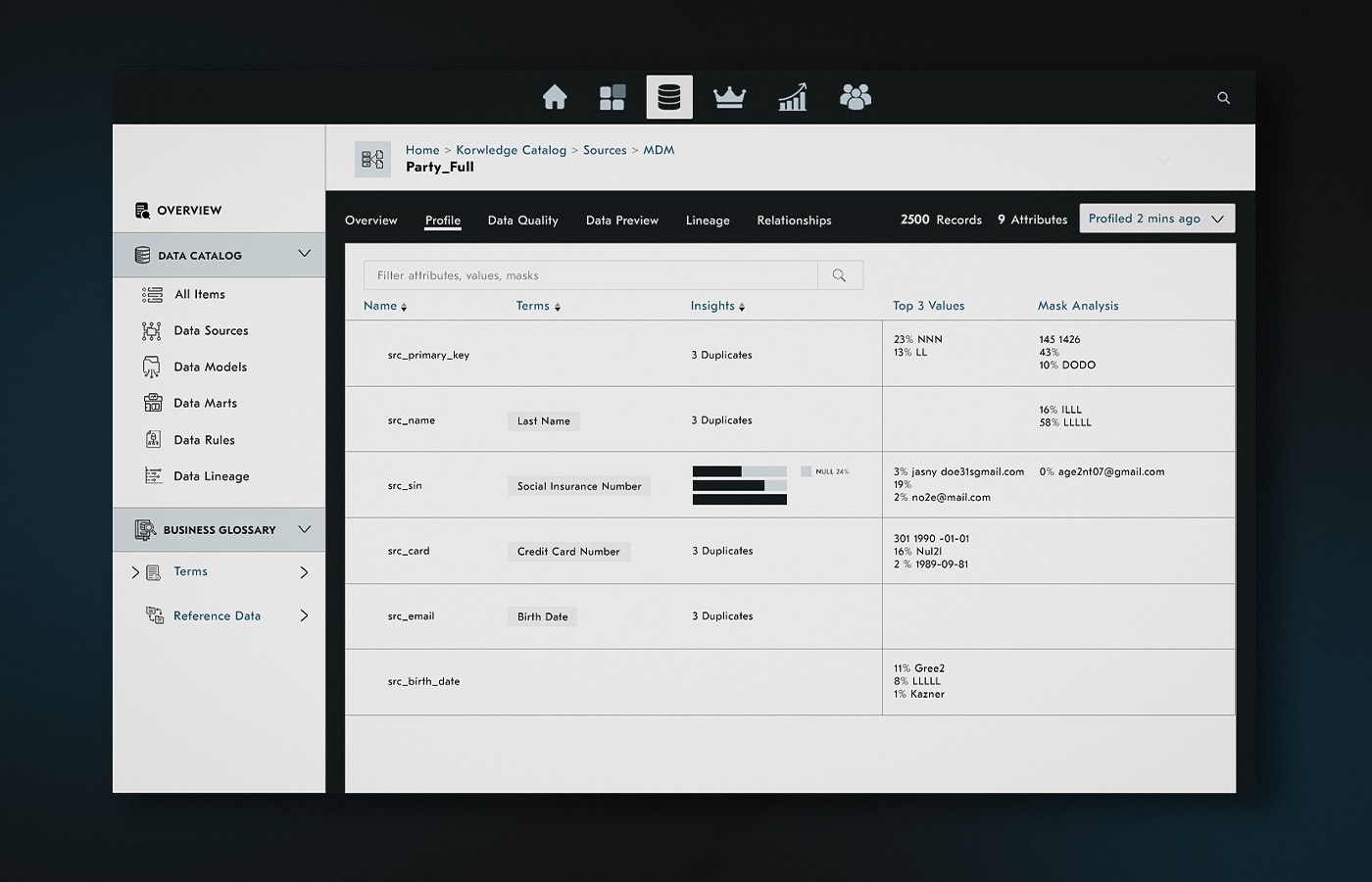
Success Story #3: Shipping Platform Rescue – vendor replaced, live in 2 months, 57%cost reduction
A USA-based 3PL logistics operator was stuck. Their previous vendor had missed deadlines, left the codebase full of bugs, and walked away from a shipping platform that could not go live. A server-side cost-calculation failure was silently costing the client up to 32% of monthly profit. They had already invested heavily and lost significant end-users before coming to us. Our remote team audited the full solution, fixed the bugs, optimized server load, and shipped a working shipping web platform in just 2 months. The turnaround retained existing customers and attracted 25 new corporate clients. Verified outcomes: 57% annual cost savings and a 37% increase in monthly profit.
These are not one-off projects. Acropolium’s average client relationship runs across multiple product cycles – which is what separates a true partner from a transactional vendor. See more case studies in our portfolio.
Why Companies Choose Acropolium as Their Remote Development Partner
This is not a generic vendor pitch. It is a specific answer to the specific problem this guide is written for: you need software built, you do not want to build a full-time IT department, and you cannot afford to learn the hard lessons of remote team failure on your own timeline and budget.
Acropolium is a top-rated software development company that has operated since 2003, working with start-ups and Fortune 500 enterprise clients across healthcare, fintech, logistics, SaaS, and beyond. Our model is built for exactly the type of organization reading this guide:
You have a product to build, not a department to manage. Acropolium handles recruitment, HR, infrastructure, and delivery management. You engage with a team, not a vendor relationship requiring its own internal team to administer.
You need senior talent, not a junior bench. All our developers are pre-vetted for technical depth, English proficiency, and the communication and async discipline that determines whether a remote engagement succeeds or stalls.
You operate in a regulated industry. Healthcare, financial services, and enterprise SaaS are Acropolium’s core verticals. HIPAA, SOC 2, GDPR – the compliance infrastructure is not a new problem for us.
You want transparent pricing. All-inclusive rates with no surprise fees, no aggressive mid-engagement rate escalation, and no hidden recruitment costs.
Conclusion
Hiring a reliable remote development team in 2026 is not a corner-cutting move. It is a better operating model than building in-house for most companies – with deeper talent, faster ramp, and cost structures that turn product ideas into shipped software instead of slide decks.
The playbook is straightforward. Run the build-vs-buy test. Define your outcome. Pick your geography on purpose. Vet like you mean it. Lock down contracts, IP, and compliance before day one. Onboard with a written plan. Manage for outcomes, not hours. Follow these steps and you will ship faster than competitors with twice your headcount.
If you want to skip the part where you build the hiring, legal, and delivery stack from scratch – talk to Acropolium. 20+ years of experience, 450+ delivered projects, ISO-certified processes, and a track record of turning remote engagements into long-term partnerships. You do not have to figure it out alone.







![How Much Does App Development Cost? [Full Breakdown]](/img/articles/how-much-it-costs-to-develop-an-app/img01.jpg)